"Black & Panamañian: Our Afro-Antillean Roots" (Nedelka F. Prescod and Jean-Paul Noel/BAC sponsored)
Автор: Nedelka Prescod
Загружено: 2022-04-03
Просмотров: 16097
Описание:
A few thoughts about the project…
I made assumptions about Ruben Blades. I assumed that though he wrote a song honoring his Caribbean lineage as a Panamañian… that we were different because our physical appearance seems different. I stand corrected and edified. And that is what this project is about. Highlighting what it means to be Panamañian with Black roots.
This project is also about bringing the youth into the conversation. Because I benefitted from seeing, feeling and experiencing Black Panamañian pride through my parents, and the village they participated in that gave birth to my sister, my cousins, my God-brothers and God-sisters and I, I believe it is something that our children should know and experience as well. My parents and their friends, who my tribe of first gen Afro-PanAmericans lovingly call Tia, Tio, Madrina and Padrino, came to the United States in the heart of the American Civil Rights Movement. That, in itself, is its own story. The combination of their cultural standards and their migration stories during a time of significant racial conflict, helped to shape our world view. I think they did an excellent job in the midst of real and strong times.
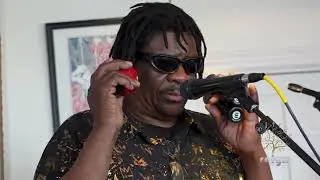
So, we invited the youth in to connect with and learn our Panamañian cultural story while providing an opportunity for them to pick up the torch as experienced through music. Regarding the music, the instrumentation you hear/see is unique. It is the combination of kinfolk who actively participated in music-making within our Panamañian community under the baton of musical legends that happen to be our family members and the ones that set us up and started us on our musical journeys. I’m specifically thinking of Maestros Mingy Hylton and Roy A. Prescod, Wil’s father and my father. There are more. Prayerfully, you will hear about a few of them as this project continues to unfold.
The songs I selected for the project at large were songs from my childhood and adolescence that I heard as part of community gathering time. The songs’ rhythms, their grooves and their lyrical stories, combined with watching “the grown folk” dance to them, or sit at communal tables during a dinner dance or party, listening, watching and talking to each other in their “Calypso English”, and using their culturally based expressions, provided grounding for my sense of community identity. “West Indian Man” I found more recently and chose to cover it because it simply tells the story so well.
We are not attempting to tell the full story of what it means to be Black & Panamañian or Black Panamañian or Afro-Panamañian (depending on who you talk to). There were waves of Black folks for whom Panama became their home. We are speaking of the one that gave birth to us, the second wave of Black folks that came to build the Panama Canal. The myriad Caribbean folk, the Afro-Antilleans, that created the vibe I identify as being “Black & Panamañian”. This story is being told from the perspective of persons born and raised in New York to Panamañian parents. There are other ways to tell the story. There must be. We hope to add our story with theirs to offer the fullest and most beautiful picture of our beloved Afro-Panamañian Elders and Ancestors, and the culture they created.
For the project I invited in community members I’ve known since I was a little girl, and some I am meeting for the first time through Jean-Paul. We met with some of them in person and some, in these pandemic times, Zoom made it convenient for us to connect with and their stories to be captured.
You will notice that we filmed the music in a church. The church, in Black community, has historically been a multi-purposed institution. It has been a spiritual refuge, a resource and learning center, a gathering an organizing space in strong social times, a place of cultural and artistic innovation, and a fellowship home. It was where my parents met, it was where my father first knew he wanted to be a musician and had the opportunity to participate in music-making, and I now have my own relationship with it. It seems only fitting that the church housed aspects of this project.
My gratitudes and official credits are at the end of the film but I must acknowledge the Brooklyn Arts Council here. Their support, understanding and patience are deeply appreciated.
I’ll end here, but I leave you with this…
“Progress caresses your path.
To the rhythm of a sublime song,
You see both your seas roar at your feet
Giving you a path to your noble mission.”
“El progreso acaricia tus lares.
Al compás de sublime canción,
Ves rugir a tus pies ambos mares
Que dan rumbo a tu noble misión.”
(English translation and Spanish lyrics to an excerpt of the Panamañian national anthem)
“Black & Panamañian” is sponsored, in part, by the Greater New York Arts Development Fund of the New York City Department of Cultural Affairs, administered by Brooklyn Arts Council (BAC)
Повторяем попытку...

Доступные форматы для скачивания:
Скачать видео
-
Информация по загрузке: