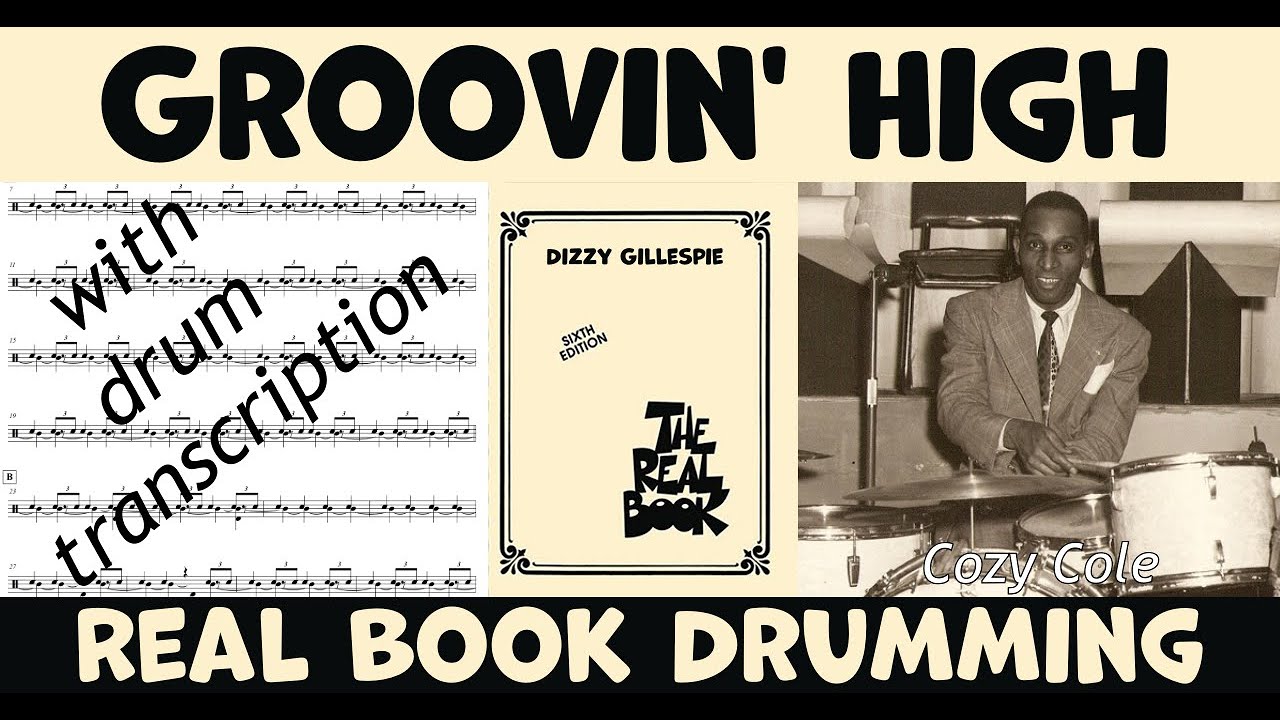
Groovin High' by Dizzy Gillespie - How Cozy Cole played it - Full Drum Transcription & Performance
Автор: Jazz Drummer's Corner
Загружено: 2026-02-06
Просмотров: 23
Описание:
Welcome to a new in-depth episode in my series of Drum Transcriptions, focusing on “Groovin’ High” by Dizzy Gillespie and on how Cozy Cole approached this recording on drums.
“Groovin’ High” was first recorded on February 9, 1945, and later released in 1947 on the album Dizzy Gillespie and His All Stars. It is widely regarded as one of the earliest and most influential bebop recordings and has since become one of the central Jazz Standards of the modern jazz repertoire. The composition is a contrafact based on the chord structure of “Whispering,” originally recorded in 1920 by Paul Whiteman and His Ambassador Orchestra. Gillespie’s new melody, however, was far more complex and rhythmically demanding, marking a decisive step away from swing-era conventions. Groovin' High was quickly adopted as a reference point for the emerging bebop language. Together with recordings by Gillespie and Charlie Parker, the piece contributed to a fundamental shift in how jazz was conceived, performed, and taught.
In this performance, the focus lies on how Cozy Cole supports the ensemble through time feel, articulation, and form awareness. Rather than drawing attention to himself, Cole’s playing remains closely connected to the musical flow, demonstrating how early bebop drumming combines clarity with flexibility.
Cozy Cole was already an established and versatile musician at the time of these recordings. Born in 1909 in East Orange, New Jersey, he worked with artists such as Cab Calloway, Benny Carter, and Louis Armstrong, and later became known to wider audiences through his recordings “Topsy I” and “Topsy II.” His career bridged swing, early bebop, and later popular jazz contexts. Importantly, Cole also played a pedagogical role in jazz history: he was a teacher and mentor to Philly Joe Jones.
As with all videos in this series, this is not a drum cover. The performance serves only to make the transcription audible and readable. The notation presented here should be understood as an analytical tool, not as a definitive statement. All Drum Transcriptions on this channel are based on close listening and contextual study and inevitably reflect interpretative decisions. Different drummers may hear certain details differently, and that exchange of perspectives is an essential part of jazz education.
If You are interested in further historically informed Drum Transcriptions, including related material on Philly Joe Jones and other key figures of the bebop and hard bop eras, feel free to explore the other videos on this channel.
The drum transcription for this video is available as a PDF on Patreon, where you will also find additional transcriptions:
👉 / jazzdrummerscorner
My book “Jazz Standards on the Drumset,” published by Hudson Music, brings together selected analyses and transcriptions as a long-term educational resource:
👉 https://hudsonmusic.com/product/jazz-...
Thank you for watching. I hope this transcription supports your own listening, practice, and understanding of early bebop drumming. Constructive dialogue and differing perspectives are always welcome in the comments.
More about me and my work:
More about me and my work:
◼️ Support on Patreon: / jazzdrummerscorner
◼️ Homepage: https://www.schlagabtausch.net
◼️ Facebook: / timo.ickenroth
◼️ YouTube: / @jazzdrummerscorner
◼️ eBook: https://hudsonmusic.com/product/jazz-...
Song Info
Band/Artist: Dizzy Gillespie
Album: Dizzy Gillespie and His All Stars
Songwriter: Dizzy Gillespie
Release date: March, 1947
Label: Musicraft
Image rights in thumbnail (Photo Credits):
Page URL: https://commons.wikimedia.org/wiki/Fi...
File URL: https://upload.wikimedia.org/wikipedi...
Attribution: Ralph F. Seghers c/o Ken Seghers, CC BY-SA 2.0 https://creativecommons.org/licenses/..., via Wikimedia Commons
Повторяем попытку...
Доступные форматы для скачивания:
Скачать видео
-
Информация по загрузке: