Relaxing Music of the Edo Period Traditional Japanese Music
Автор: Atmosphere Hub
Загружено: 2026-01-26
Просмотров: 0
Описание:
Let’s be clear from the start—this is not "background music." What you're about to experience is a careful auditory restoration of what private music sounded like in Japan's Edo period (1603–1868). This was an era of enforced peace under the Tokugawa shogunate, where art turned inward, and music became a pursuit of refinement, subtlety, and personal cultivation rather than public spectacle.
The soundscape you will hear is defined by two concepts: "Ma" (間)—the profound, intentional silence between sounds—and "Shibui" (渋い)—an aesthetic of austere, unassuming beauty. The instruments are few, the melodies are simple and cyclical, and the recording environment is key. We have replicated the acoustics of a zashiki (a formal tatami-mat room) with its paper (shōji) walls and wooden beams, which absorb high frequencies and leave a soft, warm resonance. This is not a concert hall; it’s a private chamber.
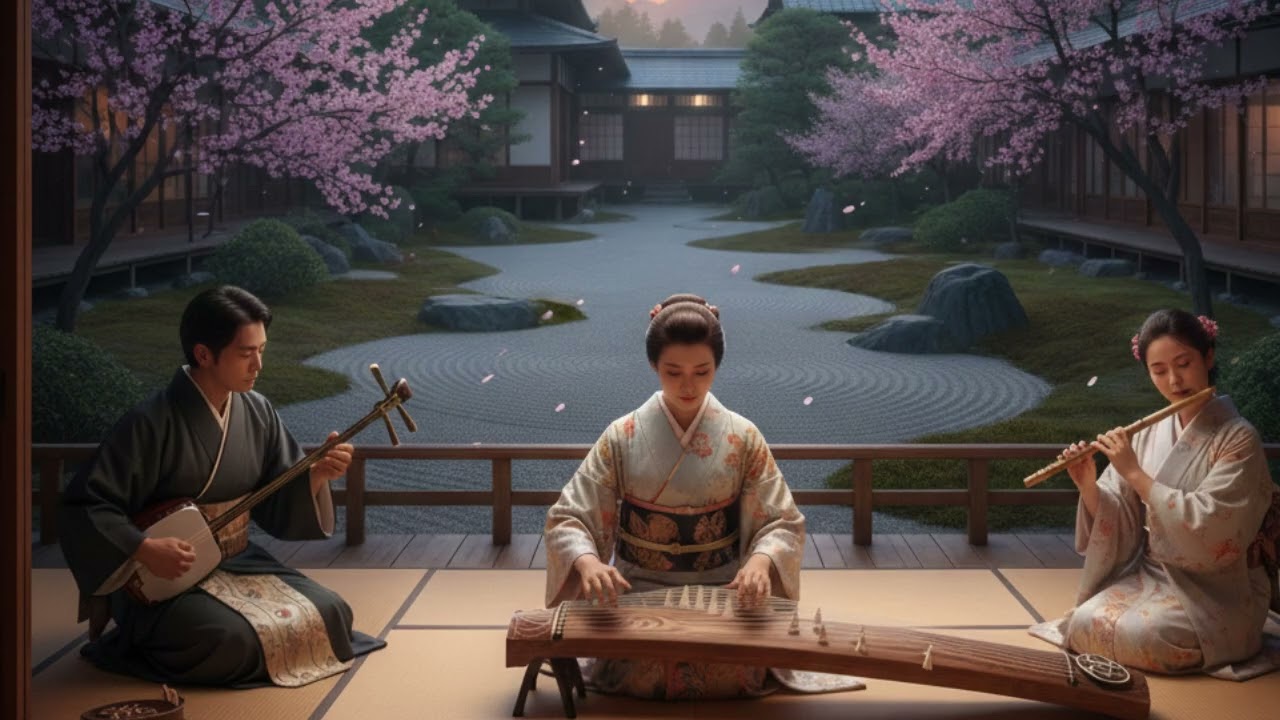
You will primarily hear three instruments, each representing a distinct social and artistic stratum of Edo society:
Koto (十三弦箏): The 13-string zither of the literate urban class. The piece is likely a section from a "Jiuta" composition, a genre of chamber music often sung with poetry. Listen not for virtuosity, but for the texture—the rustle of the silk strings, the solid ton of the movable bridges (ji) being slightly displaced upon plucking, and the subtle pitch bends created by pressing the string behind the bridge. This is the sound of studied, elegant leisure.
Shakuhachi (尺八) - "Fuke-Style": This is not the later romantic solo music. This is the earlier, more austere practice of the Fuke sect Komuso monks, for whom the bamboo flute was a tool for meditation (suizen) and alms-seeking. The notes are sparse, centered on the lower register (otsu), with a breathy, granular texture. The focus is on the journey of a single tone—its attack, its slight waver, its decay into silence. It is musical zazen.
Sanshin (三線) / Shamisen (三味線) Precursor: A quieter, older variant of the three-stringed lute, with a snakeskin membrane and played with a large plectrum. Here, it provides sparse, percussive accompaniment. Its dry, sharp pluck (bachi) contrasts with the sustain of the koto and shakuhachi, marking time like the careful steps of a tea ceremony.
What Makes This Historically Plausible: We have avoided the grand orchestral sounds of later Gagaku (court music) or the dramatic narrative styles of Gidayu (theatre music). This is "Zashiki-mono"—"parlor music." The tempo is deliberately slow, allowing the natural reverb of the room to become part of the composition. The tuning is based on older, just-intonation scales, not modern equal temperament, giving it a distinctive, slightly "unsettled" harmony to Western ears that is perfectly resolved within its own context.
This recording is an invitation to sit on the tatami, to clear the mind, and to engage in "chinmoku no kiku"—"listening to silence." The music is merely the guide that leads you into the silence between the notes. It is a tool for contemplation, not entertainment. Adjust your volume to a low, comfortable level—the dynamics are gentle, and the power is in the details and the spaces in between.
#edoperiodmusic #jijuta #koto #fukeshakuhachi #komuso #suizen #ma #shibui #zashikimono #japanesechambermusic #historicalperformance #earlymusicjapan #taishogoto #sanshin #traditionaljapan #edoera #冥想音乐 #quietmusic #austerebeauty #chinmokunokiku #tatamiacoustics #privateperformance #premodernjapan #musicalrestoration #authenticsound #healinghistory #深い聴取
Повторяем попытку...
Доступные форматы для скачивания:
Скачать видео
-
Информация по загрузке: