Fixing receive_output() Issues in Django Channels 2 Communicator
Автор: vlogize
Загружено: 2025-09-09
Просмотров: 0
Описание:
Discover how to resolve issues with the `receive_output()` function in Django Channels 2 Communicator and get your WebSocket tests running smoothly.
---
This video is based on the question https://stackoverflow.com/q/57815391/ asked by the user 'AbrahamCoding' ( https://stackoverflow.com/u/8865723/ ) and on the answer https://stackoverflow.com/a/63462779/ provided by the user 'AbrahamCoding' ( https://stackoverflow.com/u/8865723/ ) at 'Stack Overflow' website. Thanks to these great users and Stackexchange community for their contributions.
Visit these links for original content and any more details, such as alternate solutions, latest updates/developments on topic, comments, revision history etc. For example, the original title of the Question was: Django-Channels 2 Communicator receive_output() doesn't work
Also, Content (except music) licensed under CC BY-SA https://meta.stackexchange.com/help/l...
The original Question post is licensed under the 'CC BY-SA 4.0' ( https://creativecommons.org/licenses/... ) license, and the original Answer post is licensed under the 'CC BY-SA 4.0' ( https://creativecommons.org/licenses/... ) license.
If anything seems off to you, please feel free to write me at vlogize [AT] gmail [DOT] com.
---
Fixing receive_output() Issues in Django Channels 2 Communicator: A Practical Guide
When working with Django Channels, developers often run into challenges, especially during testing. One common issue arises when using receive_output() with a WebSocket communicator, leading to frustration and confusion. In this post, we'll break down the problem and provide a clear solution, so you can test your WebSocket consumers effectively.
The Problem
Imagine you have a basic WebSocket consumer set up in Django. Your goal is to send messages through this consumer and test its functionality using pytest and pytest-asyncio.
In a typical setup, your consumer might look something like this:
[[See Video to Reveal this Text or Code Snippet]]
You want to validate that your consumer correctly receives and sends messages. However, when you attempt to call communicator.receive_output(), you encounter a frustrating error message indicating a TimeoutError.
Understanding the Error
The source of the problem is that receive_output() fetches messages from the WebSocket and not directly from the channel layer. This confusion can easily occur, especially if you're new to asynchronous programming and Django Channels.
The Solution
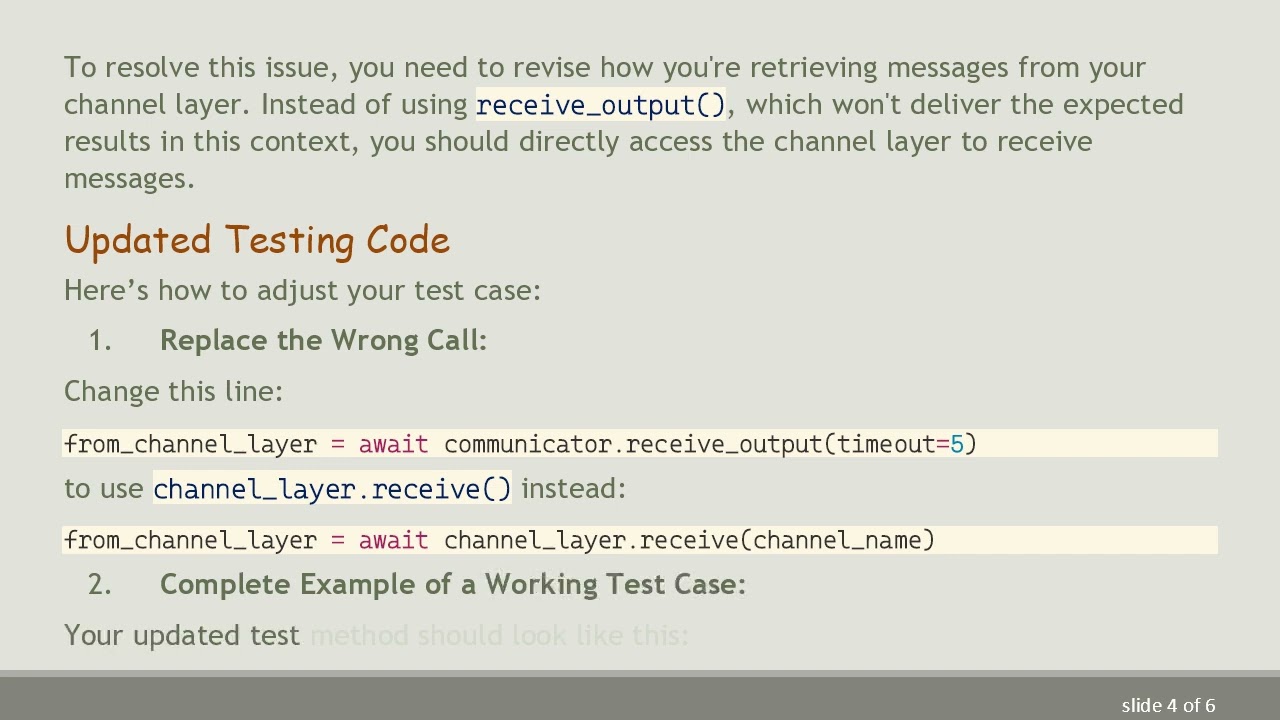
To resolve this issue, you need to revise how you're retrieving messages from your channel layer. Instead of using receive_output(), which won't deliver the expected results in this context, you should directly access the channel layer to receive messages.
Updated Testing Code
Here’s how to adjust your test case:
Replace the Wrong Call:
Change this line:
[[See Video to Reveal this Text or Code Snippet]]
to use channel_layer.receive() instead:
[[See Video to Reveal this Text or Code Snippet]]
Complete Example of a Working Test Case:
Your updated test method should look like this:
[[See Video to Reveal this Text or Code Snippet]]
Summary
By changing the method through which you retrieve your messages, you can effectively debug and test your Django Channels consumer without running into TimeoutError. Remember, ensuring that you're fetching messages from the correct source is key to making your tests work!
With these adjustments to your testing approach, you should now be able to test your WebSocket consumer smoothly. Happy coding!
Повторяем попытку...
Доступные форматы для скачивания:
Скачать видео
-
Информация по загрузке:


