Grignard Reaction-Ester/Mechanism & Product (1° or 3° Alcohol)/Alkyl Halides|
Автор: Chemistry Wallah
Загружено: 2025-11-17
Просмотров: 38
Описание:
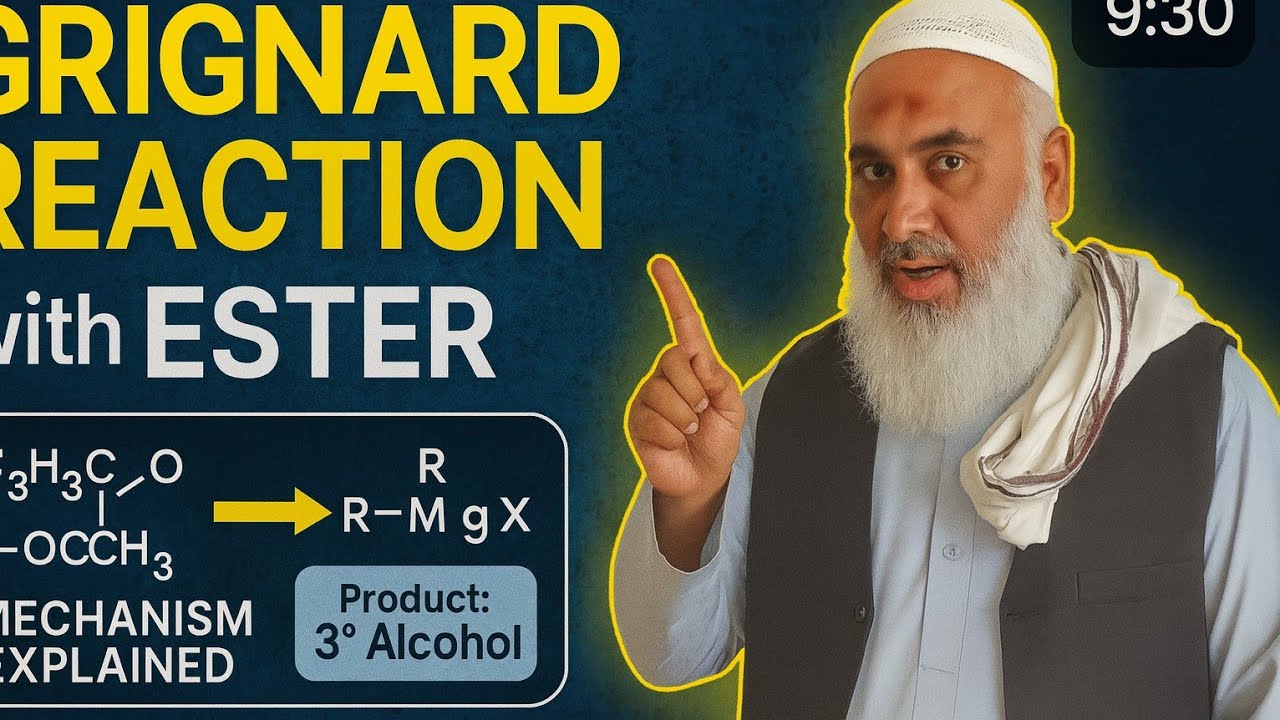
Grignard Reaction with Ester | Complete Mechanism Explained | Chemistry Wallah
The Grignard Reaction with Esters is one of the most powerful transformations in Organic Chemistry, widely tested across MDCAT, NEET, JEE, ETEA, and international competitive exams. This lecture explains, in a clear and exam-oriented way, how Grignard reagents convert esters into tertiary alcohols, why two moles of RMgX are required, and how the ketone intermediate forms and reacts further.
This video strengthens conceptual understanding and helps students solve MCQs, mechanism questions, and product-prediction problems with confidence.
---
🌟 What You Will Learn
✔ Nature and Reactivity of Grignard Reagents
Polar carbon–magnesium bond
Strong nucleophilic and basic character
Structure, preparation, and behavior
✔ Why Esters Undergo Two Consecutive Attacks
Electrophilic carbonyl carbon
OR group acting as a leaving group
Formation of a ketone intermediate
Immediate second nucleophilic attack
✔ Complete Step-by-Step Mechanism
1. First nucleophilic attack by RMgX → tetrahedral intermediate
2. Collapse of intermediate → formation of ketone
3. Second attack by RMgX
4. Acidic hydrolysis → formation of tertiary alcohol
✔ Final Product Explanation
Why esters always give tertiary alcohols
Stability of intermediates
Comparison with aldehydes and ketones (written without greater-than symbols)
---
🎯 Exam-Focused Outcomes
By the end of this lecture, students will be able to:
Predict products when esters react with Grignard reagents
Understand intermediate structures
Solve mechanism-based MCQs quickly
Recognize reaction patterns in synthesis problems
Apply concepts in board exams and competitive tests
---
🧪 Key MCQ Concepts Covered
Reactivity order explained in words (aldehydes are more reactive than ketones, and ketones are more reactive than esters)
Reason for two-step addition
Importance of acidic hydrolysis
Why tertiary alcohols are formed
Grignard reagent as a strong nucleophile
These points frequently appear in MDCAT, NEET, JEE, ETEA, NUMS, NUST and other major exams.
---
📘 Why This Lecture Matters
This lecture enhances understanding of:
Organic reaction mechanisms
Synthetic pathways
Carbonyl chemistry
Formation of complex alcohols
Essential for both medical and engineering exam aspirants.
---
🌍 About Chemistry Wallah
We deliver high-quality, conceptual chemistry lectures for FSc, MDCAT, NEET, JEE, ETEA, and international students. Our focus is clarity, mechanism understanding, and real exam problem-solving.
---
💬 Final Words
If you found this lecture helpful:
👍 Like
💬 Share your questions
🔔 Subscribe for more premium content
📤 Share with classmates
Your support helps us continue producing valuable educational content for students worldwide.
Повторяем попытку...
Доступные форматы для скачивания:
Скачать видео
-
Информация по загрузке: