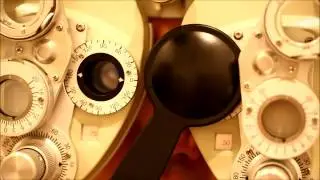
Binocular Subjective Refraction - Full Tutorial
Автор: smart optometry
Загружено: 2020-07-04
Просмотров: 9254
Описание:
Introduction:
-- Clinical procedure in which the subjective refraction is performed monocularly under binocular viewing conditions.
-- In binocular refraction:
both eye are open
Both eye are unoccluded
Both eye View a common target
PRINCIPLE:
-- The right eye views only right portion target, left eye only left portion due to a fusion lock
-- Provide visual clues to both eyes that enable the binocular fusion necessary for association of target.
Indications for Binocular Refraction:
1)Refractive Considerations:
Hyperopic anisometropia,
Antimetropia,
Latent hyperopia,
Pseudomyopia
2) Visual Acuity Considerations:
Anisooxyopia ( unequal acuities between two eyes)
Unilateral amblyopia
Unilateral reduced acuity as a result of ocular disease
3) Ocular Motility Considerations:
Significant horizontal, vertical or cyclo associated phorias
Cyclophoria
Latent nystagmus
Advantages over monocular refraction:
Accommodation , convergence , light adaptation more constant
Refractive status evaluated in more nearly normal environment.
Detection of suppression
Measurement of stereopsis
Measurement of fixation disparity
METHODS:
-- Septum
-- Polarization
-- Fogging
A. Septum Method Of Binocular Subjective Refraction:
A septum is used in the middle of the chart so that each eye views its
respective target.
Example: Turville Infinity Balance
B. Polarization Method:
• Polarized letters are used in normal background
• An Analyzer is used in front of eye which allow right eye to view right half of the target , but blocking left half of target from view and left eye to view left half of the target , but blocking right half of target from view.
• Example:
Polarized Targets and Polarizing Filters
Vectographic Slides for Projection
C. Fogging Method:
Fogging refers to the technique of adding plus sphere power during
refraction and/or retinoscopy in an attempt to control accommodation.
The goal is to move the focal point in front of the retina.
PRINCIPLE:
When a hyperopic eye has left under-corrected. Then, when
accommodation is relaxed, light focuses behind the retina and the vision is slightly blurry.
The patient accommodates (the natural lens gets "fatter") to see better.
Accommodation moves the focal point onto the retina.
We fog the eye by adding enough plus power to move the focal point in
front of the retina.
If the patient accommodates now, his vision will get blurrier instead of
clearer. Thus, accommodation is discouraged.
STEPS OF BINOCULAR REFRACTION:
1. STARTING POINT:
The objective results act as a starting point from which the subjective
refraction can take place.
The habitual spectacle correction or results of the previous subjective
refraction may suffice as the starting point.
2. CONTROL OF ACCOMMODATION:
During refraction when we change trial lenses, it cause fluctuating
accommodation. so accommodation needs to control in a relaxed state
during refraction.
Accommodation is maintain in relaxed state by fogging technique
In binocular refraction, both eyes are unoccluded, so accommodation
needs to control in untested eye while examining testing eye
So initially both eyes are fogg with +0.75DS
3. ASTIGMATIC CORRECTION:
Astigmatic Correction , the presence, amount and orientation of
astigmatic power and axis is determine by several methods, namely:
Jackson cross cylinder
Fan and block method
Clock dial method
Stenopaic slit method
4. MONOCULAR SPHERICAL END POINTS:
The circles of least confusion are essentially brought to the outer limiting
membrane of the retina in the two eyes.
The monocular spherical endpoint providing maximum visual acuity is first
determined for one eye, with the second eye occluded, and the spherical
endpoint providing maximum visual acuity is determined for the second
eye, with the first eye occluded.
It is usually done by,
Duochrome or Bichrome Method
Method of Reduced Contrast or Illumination
Trial Frame Method
5. SPHERICAL EQUALIZATION OR BINOCULAR BALANCING:"
Spherical Equalization or Binocular Balancing to balance or equalize the
state of accommodation of two eyes not the visual acuities of two eyes.
Allows both eyes have the retinal images simultaneously in focus
if Difference in accommodative response between two eyes Inequality
Methods for binocular balancing:
Alternate occlusion
prism dissociated blur balance
prism dissociated red-green (bichrome) balance
Humphriss fogging method
6. BINOCULAR SPHERICAL END POINTS:
The eyes are simultaneously fogged and then Unfogged until maximum
binocular acuity is Attained
The spherical endpoints are the maximum plus or Minimum minus power
providing maximum Binocular visual acuity
These endpoints are usually about +0.50 DS more Plus or less minus than
those found monocularly.
Повторяем попытку...

Доступные форматы для скачивания:
Скачать видео
-
Информация по загрузке: