What are the 12 Synergy stones?
Автор: Free Online Gemological course
Загружено: 2020-05-01
Просмотров: 1025
Описание:
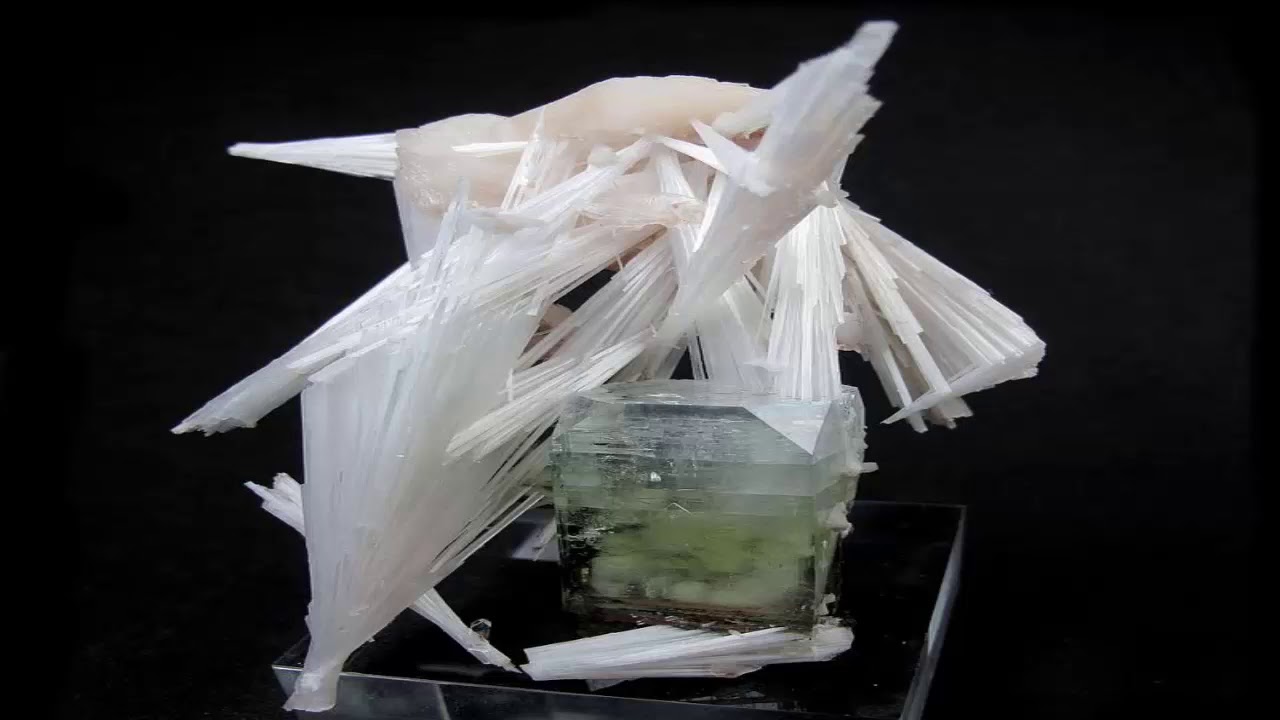
Scolecite is a tectosilicate mineral belonging to the zeolite group; it is a hydrated calcium silicate, CaAl2Si3O10·3H2O. Only minor amounts of sodium and traces of potassium substitute for calcium. There is an absence of barium, strontium, iron and magnesium.[1][5] Scolecite is isostructural (having the same structure) with the sodium-calcium zeolite mesolite and the sodium zeolite natrolite, but it does not form a continuous chemical series with either of them.[1] It was described in 1813, and named from the Greek word, σκώληξ (sko-lecks) = "worm" because of its reaction to the blowpipe flame.
Contents
1 Crystal class
2 Structure
3 Unit cell
4 Crystal habit
5 Physical properties
6 Optical properties
7 Environment
8 Localities
9 References
10 External links
Crystal class
It is monoclinic m with space group Cc, but crystals are pseudotetragonal. Scolecite, like natrolite and mesolite, usually occurs as acicular (needle-like) and fibrous aggregations. It has nearly the same angles between the crystal faces as does natrolite, but natrolite is orthorhombic and scolecite is monoclinic. The etched figures (figures that arise from the action of a solvent on a crystal face, and indicate its true symmetry) and the pyroelectric character of scolecite show that it crystallizes with a plane of symmetry, but no axis of symmetry, that is to say it belongs to the hemihedral class of the monoclinic system. Scolecite can therefore be distinguished from natrolite by an optical examination, since the acicular crystals do not extinguish parallel to their length between crossed nicol prisms. Twinning on the ortho-pinacoid is usually evident.
Structure
The structure of the aluminosilicate framework is the same for scolecite, natrolite and mesolite. Scolecite has long ordered chains, rotated 24° round the axis of the chain. One Ca cation and three H2O molecules are in four ion sites in the channels parallel to the c crystal axis. There is no sign of aluminium ions occupying silicon ion sites.[1][5]
Unit cell
Scolecite is a monoclinic mineral, with the angle β equal to about 109° and four formula units per unit cell (Z = 4). Described in this way, various sources give the following values for the parameters of the unit cell, which has one long side and two short ones:
a = 6.516 to 6.517 Å, b = 18.948 to 18.956 Å, c = 9.761 to 9.765 Å, β = 108.86 to 108.98°[1]
a = 6.52 to 6.53 Å, b = 18.96 to 18.97 Å, c = 9.76 to 9.78 Å, β = 108.9°[5]
a = 6.516 Å, b = 18.948 Å, c = 9.761 Å, β = 108.98°[2]
Crystals, however, are pseudotetragonal, and this can be represented by taking a different unit cell, with twice as many formula units (Z = 8) and two long sides and one short one. The axes are redefined, a and b are very nearly equal and the angle β between the new a and c axes is very nearly equal to 90° (a truly tetragonal crystal would have a = b and β = 90° exactly). The sources give the following values:
a=18.488 to 18.508 Å, b=18.891 to 18.96 Å, c=6.527 to 6.548 Å, β = 90.64 to 90.75°[1]
a = 18.508(5) Å, b = 18.981(5) Å, c = 6.527(2) Å β = 90.64°[3]
a = 18.508(5) Å, b = 18.981(5) Å, c = 6.527(2) Å, β = 90:64(1)°[4]
a = 18.51 Å, b = 18.97 Å, c = 6.53 Å, β = 90.6°[5]
Повторяем попытку...
Доступные форматы для скачивания:
Скачать видео
-
Информация по загрузке: