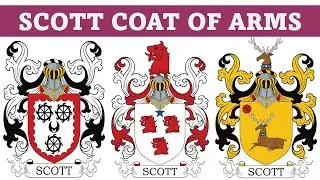
Scott Surname History
Автор: Coat of Arms Database
Загружено: 2023-06-01
Просмотров: 1940
Описание:
SURNAME MEANING
An English, Scottish, and Irish habitational surname denoting someone who came from Scotland, derived from the Middle English word Scot.
EARLY BEARERS
Uchtred filius (son of) Scot – Kelso – 1120
Roger Scot – Lincolnshire – 1150
Henry le Scotte – Scotland – c. 1195
Ade le Scot – Scotland – c. 1221
Allsaundre Scot – Lanarkshire – 1296
Henry le Scot – Edinburgh – 1296
John le Scot – Haddington – 1296
Michael le Scot – Linlithgow – 1296
Wautier le Scot – Peeblesshire – 1296
EARLY SETTLERS IN NEW WORLD
Nicholas Scott – 1607 – Jamestown
Walter Scott – 1618 – Hercules
Apphia Scott – 1618 – Gift
Robert Scott – 1630 – Winthrop
Martha Scott – 1634 – Elizabeth
Elizabeth Scott – 1635 – Expectation
James Scott – 1635 – Globe
Jane Scott – 1635 – Thomas & John
john Scott – 1635 – Falcon
William Scott – 1635 – George
LANDED GENTRY
Scott of Betton Strange, co. Shropshire, England
Scott of Great Barr, co Staffordshire, England
Scott of Rotherfield Park, Southampton, England
Scott of Brotherton, co. Kincardine, Scotland
Scott of Gala, co. Selkirk, Scotland
Scott of Raeburn, co. Dumfries, Scotland
Scott of Willsboro, co. Londonderry, Northern Ireland
Scott of Wauchope, co. Roxburgh, Scotland
Scott of Annegrove Abbey, Queen's Co, Ireland
NOBLE TITLES HELD
Sir David Scott was created Baron of Buccleuch in 1488, was the son of Sir Walter Scott of Branxholm (d. 1469), a descendant of Sir Michael Scott who died at the Battle of Durham in 1346, son of Richard Scott, 1st Laird of Rankilburn (d. 1320). One of his descendants, Walter Scott, was created Lord Scott of Buccleuch in Parliament in 1606.
The Scott Baronetcy of Kew Green in the County of Middlesex was created in the Baronetage of England in 1653 for Sir William Scott, grandson of John Scott, who settled in Flanders.
The Scott Baronetcy of Thirlestane in the County of Selkirk was created in the Baronetage of Nova Scotia in 1666 for Sir Francis Scott, son of Patrick Scott (d. 1666). He was succeeded by his son, Sir William Scott, 2nd Baronet, who was a Scottish lawyer and poet. Sir Francis Scott, 3rd Baronet, succeeded to the title of Lord Napier upon the death of his maternal grandmother, and assumed the surname Napier in lieu of Scott.
The Scott Baronetcy of Ancrum in the County of Roxburgh, was created in the Baronetage of Nova Scotia in 1671 for Sir John Scott of Kirkstyle.
The Scott Baronetcy of Great Barr in the County of Stafford, was created in the Baronetage of the United Kingdom in 1806 for Sir Joseph Scott of Great Barr Hall, Member of Parliament for Worcester and High Sheriff of Staffordshire, son of William Scott (d. 1753) of Great Barr Hall.
The Scott Baronetcy of Abbotsford in the County of Roxburgh, was created in the Baronetage of the United Kingdom in 1820 for the historian, novelist, poet, and playwright, Sir Walter Scott.
The Scott Baronetcy of Lytchet Minster in the County of Dorset was created in the Baronetage of the United Kingdom in 1821 for Sir Claude Scott of Sundridge Park, co. Kent, self-made entrepreneur in the corn trade and Member of Parliament.
The Scott Baronetcy of Connaught Place in the County of London was created in the Baronetage of the United Kingdom in 1899 for Sir John Edward Arthur Murray Scott (1847–1912), secretary to Sir Richard Wallace, the eldest son of Dr. John Scott, a physician at Boulogne-sur-Seine, France.
James Scott (1649-1685), Dutch-born English military officer, illegitimate son of King Charles II of England, was elevated to the peerage as
Duke of Monmouth, with the subsidiary title of Earl of Doncaster and Baron Scott of Tynedale in 1663. He was also made Duke of Buccleuch upon his marriage to Anne Scott, 4th Countess of Buccleuch. He was beheaded for treason in 1685.
James Scott (1675-1705), son of James Scott, 1st Duke of Monmouth, was created Earl of Dalkeith.
Francis Scott (1721-1750), Member of Parliament for Boroughbridge, son of Francis Scott, 2nd Duke of Buccleuch, was created Earl of Dalkeith.
Earl of Deloraine was a title in the Peerage of Scotland created in 1706 for Major-General Henry Scott
John Scott, British barrister and politician was elevated to the Peerage of Great Britain as Baron Eldon and Viscount Encombe in 1799. He was further elevated to Earl of Eldon in 1821.
John Scott (1739-1798), Lord Chief Justice of the King’s Bench for Ireland, was elevated to the peerage as Baron Earlsfort in 1784, and was further elevated to Viscount Clonmell in 1789, and was again elevated to Earl of Clonmwell in 1793.
Walter Scott of Highchester was elevated to the Peerage of Scotland as Baron Almoor and Earl of Tarras in 1660, son of Sir Gideon Scott of Highchester.
Sir William Scott (d. 1656) was a Scottish politician and judge who was granted the title Lord Clerkington in 1649, son of Laurence Scott of Harprig, clerk to the privy council.
William Scott, English judge and jurist, was elevated to the peerage in 1821 as Baron Stowell of Stowell Park in 1821.
Повторяем попытку...
Доступные форматы для скачивания:
Скачать видео
-
Информация по загрузке: