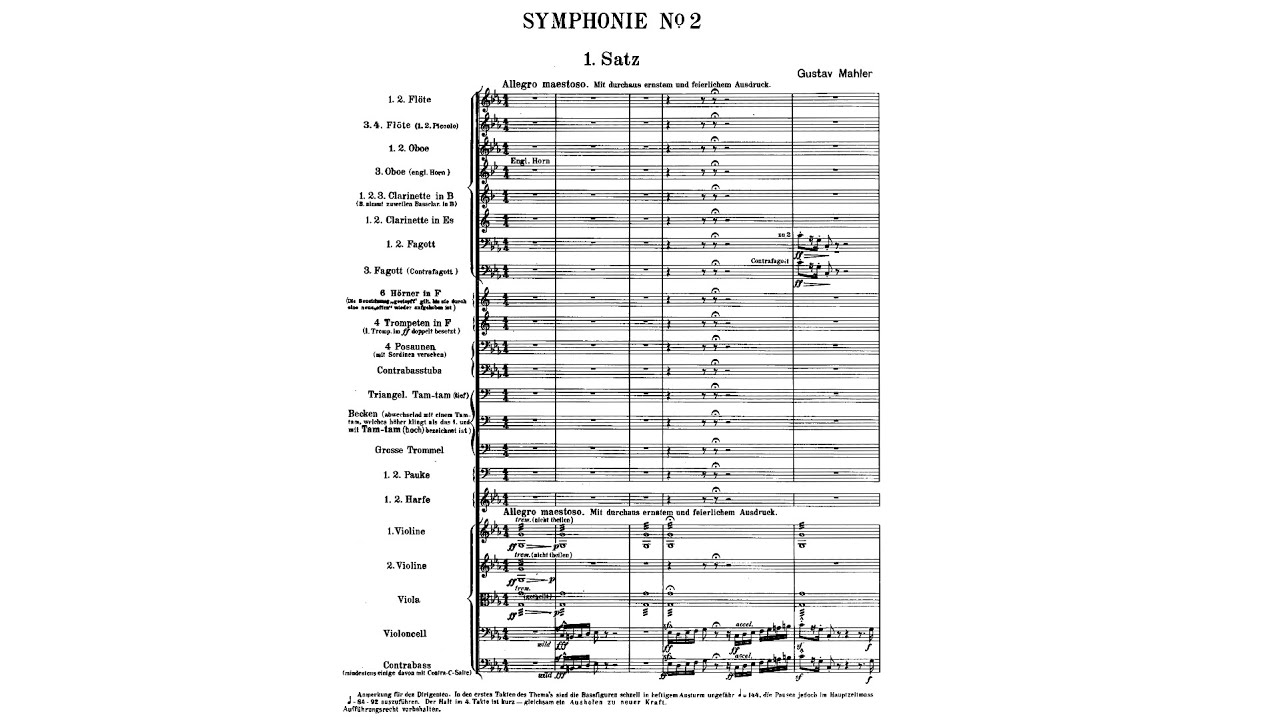
Gustav Mahler - Symphony No.2 in C minor "Resurrection" (Vásquez - SBSO)
Автор: Momrad Carko
Загружено: 2024-07-07
Просмотров: 644
Описание:
Gustav Mahler (1860 - 1911)
⸻⸻⸻⸻⸻
Symphony No.2 in C minor "Resurrection" (1894)
⸻⸻⸻⸻⸻
Christian Vásquez (1984 -)
Simón Bolívar Symphony Orchestra
Recorded in 2008
⸻⸻⸻⸻⸻⸻⸻
The Symphony No. 2 in C minor by Gustav Mahler, known as the Resurrection Symphony, was written between 1888 and 1894, and first performed in 1895.
⸻⸻⸻⸻⸻⸻⸻
This symphony was one of Mahler's most popular and successful works during his lifetime. It was his first major work that established his lifelong view of the beauty of afterlife and resurrection.
⸻⸻⸻⸻⸻⸻⸻
I. Allegro maestoso (0:00)
The first movement is written in C minor, but passes through a number of different moods and resembles a funeral march.
The movement's formal structure is modified sonata form. The exposition is repeated in a varied form.
The development presents several ideas that will be used later in the symphony, including a theme based on the Dies irae plainchant.
The secondary theme, first presented in E major, begins its second statement in C major, a key in which it is not expected until the recapitulation.
Following this movement, Mahler calls in the score for a gap of five minutes before the second movement. This pause is rarely observed today.
⸻⸻⸻⸻⸻⸻⸻
II. Andante moderato (22:20)
The second movement is a delicate Ländler in A♭ major.
It has two contrasting sections of slightly darker music.
This slow movement itself is contrasting to the two adjacent movements. Structurally, it is one of the simplest movements in Mahler's whole output. It is the remembrance of the joyful times in the life of the deceased.
⸻⸻⸻⸻⸻⸻⸻
III. In ruhig fließender Bewegung (34:03)
The third movement is a scherzo in C minor. It opens with two strong, short timpani strokes.
It is followed by two softer strokes and then followed by even softer strokes that provide the tempo to this movement, which includes references to Jewish folk music.
Mahler called the climax of the movement, a blistering B♭m/C chord in triple-forte which occurs near the end, sometimes a "cry of despair", and sometimes a "death shriek".
The movement is based on Mahler's setting of "Des Antonius von Padua Fischpredigt" from Des Knaben Wunderhorn, which Mahler composed almost concurrently; in correspondence, Mahler expressed amusement that his sinuous musical setting could imply St. Anthony of Padua was himself drunk as he preached to the fish.
⸻⸻⸻⸻⸻⸻⸻
IV. "Urlicht" (44:23)
The fourth movement, "Urlicht" is marked Sehr feierlich, aber schlicht. It is a Wunderhorn song, sung by an alto, which serves as an introduction to the Finale. The song, set in the remote key of D♭ major, illustrates the longing for relief from worldly woes, leading without a break to the response in the Finale.
⸻⸻⸻⸻⸻⸻⸻
V. Im Tempo des Scherzos (49:13)
The finale is the longest movement, typically lasting over half an hour. It is divided into two large parts, the second of which begins with the entry of the chorus and whose form is governed by the text of this movement.
The movement opens with a long introduction, beginning with the "cry of despair" that was the climax of the third movement, followed by the quiet presentation of a theme which reappears as structural music in the choral section.
This is followed by a call in the offstage horns.
The first theme group reiterates the Dies irae theme from the first movement and then introduces the "resurrection" theme to which the chorus will sing their first words, and finally a fanfare.
The second theme is a long orchestral recitative, which provides the music for the alto solo in the choral section.
The development section is what Mahler calls the "march of the dead". It begins with two long drum rolls, which include the use of the gongs. In addition to developing the Dies irae and resurrection themes and motives from the opening cry of despair, this section also states, episodically, a number of other themes, based on earlier material.
The recapitulation overlaps with the march, and only brief statements of the first theme group are restated.
The chorus comes in quietly a little past the halfway point of the movement.
The choral section is organized primarily by the text, using musical material from earlier in the movement.
Each of the first two verses is followed by an instrumental interlude.
E♭ suddenly reenters with the text "Sterben werd' ich um zu leben," and a proper cadence finally occurs on the downbeat of the final verse, with the entrance of the heretofore silent organ and with the choir instructed to sing mit höchster Kraft.The instrumental coda is in this ultimate key as well, and is accompanied by the tolling of deep bells.
Mahler went so far as to purchase actual church bells for performances, finding all other means of achieving this sound unsatisfactory.
⸻⸻⸻⸻⸻⸻⸻
Mahler wrote of the 5th movement: "The increasing tension, working up to the final climax, is so tremendous that I don't know myself, now that it is over, how I ever came to write it."
Повторяем попытку...
Доступные форматы для скачивания:
Скачать видео
-
Информация по загрузке:


![[4K] 말러 교향곡 제2번 '부활' / 정명훈 지휘 G. Mahler, Symphony No.2 'Resurrection'](https://image.4k-video.ru/id-video/hSG1FKGVuD8)


![Scriabin - Fantasie in B minor [ORCHESTRATION]](https://image.4k-video.ru/id-video/c_Gein9xqB4)