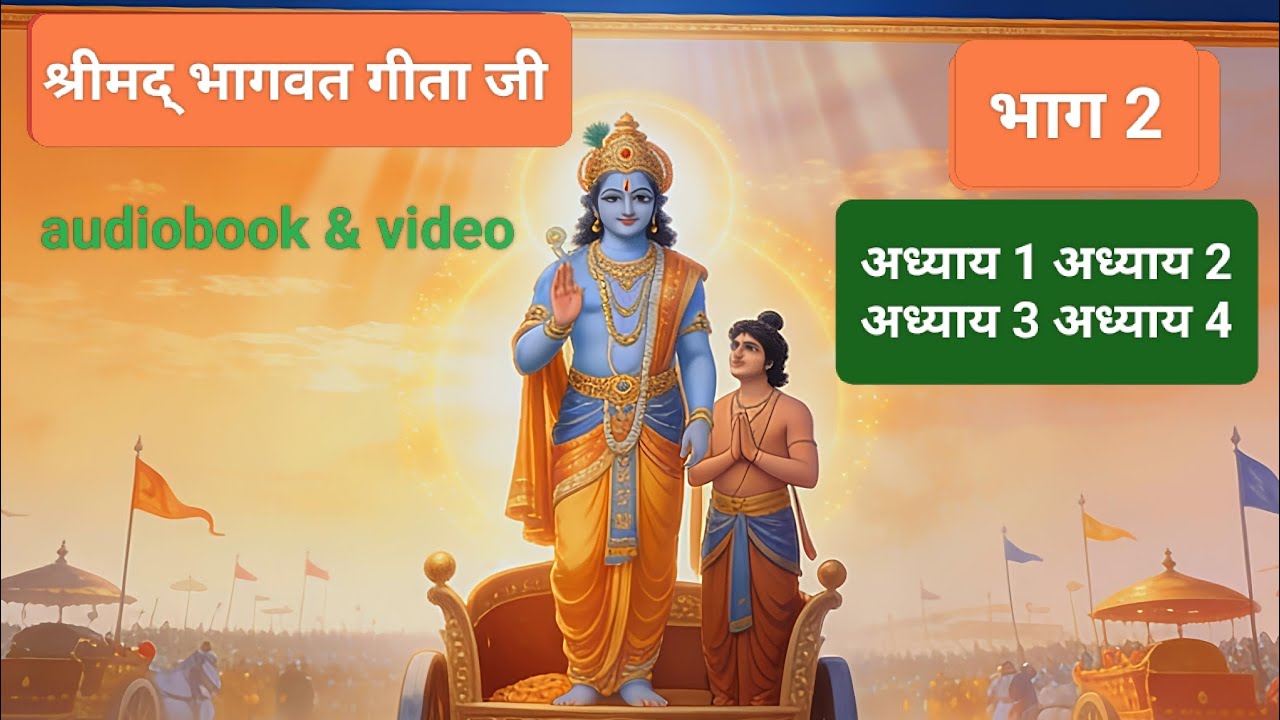
श्रीमद् भागवत गीता(भाग 2)||भक्ति भजन मार्ग|| audiobook & video
Автор: Book walla
Загружено: 2026-01-10
Просмотров: 30
Описание:
share subscribe and follow 🙏
This video, titled "श्रीमद् भागवत गीता(भाग 2)||भक्ति भजन मार्ग|| audiobook & video", is the second part of an audiobook series on the Srimad Bhagavad Gita, covering Chapters 3 and 4.
Here's a summary of the key teachings:
Chapter 3: Karma Yoga (The Yoga of Action)
Arjuna's Dilemma: Arjuna questions why he should engage in "terrible actions" if knowledge is considered superior to action (0:26).
Lord Krishna's Response: Lord Krishna explains that there are two types of devotion: Jnana Yoga (Yoga of Knowledge) for the contemplative, and Karma Yoga (Yoga of Action) for the active (0:51).
The Inevitability of Action: No one can remain without action, as all beings are compelled to act by the qualities of nature (1:17).
Performing Action Without Attachment: Krishna emphasizes that one should perform duty without attachment to the results, as this leads to liberation (2:04).
The Cycle of Sacrifice: The video explains the interconnectedness of creation, where beings are nourished by food, food by rain, rain by sacrifice, and sacrifice by actions prescribed in the Vedas, originating from the imperishable Brahman (3:33).
The Importance of Duty: Those who do not follow the established order and indulge in sensory pleasures live in vain (3:57).
The Ideal Person: A person who finds satisfaction within themselves has no obligation to perform or abstain from action (4:10).
Lord Krishna's Example: Krishna states that even he, though having nothing to gain, constantly engages in action to set an example for humanity (5:18).
Overcoming Desire and Anger: Arjuna asks what impels a person to commit sin. Krishna identifies desire (Kama) and anger (Krodha), born of the quality of passion (Rajas), as the great enemies that obscure knowledge (8:42). He advises Arjuna to control the senses, mind, and intellect to conquer these enemies (9:30).
Chapter 4: Jnana-Karma-Sanyasa Yoga (The Yoga of Renunciation of Action in Knowledge)
The Ancient Yoga: Krishna reveals that he first taught this imperishable yoga to the Sun god, who then taught it to Manu, and Manu to Ikshvaku (10:25). This ancient knowledge was lost over time (10:54).
The Divine Incarnation: Krishna explains that he takes birth in various ages to protect the righteous, destroy the wicked, and re-establish righteousness whenever dharma declines and adharma flourishes (11:47).
Understanding Krishna's Nature: Those who understand the divine nature of Krishna's birth and actions attain liberation and do not take rebirth (12:25).
The Path to Liberation: Many have achieved liberation by surrendering to Krishna with love, being purified by knowledge and austerity (12:40).
The Four Varnas: Krishna created the four divisions of society (Brahmin, Kshatriya, Vaishya, Shudra) based on qualities and actions, but he remains the non-doer (13:13).
The Nature of Action and Non-Action: The video delves into the complexity of understanding what constitutes action (Karma), non-action (Akarma), and forbidden action (Vikarma) (13:58).
The Path of the Wise: Those who see inaction in action and action in inaction are truly wise and perform all actions (14:26).
Action Purified by Knowledge: All actions performed without desire and attachment, consumed by the fire of knowledge, are considered wise (14:45).
The Importance of Knowledge: Knowledge is the purest purifier in this world (20:07).
Obtaining Knowledge: Knowledge can be obtained by seeking it from a knowledgeable guru with humility and service (19:09).
Freedom from Bondage: A person who has offered all actions to the Supreme, whose doubts are destroyed by wisdom, and who is self-controlled, is not bound by actions (20:50).
Arjuna's Call to Action: Krishna instructs Arjuna to cut the doubts born of ignorance with the sword of knowledge and stand up for battle, established in Karma Yoga (21:07).
Повторяем попытку...
Доступные форматы для скачивания:
Скачать видео
-
Информация по загрузке: