Dynamic Inefficiency: Solow Growth Model
Автор: Everything Econ
Загружено: 2020-04-27
Просмотров: 4770
Описание:
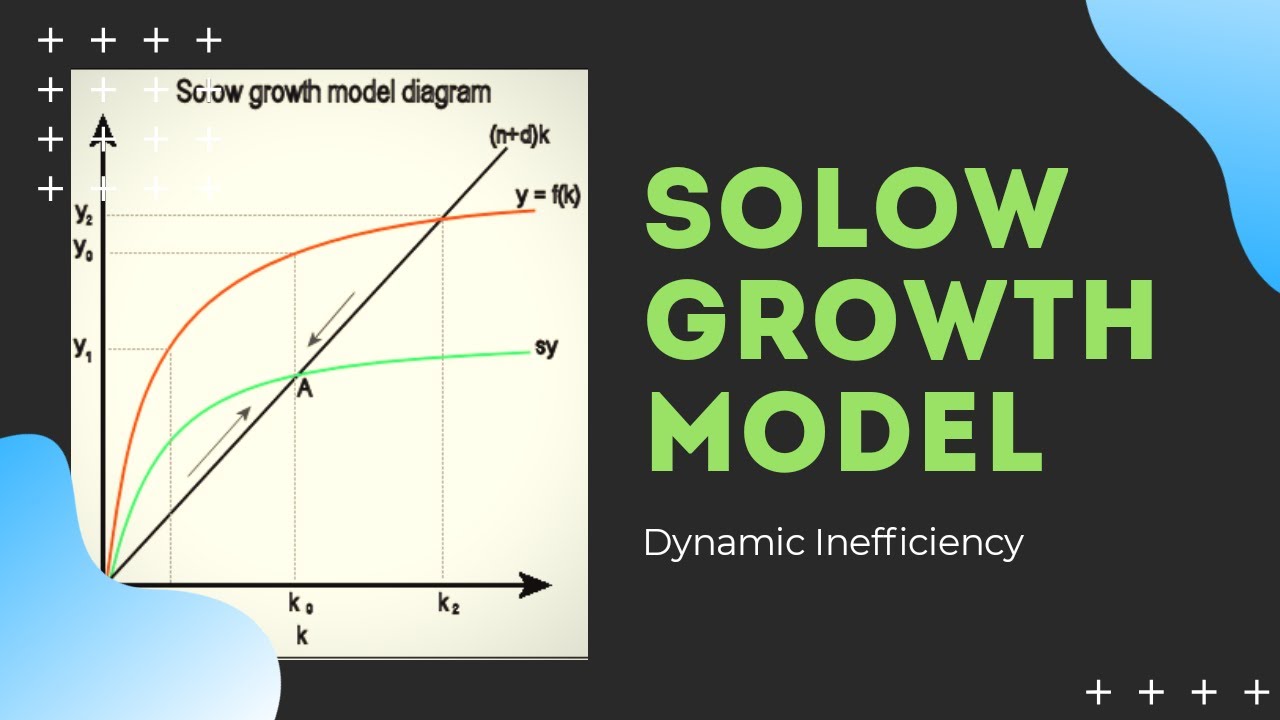
I discuss the concept of dynamic inefficiency and use diagrams to see how we transition to the golden rule steady state by altering the savings rate. We see a dynamically efficient economy and a dynamically inefficient one.
In previous videos, I give an introduction to the Solow Growth model. These videos explains the basics of the Solow Growth model, giving a description of what the model does, and the assumptions it makes. I also derive some initial equations that are useful in finding the outcomes of the model.
The Solow model is a basic theory of economic growth. It introduces the theory of capital accumulation to the classical production function. This is thus a neoclassical model. It is thus also sometimes named the neoclassical growth model, or the Solow-Swan Growth model. This is usually the second model of economic growth that is covered in an intermediate macroeconomics course, after the classical model. Solow endogenises the capital stock, by assuming that we have some depreciation of capital which decreases the capital stock. We have that investment increases the capital stock. These two facts can be combined to give us the law of motion of capital. I also derive the fundamental equation of the Solow Growth model.
The Solow model is a key model to learn as it is widely used in economic policy-making. It is also used as a benchmark for other growth theories, to evaluate their performance against empirical findings.
Future videos will look at deriving the steady state of the Solow model, looking at Solow model dynamics and more. For example, we can use this model to look at instantaneous impacts of a shock to population, or a shock to the population growth rate. The model can also examine shocks to the productivity parameter (or the technological progress parameter).
The model looks at the impact of capital accumulation on savings, consumption and output. we can use per capita or aggregate variables. This gives the basics in a more general sense. With given values of the savings rate and so on, we can get actual values of output per capita. The basic form of the Solow model has a number of shortcomings as shown by empirical data, but we can augment this model with additional features such as human capital in order to better replicate the true characteristics of an economy. The model does well in predicting conditional convergence, but absolute convergence is not seen in reality.
The Solow Growth can be attributed to Solow (1956)
Robert M. Solow, A Contribution to the Theory of Economic Growth, The Quarterly Journal of Economics, Volume 70, Issue 1, February 1956, Pages 65–94
Subscribe for more videos looking at games of chance, tutorials, and everything to do with the industry. Put suggestions for video ideas in the comments section below and any feedback offered would be greatly appreciated.
My videos are intended for educational and entertainment purposes. I try to credit the relevant parties for any work that I refer to in my videos (for example, citing relevant academic papers). If you believe a video does not observe good academic practice, please do not hesitate to contact me by email at [email protected]
Повторяем попытку...
Доступные форматы для скачивания:
Скачать видео
-
Информация по загрузке: