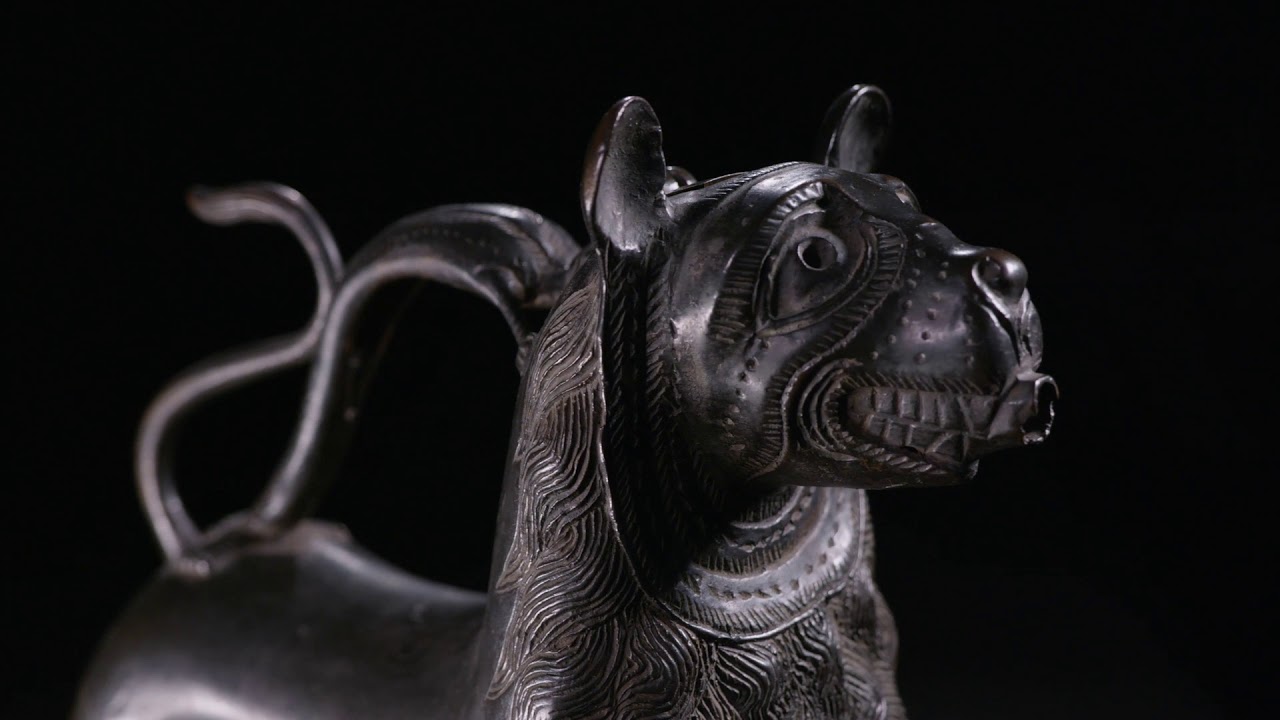
Aquamanile in form of a lion
Автор: Julius Böhler (Kunsthandlung)
Загружено: 2020-11-05
Просмотров: 227
Описание:
This extraordinary aquamanile (27 x 27) in the form of a lion in copper alloy is already 770 years old! It was cast in Hildesheim, Germany, circa 1250. Two recent ink-inscriptions "1909 E R" and "J. v S. G. on the body refer to the provenance which, according to Dr. Joanna Olchawa is hard to conclude. In her view, the two ink-inscriptions shall refer to the art gallery Julius and Selig Goldschmidt, active in the 19th century in Frankfurt /Main, who sold medieval aquamaniles from the collection Friedrich Hahn, Hannover, around 1868.
The origin of such exquisite ewers, cast using the lost wax technique, is to be found in the Orient. They arrived in Europe as a result of the crusades and the spread of the Byzantine culture. Aquamaniles executed in bronze soon became firm favourites among Romanesque sculpted objects in the Holy Roman Empire. They were used for washing hands as part of a liturgical ritual, as well as at mealtimes in a secular context. The art-historical term ‘aquamanile’ is actually not entirely correct. The word, originally used to describe the basin for collecting water, has been transferred to the ewer –the pouring vessel –itself. Many aquamaniles are in the form of animals, whereby the lion was the most sought-after motif. Griffins, horses and equestrian figures were also popular subjects. Aquamaniles had their heyday between the early 12th and the late 16th centuries. As in the Orient, the lion – the most majestic of animals – also has positive connotations in the western world. A certain identification between the user and the characteristics of the animal, such as strength, courage and generosity, was intended. The lion aquamanile was a symbolic embodiment of the ideal characteristics of a courtly person. Only some 120 lion aquamaniles are known to have survived to this day.
Повторяем попытку...
Доступные форматы для скачивания:
Скачать видео
-
Информация по загрузке: