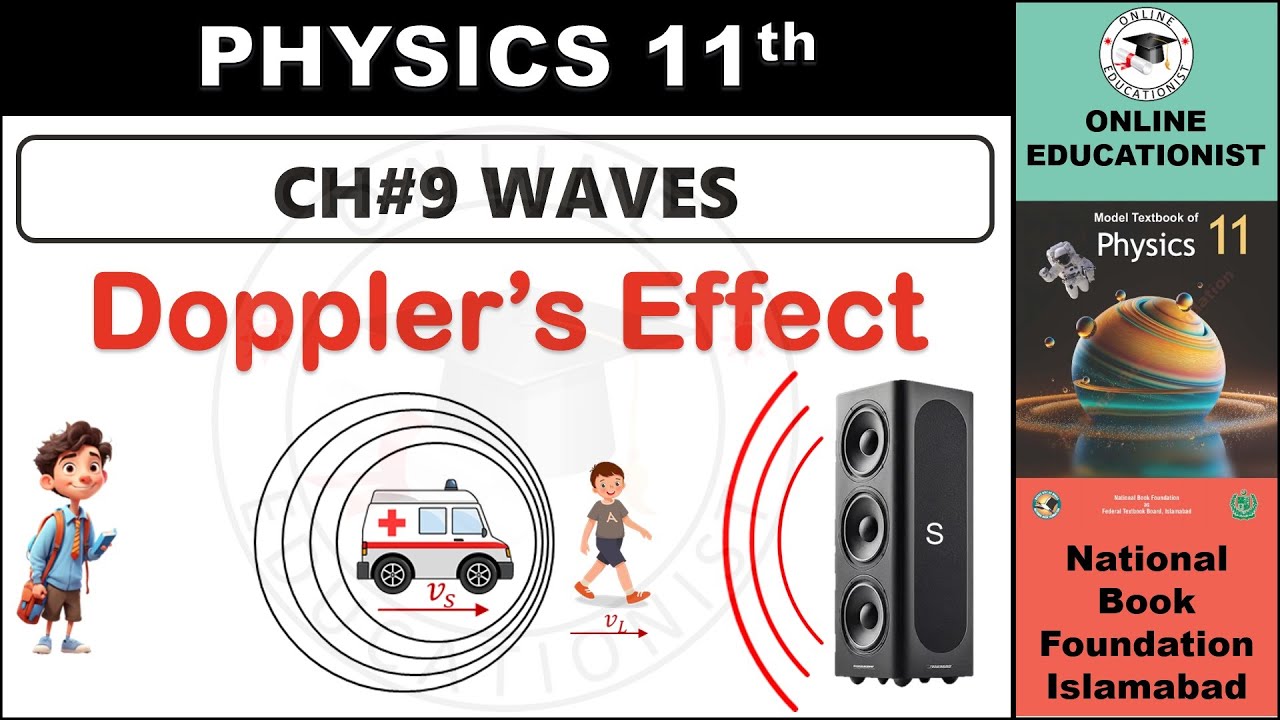
Doppler's Effect | Chapter 9 | Waves | Physics 11th | National Book Foundation | FBISE
Автор: Online Educationist
Загружено: 2024-12-18
Просмотров: 1079
Описание:
Click on the link below for latest videos.
https://whatsapp.com/channel/0029VaGr...
Two identical waves undergo pure constructive interference. Is the resultant intensity twice that of the individual waves? Explain your answer.
Circular water waves decrease in amplitude as they move away from where a rock is dropped. Explain why.
Differentiate between constructive and destructive interference?
The frequency of a stretched string depends on its length. Give two other factors that affect the frequency of a stretched string.
What are stationary waves? How are they produced?
The pitch of the sound emitted by the siren of a moving fire engine appears to change as it passes a stationary observer. (i) Name this phenomenon. (ii) Will the crew in the fire engine notice this phenomenon? Give a reason for your answer. (iii) Give an application of this phenomenon.
How should a sound source move with respect to an observer so that the frequency of its sound does not change?
Can sound waves be polarized? Explain
Suppose that light passes through two polaroid filters whose polarization axis are parallel to each other. What would be the result?
Give any three example of a gravitational wave?
What is an interferometer?
Consider the three pairs of sunglasses below. Which pair of the glasses is capable of eliminating the glare resulting from sunlight reflecting off the calm waters of a lake? Explain you option. (The polarization axes are shown by straight lines)
Ultrasound of intensity 1.50×〖10〗^2 〖W/m〗^2 is produced by the rectangular head of a medical imaging device measuring 3.00 by 5.00 cm. What is its power output?
Two tuning forks of frequencies 440Hz and 437Hz are sounded together. How many beats will be heard over a period of 10 seconds?
Suppose that a string is 1.2m long and vibrates in first, second and third harmonic standing wave patterns. Determine the wavelength of the waves for each of the three patterns.
The string is 6.0m long and is vibrating at the third harmonic. The string vibrates up and down with 45 complete vibrational cycles in 10 seconds. Determine the frequency, period, wavelength and speed for this wave.
An air column closed at one end resonates at the second maximum or the second resonant length. The frequency of the sound wave is 1024Hz. The air temperature is 18.6℃. (a) Draw a diagram for the displacement wave pattern inside the column. (b) Calculate the speed of sound in air. (c) Calculate the wavelength. (d) Calculate the length of the closed air column.
Suppose a train that has a 150Hz horn is moving at 35.0m/s in still air on a day when the speed of sound is 340m/s. What frequencies are obtained by a stationary person at the side of the tracks (a) as the train approaches (b) after it passes (c) What frequency is observed by the train’s engineer traveling on the train?
A polarized light of intensity 𝑰_𝒐 is passed through another polarizer whose axis makes an angle of 𝟔𝟎° with the axis of polaroid filter. What is the intensity of transmitted polarized light from second polaroid filter?
9.1 To increase intensity of a wave by factor of 50, by what factor should the amplitude be increased?
9.2 A bus is moving at 20m/s along a straight road with its 500Hz horn sounding. You are standing at the road side. What frequency do you hear as the bus is: a) Approaching you? b) Receding from you? (Take the speed of sound=340m/s)
9.3 A frequency of the first harmonic is 587Hz is sounded out by a vibrating guitar string. The speed of the wave is 600m/s. Find the length of the string.
9.4 What angle is required between the direction of polarized light and the axis of a polaroid filter to reduce its intensity by 90%?
1. What is superposition principle? Discuss.
2. What is interference? Discuss its types and corresponding conditions.
3. Discuss the phenomenon of beats.
4. What are stationary waves? How stationary wave is formed? Discuss.
5. Discuss the formation of stationary waves in (a) stretched string (b) open pipe (c) closed pipe.
6. What is meant by Doppler’s effect? Discuss its cases. Also give some application of the Doppler’s effect.
7. Describe an experiment to demonstrate that sound requires a medium to travel.
8. Describe an experiment to demonstrate the interference of sound.
9. What is polarization? How is plane polarized light produced and detected?
10. What is interferometer? Explain.
Повторяем попытку...
Доступные форматы для скачивания:
Скачать видео
-
Информация по загрузке: