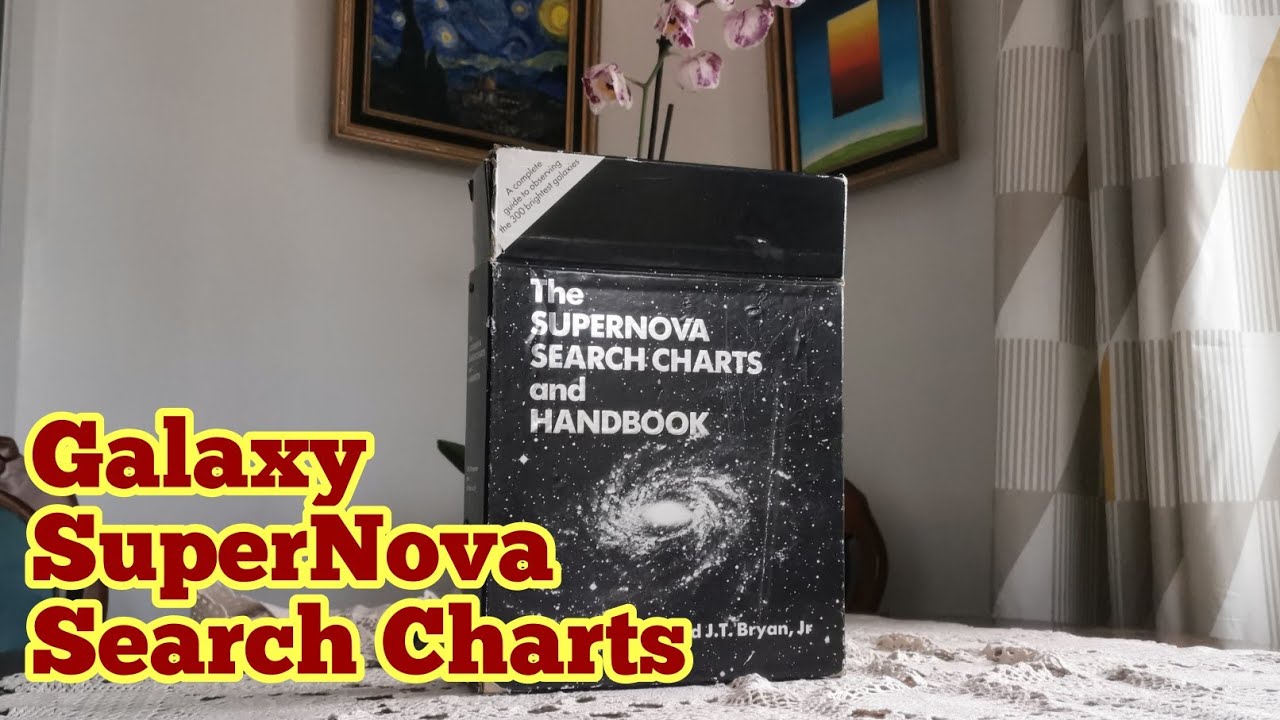
Supernova Search Charts And Handbook Of Late Maurice Gavin (nytecam)Discoverer Of Supernova SN2011AZ
Автор: Dr AstroGeoTech
Загружено: 2022-01-27
Просмотров: 63
Описание:
This unique atlas contains 248 charts of more than 300 of the brightest galaxies, each specially prepared to facilitate the discovery of supernovae. The comparison of these charts with the field seen in a telescope enables any extragalactic supernova to be spotted immediately. The charts include 345 galaxies printed on translucent paper for use on a light-box, each one carrying an explanation of the constellation in which the galaxy lies, special characteristics of the galaxy, observing instructions, expected maximum brightness for the supernovae in each galaxy, and the reference for the sequence. A handbook accompanies the charts advising on their use, on how to make and record supernova discoveries, and reviewing the present understanding of supernovae. Published for an international market, these charts carry real potential for numerous discoveries of supernovae. Supernova Search Charts are is a must for both serious observers and the growing number of deep sky enthusiasts around the world.
Review
'... a much needed addition to the library of the active observer who wishes to hunt for these most important objects.' Observatory
'... a mine of useful information and contains many hints on observing supernovae, as well as appendices on current supernova research.' Contemporary Physics
'… they are a valuable asset to the field of supernovae searching' Journal of the British Astronomical Association
In 1990 Gregg Thompson co-authored with James T. Bryan, Jr. the astronomical atlas The Supernova Search Charts and Handbook, containing 248 comparison charts of 345 of the brightest galaxies, highly valued especially by supernova hunters and recommended by the Supernova Search Committee of the American Association of Variable Star Observers. In 1993 he published The Australian Guide to Stargazing, a manual for both naked-eye and telescope observing of the sky of the southern hemisphere with explanatory diagrams, photographs and detailed drawings, describing the basics of the night sky observation to novice amateur astronomers.
DATE PUBLISHED: February 1990
FORMAT: Paperback
ISBN: 9780521267212
LENGTH: 154 pages
DIMENSIONS: 224 x 311 x 60 mm
WEIGHT: 3.35kg
CONTAINS: 248 b/w illus.
CHECK A POSSIBLE SUPERNOVA
By Juhani Salmi. Published by the author, Lahti, Finland, 1984. Forty photographs of galaxies on stiff cards, with index. Small format (145mmx105mm), spiral bound. Obtainable from The Webb Society, 9 Fairacres Close, Herne Bay, Kent, CT6 6LL. £3-65 post-paid.
Supernova hunting ought to be one of the most rewarding pursuits of amateur 'deep-sky' observers, and with the right approach, is a field where valuable information can be gathered. A few dedicated individuals-notably Robert Evans in Australia-have shown that successful discovery is well within the amateur's grasp, and yet few organized schemes seem to last more than a year or so. Why then, is supernova hunting not the popular sport it deserves to be? And why is success so rare?
One reason would seem to be that supernovae are pretty rare events themselves, and long sequences of 'nil returns have little appeal to the observer who hungers for immedi ate results. This, however, is probably an unjust verdict: amateur astronomers, as a rule, certainly do not lack the virtues of patience and persistence. Perhaps the greatest obstacle to success lies in the difficulty of identifying the 'intruder' in the field of the galaxy under observation; too often the supernova' turns out to be a faint foreground star which one has not mapped before.
The first requirement, then, is a clear and accurate chart of the galaxy in its normal, supernova-free state, and here lies the nub of the problem. Most photographs of galaxies, whether professional or amateur, are of long exposure, enhancing the faint nebulosity and thus tending to burn out the optically visible region with its attendant stellar images. The alternative is for each observer to draw his own field diagram for each galaxy in his list, but as anyone who has tried it knows, this is a task both tedious and liable to error. The best solution is obvious; the provision of galaxy photographs carefully exposed to leave the stars clear while still revealing the main nebulous features. The idea has been proposed before, but it is not all that easy to carry into effect, and great credit is due to Juhani Salmi for putting it into practice with conspicuous success.
The photographs were taken with a 305mm (12-inch) Newtonian reflector on 103a-O emulsion with exposures varying from 15 to 35 minutes of a selection of potentially supernova-productive galaxies in the magnitude range 4-6.
Повторяем попытку...
Доступные форматы для скачивания:
Скачать видео
-
Информация по загрузке: