Camille Corot - Paintings by Camille Corot in the National Gallery of Art, Washington, US.
Автор: Rollo Paterson - The Last Impressionist
Загружено: 2020-01-18
Просмотров: 1574
Описание:
Jean-Baptiste-Camille Corot - Paintings by Jean-Baptiste-Camille Corot in the National Gallery of Art (NGA), Washington D.C., US.
Jean-Baptiste-Camille Corot (French, Paris 1796-1875 Paris) was a French landscape and portrait painter as well as a printmaker in etching. He is a pivotal figure in landscape painting and his vast output simultaneously references the Neo-Classical tradition and anticipates the plein-air innovations of Impressionism.
Art and technique
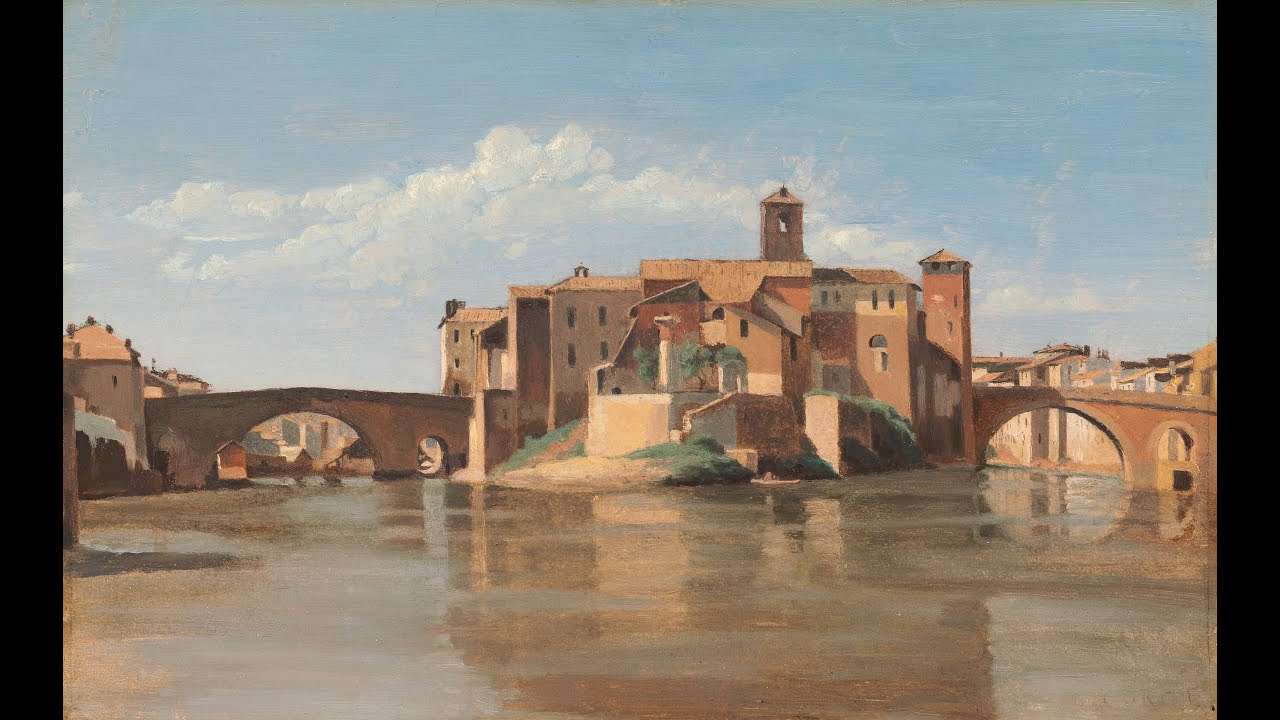
Corot is a pivotal figure in landscape painting. His work simultaneously references the Neo-Classical tradition and anticipates the plein-air innovations of Impressionism. Of him Claude Monet exclaimed in 1897, "There is only one master here—Corot. We are nothing compared to him, nothing." His contributions to figure painting are hardly less important; Degas preferred his figures to his landscapes, and the classical figures of Picasso pay overt homage to Corot's influence.
Historians have divided his work into periods, but the points of division are often vague, as he often completed a picture years after he began it. In his early period, he painted traditionally and "tight"—with minute exactness, clear outlines, thin brush work, and with absolute definition of objects throughout, with a monochromatic underpainting or ébauche. After he reached his 50th year, his methods changed to focus on breadth of tone and an approach to poetic power conveyed with thicker application of paint; and about 20 years later, from about 1865 onwards, his manner of painting became more lyrical, affected with a more impressionistic touch. In part, this evolution in expression can be seen as marking the transition from the plein-air paintings of his youth, shot through with warm natural light, to the studio-created landscapes of his late maturity, enveloped in uniform tones of silver. In his final 10 years he became the "Père (Father) Corot" of Parisian artistic circles, where he was regarded with personal affection, and acknowledged as one of the five or six greatest landscape painters the world had seen, along with Meindert Hobbema, Claude Lorrain, J.M.W. Turner and John Constable. In his long and productive life, he painted over 3,000 paintings.
Though often credited as a precursor of Impressionist practice, Corot approached his landscapes more traditionally than is usually believed. Compared to the Impressionists who came later, Corot's palette is restrained, dominated with browns and blacks ("forbidden colors" among the Impressionists), along with dark and silvery green. Though appearing at times to be rapid and spontaneous, usually his strokes were controlled and careful, and his compositions well-thought out and generally rendered as simply and concisely as possible, heightening the poetic effect of the imagery. As he stated, "I noticed that everything that was done correctly on the first attempt was more true, and the forms more beautiful."
Corot's approach to his subjects was similarly traditional. Although he was a major proponent of plein-air studies, he was essentially a studio painter and few of his finished landscapes were completed before the motif. For most of his life, Corot would spend his summers travelling and collecting studies and sketches, and his winters finishing more polished, market-ready works.[56] For example, the title of his Bathers of the Borromean Isles (1865–70) refers to Lake Maggiore in Italy, despite the fact that Corot had not been to Italy in 20 years. His emphasis on drawing images from the imagination and memory rather than direct observation was in line with the tastes of the Salon jurors, of which he was a member.
In the 1860s, Corot became interested in photography, taking photos himself and becoming acquainted with many early photographers, which had the effect of suppressing his painting palette even more in sympathy with the monochromic tones of photographs...
https://en.wikipedia.org/wiki/Jean-Ba...
Text & images:
https://www.nga.gov/
https://www.nga.gov/exhibitions/2018/...
https://es.wikipedia.org/wiki/Camille...
https://en.wikipedia.org/wiki/Jean-Ba...
https://commons.wikimedia.org/wiki/Ca...
https://commons.wikimedia.org/wiki/Ca...
https://commons.wikimedia.org/wiki/Ca...
The images are only being used for informational and educational purposes.
Music:
To use this music you are required to give credit to the musicians.
Middle Spring Spleen (Duet)
Middle Spring Spleen (Duet) by Martijn de Boer (NiGiD) (c) copyright 2015 Licensed under a Creative Commons Attribution Noncommercial (3.0) license. http://dig.ccmixter.org/files/NiGiD/5... Ft: The Alsajo Project
http://dig.ccmixter.org/files/NiGiD/5...
Повторяем попытку...
Доступные форматы для скачивания:
Скачать видео
-
Информация по загрузке: