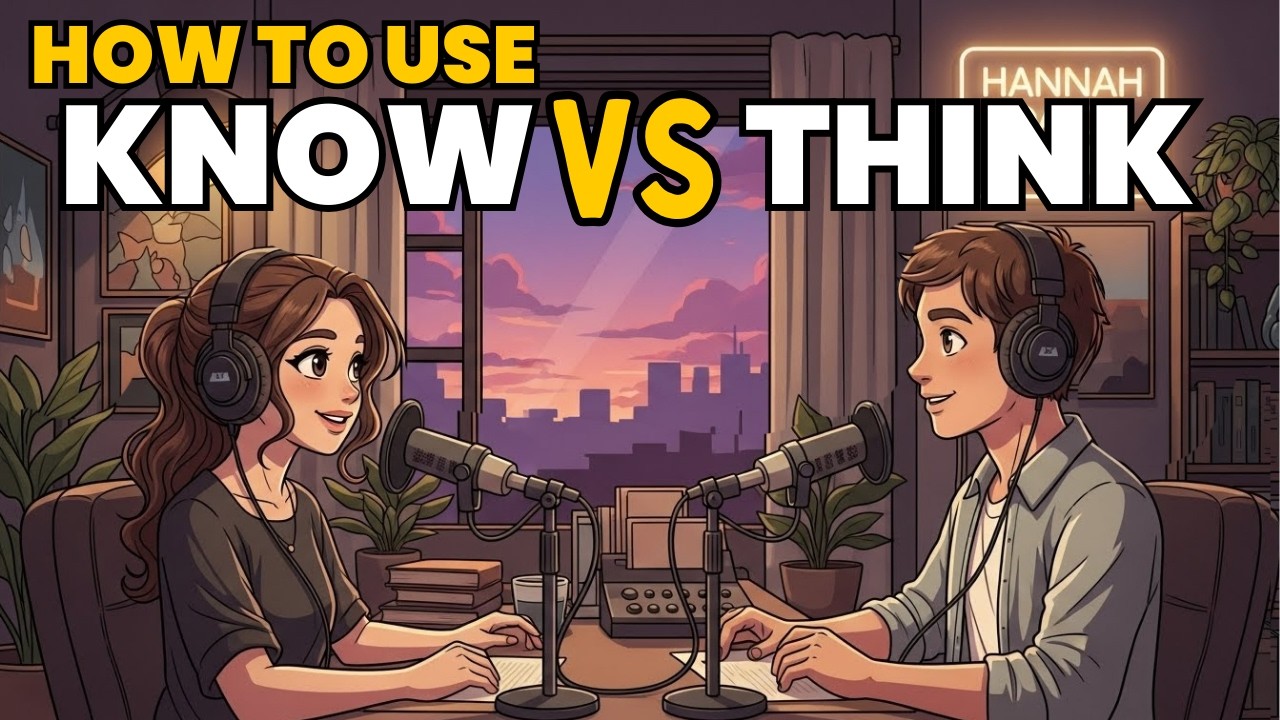
Learn English with Real Conversations Podcast | How to Use KNOW & THINK in English
Автор: Hannah Daily English
Загружено: 2026-02-16
Просмотров: 176
Описание:
Master the mental verbs that express everything from certainty to opinion! In this insightful and practical episode of the Hannah Daily English podcast, your hosts Hannah and James break down the essential difference between KNOW and THINK. Learn to express facts, beliefs, opinions, and uncertainty with the precision of a native speaker. ✨
Stop confusing "I know" with "I think" and sounding more certain than you intend. This lesson reveals the key principle: KNOW expresses certainty, facts, and familiarity, while THINK expresses opinions, beliefs, and less certainty. Master this distinction to communicate your level of confidence accurately in every conversation. 🎯
Join Hannah and James in a thoughtful, engaging conversation about facts, opinions, memories, and future plans. Through their natural back-and-forth, you'll hear how the choice between "know" and "think" completely changes the meaning of a sentence—and learn to make the same instinctive choices yourself. 🎧
🧠 IN THIS LESSON, YOU WILL MASTER:
✅ The Core Difference – Finally understand the fundamental distinction: KNOW = facts, certainty, familiarity (I know her name). THINK = opinions, beliefs, less certainty (I think it's a good idea).
✅ Grammar & Sentence Patterns – Master the structures: Know + that clause / noun / how to / about. Think + that clause / about / of.
✅ Common Questions & Responses – Learn natural question and answer patterns: "Do you know...?" "I don't know." "What do you think?" "I think so." "I don't think so."
✅ KNOW vs. THINK in Context – Compare: "I know he's coming" (fact, invitation confirmed) vs. "I think he's coming" (opinion, probably but not sure).
✅ Fixed Phrases & Idioms – Master expressions like "You know what?", "I know what you mean," "Come to think of it," "Think twice," "To be honest, I think..."
🌟 THE HANNAH DAILY ENGLISH METHOD:
🔹 Learn Through Mental Contrast – Absorb grammar by hearing the difference between certainty and opinion in real conversations.
🔹 Build Precision in Expressing Belief – Move from vague to specific in how you share your thoughts and knowledge.
🔹 Understand the Speaker's Confidence Level – Grasp why choosing "know" vs. "think" signals exactly how sure the speaker is.
🔹 Enjoy Clear, Thoughtful Explanations – We teach through comparison and contrast, making the distinction unforgettable.
🚀 PERFECT FOR:
✅ Beginner to Intermediate learners who want to express certainty and opinion accurately.
✅ Students and professionals who need to participate in discussions, share ideas, and report facts.
✅ Self-learners confused by when to use "I know" vs. "I think" in conversation.
✅ Anyone who wants to sound more natural and precise when sharing their thoughts and knowledge.
🎁 WHAT YOU WILL TAKE AWAY:
🎯 A clear mental framework for choosing between KNOW and THINK in any situation.
🎯 Confidence to express facts, opinions, and uncertainty with perfect accuracy.
🎯 Key phrases for daily conversation: "I know what you mean," "I don't know," "What do you think?", "I think so," "You know?"
🎯 The ability to understand the level of certainty in what others tell you.
🎯 More precise communication that helps you share exactly what you mean—no more, no less.
📌 Subscribe to Hannah Daily English for regular, thoughtful lessons that sharpen your ability to express ideas, opinions, and knowledge with clarity and confidence.
🔑 KEYWORDS FOR SEARCH:
learn english podcast, know vs think difference, expressing certainty and opinion, english mental verbs, real english conversations, everyday english phrases, common english mistakes, hannah daily english, hannah and james english, spoken english practice, learn english through podcasts, english listening practice podcast, english grammar lesson, know and think grammar, podcast for english learners, how to express opinions, facts vs beliefs english, conversational english, i know vs i think
#LearnEnglish #EnglishPodcast #HannahDailyEnglish #EnglishGrammar #KnowVsThink #MentalVerbs #RealEnglishConversations #EnglishLearning #ESLPodcast #SpeakingEnglish #EnglishPractice #LearnEnglishOnline #EnglishLesson #OpinionsAndFacts
Повторяем попытку...
Доступные форматы для скачивания:
Скачать видео
-
Информация по загрузке: