Money Talks: Deal or No Deal? The State Budget Surplus (and other education news)
Автор: Wisconsin ASBO (WASBO)
Загружено: 2026-02-27
Просмотров: 30
Описание:
This edition of Money Talks covers:
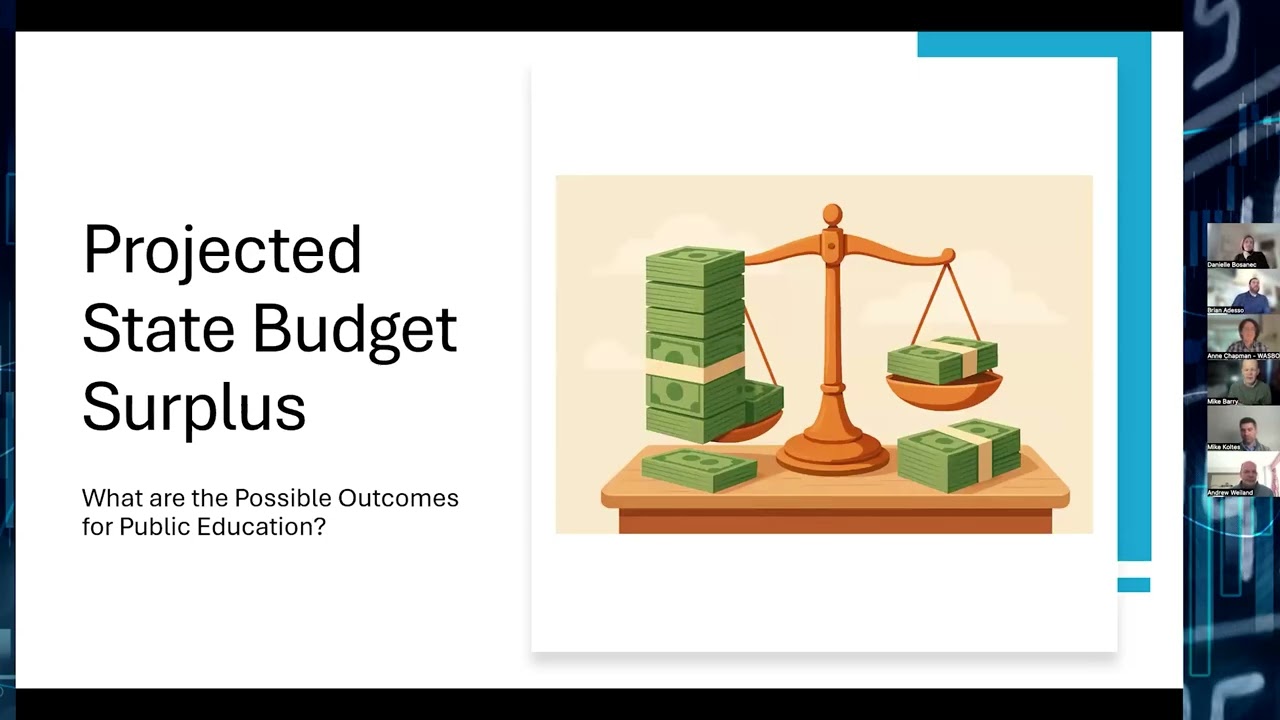
An update on the state's projected budget surplus and negotiations.
A new school funding lawsuit is based on adequacy.
A proposed constitutional amendment affecting the governor's veto power is on the ballot this November.
View the webinar handout: https://wasbo.com/images/wasbo/docume...
Your Money Talks Webinar hosts, Mike Barry, Andy Weiland, and Brian Adesso, were joined by guest speaker Anne Chapman, WASBO’s research director, on Friday morning for “Deal or No Deal,” the February 2026 Money Talks webinar.
The discussion centered on the state's projected $2.4 billion budget surplus and the tense negotiations surrounding its allocation. A key point of agreement between the Governor and legislative leaders is a proposed $200 million boost for special education aid. Meanwhile, so far, no agreement has been reached on using the funds for general aid, a school levy tax credit, or one-time income tax rebates. Because the state assembly recently adjourned without finalizing a deal, school districts are left facing uncertain special education reimbursement rates—currently projected around 35-38%, despite many districts budgeting for 40% or more. The panelists stressed that district leaders must prioritize filling these immediate budget holes before considering new spending or banking on one-time surplus funds.
The panel also broke down a new school funding lawsuit recently filed in Eau Claire County Court by five representative districts: Adams-Friendship, Beloit, Green Bay, Eau Claire, and Necedah. Drawing heavily on the precedent set by the 1999 Vincent v. Voight case, the plaintiffs argue that Wisconsin's current school finance system is unconstitutional in several ways. A principal shortcoming of the system is that it fails to provide adequate resources to students with disabilities, English learners, and students in poverty. The lawsuit asks the court to declare that Wisconsin's school finance system violates the Constitution. It then asks the court to enforce a timeline whereby the legislature adopts a policy that meets all relevant state constitutional guarantees. The hosts emphasized that this is a long-term legal process, but one that will require robust public awareness efforts, ultimately needed to support legislative reform.
Finally, the discussion covered a statewide constitutional amendment headed for the November 2026 ballot that would restrict the governor's partial veto authority. Specifically, the amendment would prevent any governor from using a veto to enact or increase taxes or fees, a direct legislative response to Governor Evers' prior use of his veto pen to extend a $ 325-per-pupil revenue increase for 400 years. The hosts noted that this amendment could fundamentally alter future budget negotiations and the balance of power in Madison.
Повторяем попытку...

Доступные форматы для скачивания:
Скачать видео
-
Информация по загрузке: