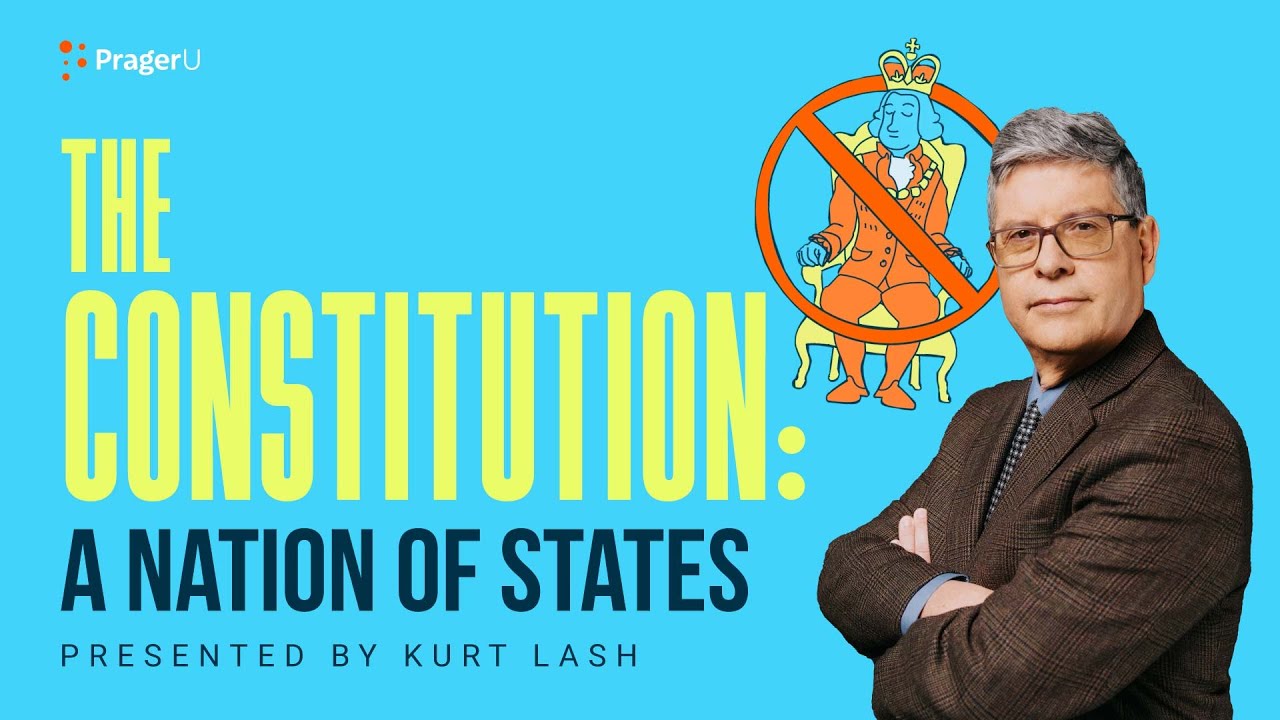
The Constitution: A Nation of States | 5-Minute Videos
Автор: PragerU
Загружено: 2023-01-16
Просмотров: 369452
Описание:
How did thirteen separate colonies become the United States of America? The answer is found in the second half of the American Constitution—Articles IV through VII. Kurt Lash, Professor of Law at the University of Richmond, explains.
SUBSCRIBE 👉 https://www.prageru.com/join
#constitution #america #prageru #history
Script:
The first half of the Constitution —Articles I, II and III — discuss the powers of the three branches of the national government. The second half of the Constitution — Articles IV through VII — discuss the relationship between the national government and the states.
These four articles don’t get the attention of the first three, but that doesn’t mean they’re any less important.
Let’s take a closer look.
First, Article IV.
When America won the Revolutionary War, the former English colonies became free and independent states—almost as if they were separate countries. But when those states later voted to ratify the federal Constitution, they became part of an indestructible union of states under a common national government, one in which all citizens were granted the same rights.
This seems obvious to us now, but it was new then. As Article IV affirms, “The Citizens of each State shall be entitled to all Privileges and Immunities of Citizens in the several States.”
This gets complicated -- as everything did at the time -- when the issue of slavery is raised.
Section Two of Article IV declares that “[N]o Person held to…Labour in one State…escaping into another, shall… be discharged from such…Labour, but shall be delivered up [to] the Party to whom such…Labour may be due.”
This is called the Fugitive Slave Clause, though the term “slave” is not used. In fact, you can’t find the word “slave” anywhere in the original Constitution. The Framers were wary about endorsing slavery even though, for political reasons — to keep the Southern states in the Union — they permitted it.
As James Madison explained, it would be “wrong to admit in the Constitution the idea that there could be property in men.”
Article V explains how the Constitution can be amended.
Changing a federal law is simple: it just takes a majority vote in Congress. This happens all the time. Changing the Constitution, however, is much more difficult. It takes a two-thirds majority vote in both the House and the Senate, or a special convention called for by two-thirds of the states.
The proposed amendment must then be ratified by three-quarters of the states.
This deliberately difficult two-stage process ensures that only those amendments with widespread support get to become part of the Constitution.
Article VI ensures that the Constitution is the “supreme Law of the Land.” In other words, every state must obey the Constitution and the laws of the federal government.
Before the Constitution was ratified in 1788, the new nation was organized under what were called the Articles of Confederation. But this governing document proved woefully inadequate. It had no chief executive, no federal court system, and no ability to collect taxes to support the national defense.
The new Constitution addressed all these problems. But it did so in a way that preserved the power of the states to control matters of local concern.
This division of power between the national government and the states is called federalism. Prior to the adoption of the American Constitution, nothing like it had existed in the history of the world. No nation had ever attempted to place these kinds of limits on a central government.
For this new federalist system to work, however, states had to agree to be bound by the new Constitution and federal law. Of course, federalism is a two-way street: Federal officials also had to accept the fact that their powers were limited and that the people in the states retained all powers and rights not constitutionally delegated to the federal government.
That’s why Article VI requires every official in the national government and in the states to take an oath “to support this Constitution.” The Constitution these officials swear to uphold is a federal Constitution of limited and divided power.
For the full script, visit: https://www.prageru.com/video/the-con...
Повторяем попытку...
Доступные форматы для скачивания:
Скачать видео
-
Информация по загрузке: