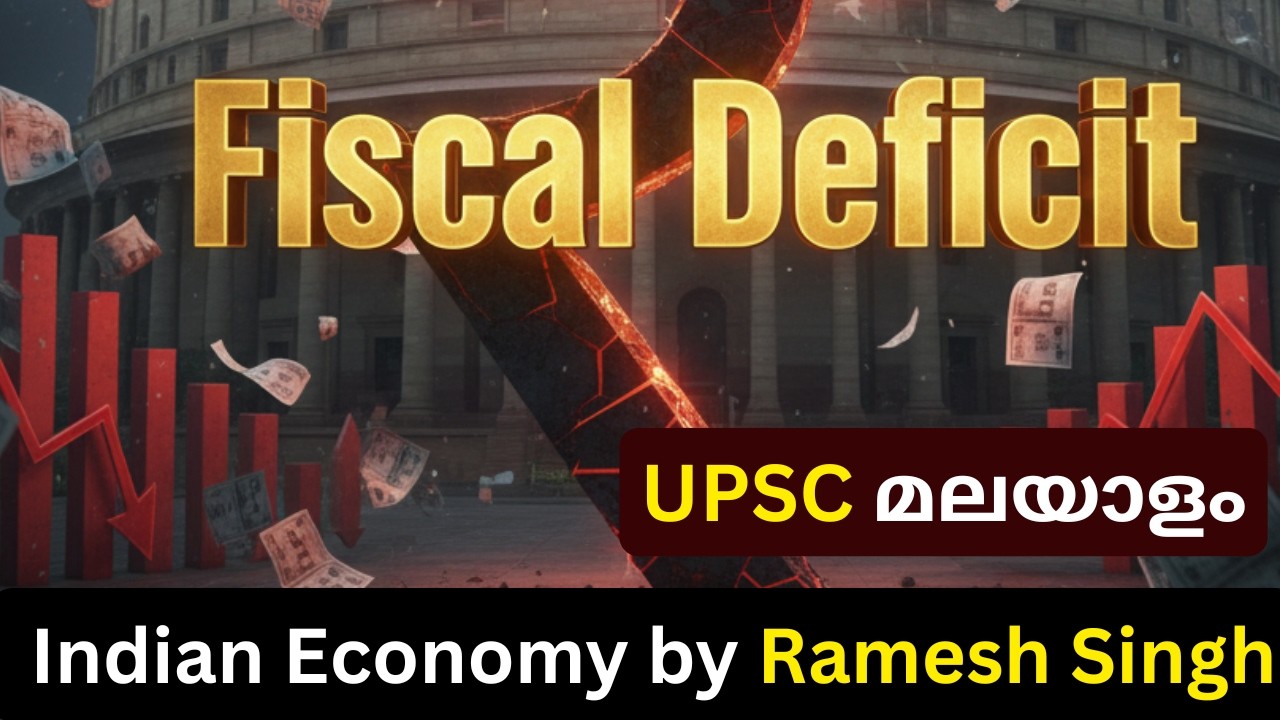
Fiscal Deficit Malayalam | Indian Economy by Ramesh Singh malayalam | UPSC / KERALA PSC
Автор: WE LEARN IAS MALAYALAM
Загружено: 2025-10-27
Просмотров: 132
Описание:
📘 Fiscal Deficit Explained Malayalam | UPSC Economics Malayalam | Fiscal Responsibility & Budget Management Malayalam
Welcome to another in-depth episode from Malayalam UPSC Masterclass, where we simplify the most complex economic concepts for aspirants of UPSC, KAS, and Kerala PSC in pure Malayalam.
Today’s topic is one of the most frequently asked and conceptually vital parts of the Indian Economy syllabus — Fiscal Deficit (ധനകാര്യ കുറവ്).
In this detailed Malayalam economics explanation, we explore:
🔹 What is Fiscal Deficit?
🔹 Why it matters for India’s economic health?
🔹 How it is calculated using government expenditure and receipts?
🔹 And why the FRBM Act plays a key role in controlling it.
💡 Concept Simplified for UPSC Malayalam Aspirants
Fiscal Deficit (FD) is not just a number — it represents how much the government needs to borrow to meet its total expenditure in a financial year.
It’s the gap between what the government earns (revenue receipts + non-debt capital receipts) and what it spends (total expenditure).
Formula:
🧮 Fiscal Deficit = Total Expenditure – (Revenue Receipts + Non-debt Capital Receipts)
Through this Malayalam economics explanation, you’ll understand that Fiscal Deficit reflects the borrowing requirement of the government — and hence, it’s a crucial indicator of India’s fiscal health.
📊 Key Components Covered in This Malayalam Lecture
1️⃣ Total Expenditure – includes both revenue and capital expenditure.
2️⃣ Revenue Receipts – government income from taxes and non-tax sources.
3️⃣ Non-debt Capital Receipts – recoveries of loans and disinvestment proceeds.
You’ll also learn about the difference between Gross Fiscal Deficit (GFD) and Net Fiscal Deficit (NFD) — an area many aspirants often confuse during exams.
⚖️ FRBM Act & Fiscal Discipline Explained
The Fiscal Responsibility and Budget Management (FRBM) Act was enacted to promote fiscal prudence and sustainable macroeconomic management.
In 2018, the Act was amended to set a Fiscal Deficit target of 3% of GDP by 2020–21 — a benchmark that reflects fiscal stability and discipline.
The purpose of the FRBM Act is to:
✔ Maintain fiscal discipline.
✔ Prevent unsustainable borrowing.
✔ Promote long-term macroeconomic stability.
You’ll also understand how deviations from this target impact India’s credit ratings, inflation levels, and growth potential — all in simple Malayalam explanations with real-life examples.
💰 Types of Fiscal Deficit Covered
(a) Gross Fiscal Deficit (GFD):
Represents the total borrowing requirement of the Union Government during a financial year.
(b) Net Fiscal Deficit (NFD):
Calculated by subtracting loans given to states and PSUs from GFD.
Formula:
Net Fiscal Deficit = Gross Fiscal Deficit – Loans to States/PSUs
This distinction helps in understanding the real borrowing burden that affects the central government directly.
📉 Fiscal Deficit Trends in India (2010–2020)
The video also discusses decade-long fiscal data — from 4.8% in 2010–11 to 3.4% in 2019–20 — showing how India gradually improved fiscal management through the FRBM framework.
You’ll see how the deficit narrowed due to increased revenue efficiency, digital governance, and prudent expenditure management, helping India maintain global investor confidence.
🎯 Why This Topic Matters for UPSC Malayalam Students
For UPSC Prelims, Mains, and Interview, Fiscal Deficit is a core recurring concept under Indian Economy.
Questions often revolve around:
Definition and Formula of Fiscal Deficit
Difference between Gross and Net Fiscal Deficit
FRBM Act Targets (3% Rule)
Recent Fiscal Policy Trends in India
Understanding this concept strengthens your foundation in topics like Public Finance, Budget, and Economic Policy, which directly connect to GS Paper III and Economic Survey sections.
📚 Summary Recap for UPSC Notes
Fiscal Deficit = Total Borrowing Requirement
It shows how much expenditure exceeds revenue.
High Fiscal Deficit → More Borrowing → Higher Debt Burden
Low Fiscal Deficit → Economic Stability → Fiscal Discipline
FRBM Act (2018) aimed to reduce deficit to 3% of GDP by 2020–21.
Types: Gross vs Net Fiscal Deficit.
This Malayalam economics explanation gives you a complete conceptual, analytical, and current affairs-oriented view of the topic — perfect for UPSC Malayalam preparation, Kerala PSC, and other Civil Services exams.
🧠 Who Should Watch This Video:
UPSC Malayalam aspirants preparing Indian Economy for Prelims & Mains
Kerala PSC and KAS students focusing on Economics
College students seeking clear, exam-oriented understanding
#upscmalayalam #indianeconomymalayalam #fiscaldeficitmalayalam #frbmactmalayalam #upscnotesmalayalam #economicspdfmalayalam #malayalameconomicslecture #keralapscmalayalam #kasmalayalam #budgetmalayalam #indianbudgetmalayalam #publicfinance #upscprelimsmalayalam #upscmainseconomics #civilservicesmalayalam #economyclassmalayalam #iasmalayalam #upsc2025malayalam
Повторяем попытку...
Доступные форматы для скачивания:
Скачать видео
-
Информация по загрузке: