India’s Defence Paradox: Military Giant, Arms Importer
Автор: Study Pathshala
Загружено: 2026-06-09
Просмотров: 7490
Описание:
India’s defense numbers show a clear paradox: it is becoming a major military power while still relying heavily on foreign arms for advanced capability gaps. The data suggest not weakness, but a transitional phase in India’s military modernization.
What the numbers mean
India spent $92.1 billion on defense in 2025, up 8.9% year on year, and remained the world’s fifth-largest military spender, behind the U.S., China, Russia, and Germany. It also stayed the second-largest importer of major arms in 2021–25, with 8.2% of global imports, while Pakistan ranked fifth with 4.2%. That combination means India is investing aggressively in security while still depending on imports for high-end systems.
Strategic logic : This is best understood as a dual-track defense model: buy what is urgently needed, and build what can be indigenized over time.
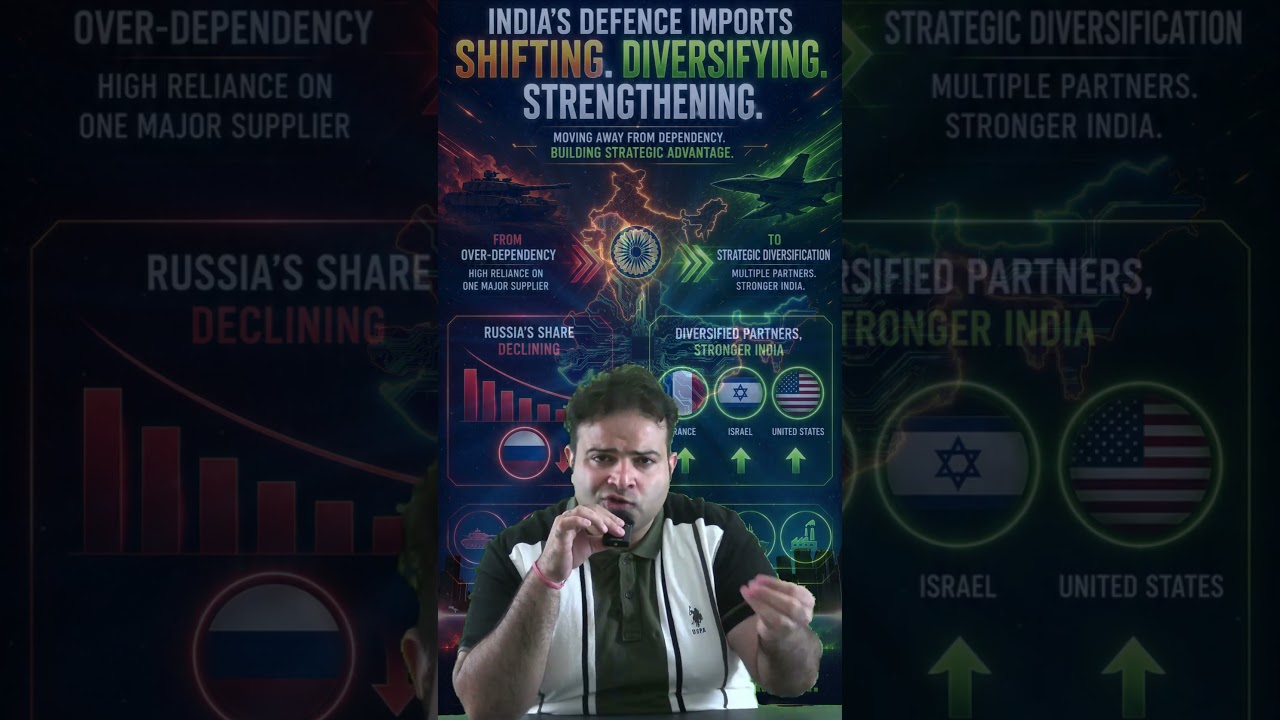
India’s imports are increasingly shifting away from one dominant supplier toward a more diversified mix, especially France, Israel, and the United States, while Russia’s share has declined. That reduces dependence on any single foreign source and gives India more room to manage supply shocks and sanctions risk.
Why imports still remain high High imports usually reflect three things: immediate operational needs, long procurement cycles in domestic industry, and the fact that some cutting-edge capabilities are still easier to buy than to build quickly.
SIPRI-linked reporting also notes that India’s imports fell slightly between 2016–20 and 2021–25 because domestic production capacity is growing, but delays in production still keep imports relevant. So this is not a contradiction; it is the cost of modernizing a large military under real regional threats.
India’s bigger message The broader signal is that India is trying to become both a security consumer and a security producer. Defense exports crossed $4 billion in 2025–26, showing that domestic industry is gaining traction even as imports remain substantial. In other words, India is not simply buying more weapons; it is trying to move up the defense value chain.
Geopolitical reading For your analysis angle, the strongest takeaway is this: India’s spending is driven by a neighborhood shaped by China’s military rise, Pakistan-linked instability, and long-term maritime competition. So the imports are not a sign of strategic drift; they are a response to time pressure, deterrence needs, and capability gaps that cannot wait for full indigenous replacement. The endgame is strategic autonomy,
Повторяем попытку...
Доступные форматы для скачивания:
Скачать видео
-
Информация по загрузке: