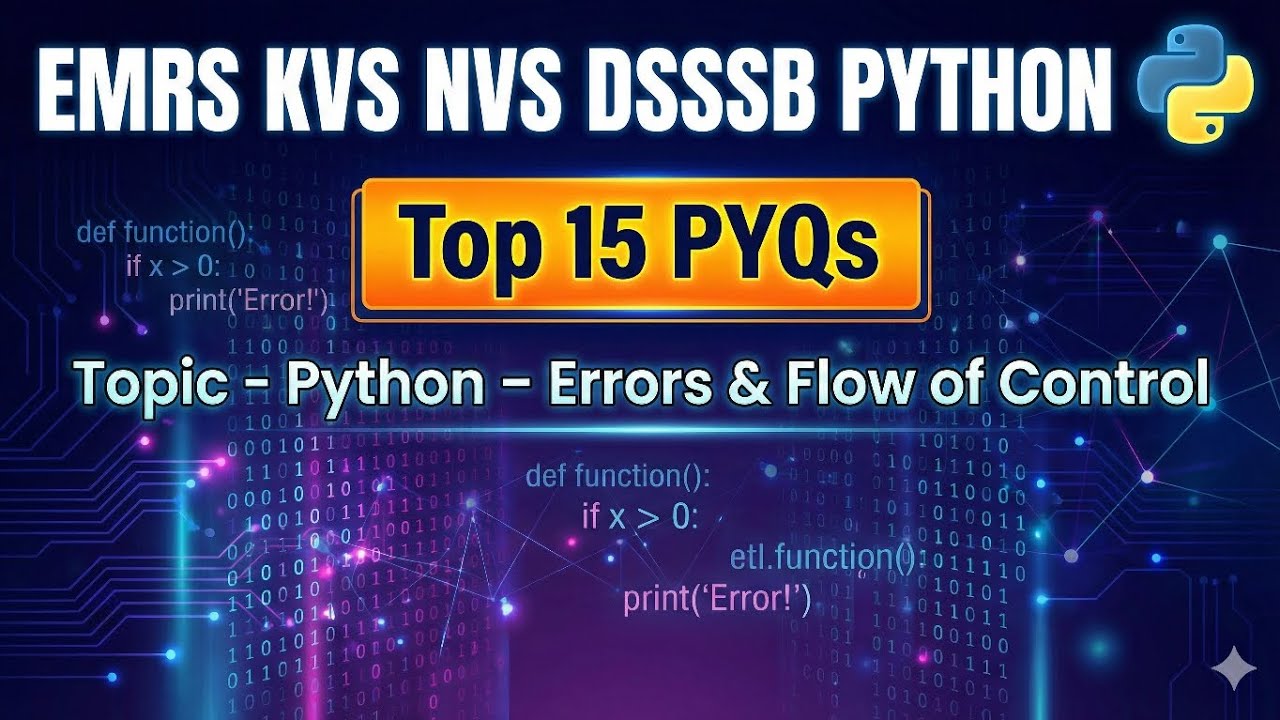
Unit 12 | Dictionary in Python 📚 | PYTHON TOP 15 PYQ Series ✨ |
Автор: EMRS Prep Bytes
Загружено: 2026-02-21
Просмотров: 4
Описание:
Welcome back, TGT & PGT Computer Science aspirants!
Today, we are unlocking one of the most powerful and widely used data structures in Python: Dictionaries.
While Lists and Tuples are indexed by numbers, Dictionaries are indexed by Keys. Understanding this Key-Value mapping is absolutely critical for competitive exams, as questions frequently test your knowledge on dictionary mutability, valid key types (hashing), and output prediction using various dictionary methods.
This complete masterclass covers everything you need to know about Python Dictionaries, strictly strictly aligned with your exam syllabus!
📘 What We Cover in This Video:
We break down dictionaries from basic syntax to advanced built-in functions:
✅ Dictionary Fundamentals:
Introduction: What is a dictionary? Understanding the {key: value} syntax.
Accessing Items: How to retrieve values using keys (and avoiding KeyError).
Mutability: Dictionaries are mutable! Learn how to add new key-value pairs and modify existing ones dynamically.
✅ Traversing a Dictionary:
Iterating through dictionaries using for loops.
Extracting just keys, just values, or both simultaneously.
✅ The Complete Dictionary Toolkit (Built-in Functions & Methods):
We provide a detailed walkthrough with practical code snippets for every essential method:
Core Functions: len(), the dict() constructor.
Extraction Methods: keys(), values(), and items().
Safe Access & Updates: get() (the safest way to access elements), update(), and setdefault().
Deletion Methods: del(), clear(), pop() (removes specific key), and popitem() (removes the last inserted pair).
Creation & Duplication: fromkeys(), copy().
Utility/Math: max(), min(), sorted(). (Note: We also clarify how counting logic works with dictionaries, as dicts don't have a direct .count() method like lists!)
✅ Suggested Practical Programs (Exam Focus):
We apply theory to practice by solving standard exam-favorite algorithms:
Character Frequency Counter: Writing a program to count the exact number of times each character appears in a given string using a dictionary.
Employee Database: Creating a dictionary to store Employee Names (Keys) and their Salaries (Values), and demonstrating how to access and update them.
🎯 Exams Covered:
EMRS TGT Computer Science
KVS PGT & TGT CS
NVS TGT Computer Science
DSSSB TGT Computer Science
Various State SET/TET exams for Computer Science.
🔗 Important Links & Resources:
📺 Full Python Playlist for Teaching Exams (EMRS/KVS/DSSSB):
[ • EMRS Python TGT PGT Computer Science
👍 Support Your Preparation:
If this session helped you conquer Python Dictionaries, please hit the LIKE button and SHARE it with your study groups. SUBSCRIBE to the channel to ensure you don't miss our upcoming practice sessions on Python Data Structures!
Quick Question for You: What happens if you try to use a mutable data type (like a List) as a Key in a Python Dictionary? Let me know your answer in the comments below!
#Hashtags:
#PythonDictionary #PythonDict #KeyValuePairs #PythonProgramming #EMRSComputerScience #KVSExams #NVS #DSSSBCompSci #TGTComputerScience #PGTComputerScience #CSExamPrep
Повторяем попытку...
Доступные форматы для скачивания:
Скачать видео
-
Информация по загрузке: