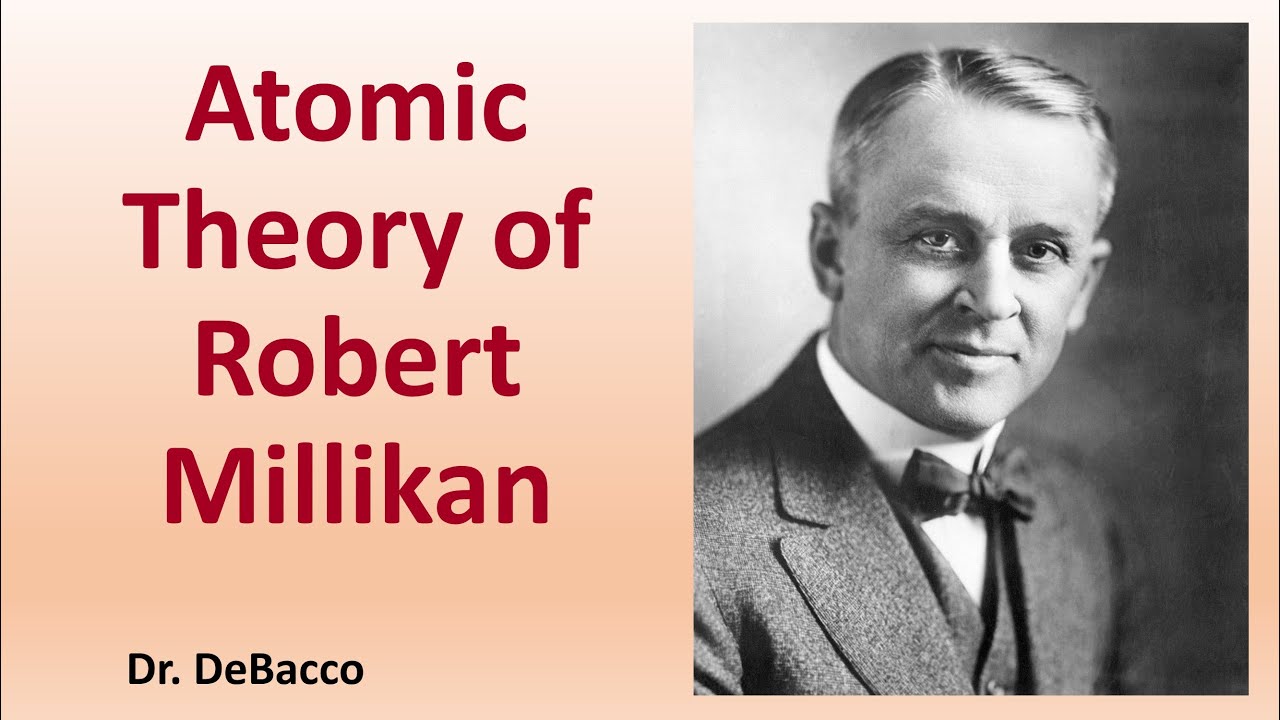
Atomic Theory of Robert Millikan
Автор: DeBacco University
Загружено: 2025-08-13
Просмотров: 518
Описание:
Atomic Theory of Robert Millikan
Dr. DeBacco
Context and Development of Millikan’s Atomic Theory
Robert Andrews Millikan (1868–1953), determined the charge of the electron with unprecedented precision.
Thomson’s Electron Discovery (1897): J.J. Thomson discovered the electron and measured its charge-to-mass ratio (e/m), establishing it as a negatively charged subatomic particle.
However, the exact charge and mass were unknown, prompting further investigation.
Rutherford’s Nuclear Model (1911): Ernest Rutherford’s model proposed a dense, positively charged nucleus with orbiting electrons, raising questions about the electron’s properties and role in atomic structure.
Charge Quantization: Early 20th-century physicists suspected that electric charge was quantized (existing in discrete units).
But no precise measurement of the fundamental unit of charge existed.
Experimental Advances: Improvements in experimental techniques, such as precise measurement tools and vacuum systems, enabled Millikan to design his oil-drop experiment, building on earlier attempts by others like H.A. Wilson to measure electron charge.
Millikan Oil-Drop Experiment
Oil-Drop Experiment: Millikan sprayed tiny oil droplets into a chamber, allowing them to acquire electric charge (via friction or ionization).
He balanced the gravitational force on the droplets with an electric field, measuring their motion to calculate the charge they carried.
By observing many droplets, he found that their charges were always multiples of a single value, indicating a fundamental unit of charge.
Breakdown of Millikan Atomic Theory
Electron Charge Measurement: Millikan determined the electron’s charge to be approximately -1.602 × 10⁻¹⁹ coulombs, a value remarkably close to the modern accepted value.
This confirmed that electric charge is quantized, with the electron’s charge as the smallest unit.
Support for Subatomic Structure: By quantifying the electron’s charge, Millikan supported Thomson’s discovery of the electron as a fundamental particle and provided data to refine Rutherford’s nuclear model, where electrons orbit a positively charged nucleus.
Breakdown of Millikan Atomic Theory
Mass Calculation: Millikan calculated the electron’s mass as approximately 9.109 × 10⁻³¹ kg
This confirmed the extremely small size of the electron compared to the atom.
Implications for Atomic Theory: Millikan’s work clarified the electron’s role in balancing the nucleus’s positive charge
Reinforcing the idea that atoms are composed of discrete subatomic particles.
Modern Atomic Theory vs. Millikan:
Electron Role: Modern theory uses Millikan’s electron charge as a constant in calculations for electron-nucleus interactions and chemical bonding, described via quantum orbitals.
Nuclear Structure: The modern model includes protons and neutrons (from Rutherford and Chadwick)
Which Millikan’s work didn’t address but supported indirectly through charge balance.
Quantum Framework: Modern theory relies on quantum mechanics
Unlike Millikan’s classical approach, to explain electron behavior and nuclear forces.
Applications: Millikan’s electron charge is fundamental to modern physics, from quantum electrodynamics to practical technologies like particle accelerators.
Link to Lecture Slides: https://drive.google.com/file/d/1YeDZ...
*Due to the description character limit the full work cited for "Atomic Theory of Robert Millikan" can be viewed at... https://docs.google.com/document/d/1y...
Повторяем попытку...
Доступные форматы для скачивания:
Скачать видео
-
Информация по загрузке: