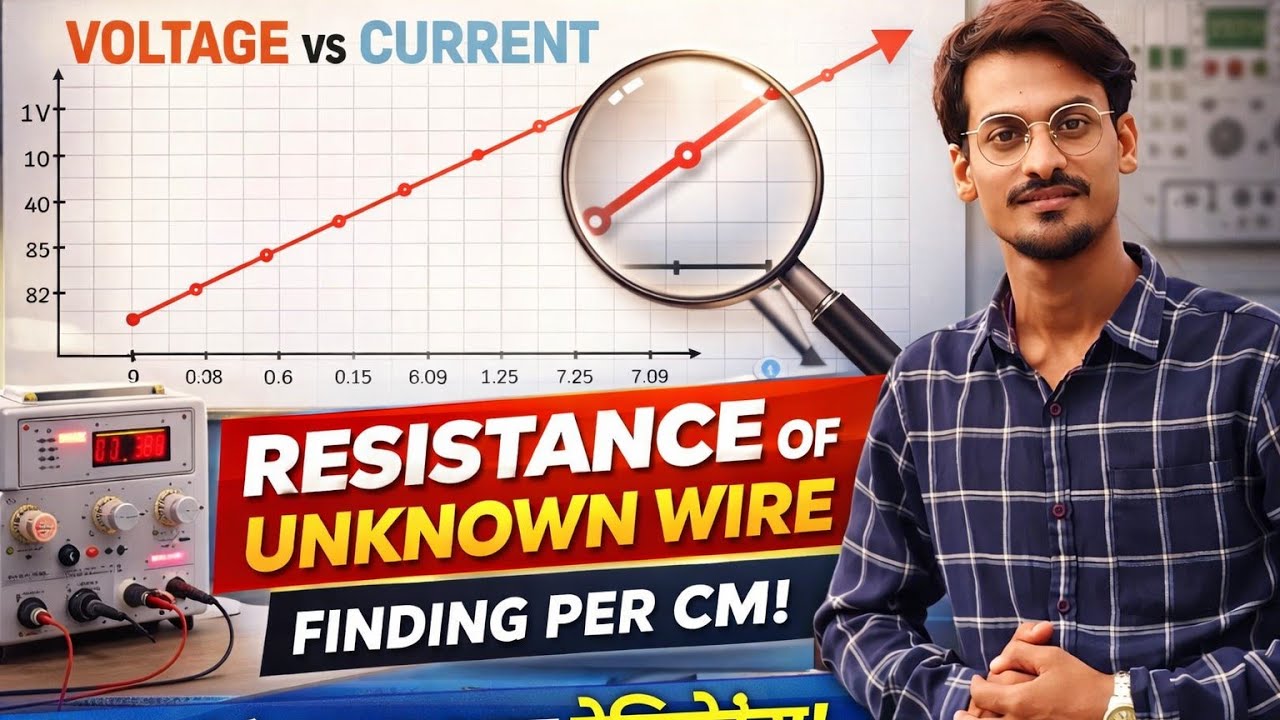
Ohm’s Law Practical | To Determine Resistance of Unknown Wire by V-I Graph | Class 12
Автор: maaz tarique
Загружено: 2026-01-07
Просмотров: 608
Описание:
📌 MOST IMPORTANT VIVA QUESTIONS..
🔹 A. Basic & Conceptual Questions (1–10)
Q1. What is Ohm’s Law?
Ans: Ohm’s Law states that the current through a conductor is directly proportional to the potential difference across it, provided temperature remains constant.
Q2. Write the mathematical form of Ohm’s Law.
Ans: V = IR
Q3. What do V, I and R represent in V = IR?
Ans: V = Voltage, I = Current, R = Resistance.
Q4. Under what condition is Ohm’s Law valid?
Ans: When the physical conditions like temperature remain constant.
Q5. What is resistance?
Ans: Resistance is the opposition offered by a conductor to the flow of electric current.
Q6. What is the SI unit of resistance?
Ans: Ohm (Ω).
Q7. What is the SI unit of current?
Ans: Ampere (A).
Q8. What is voltage?
Ans: Voltage is the potential difference between two points in an electric circuit.
Q9. What is the SI unit of voltage?
Ans: Volt (V).
Q10. Define one ohm.
Ans: One ohm is the resistance of a conductor when a potential difference of 1 volt produces a current of 1 ampere.
🔹 B. Apparatus & Instruments (11–20)
Q11. Name the apparatus used in this experiment.
Ans: Ammeter, voltmeter, rheostat, DC power supply, unknown wire, plug key and connecting wires.
Q12. What is the function of an ammeter?
Ans: It measures electric current.
Q13. What is the function of a voltmeter?
Ans: It measures potential difference.
Q14. Why is the ammeter connected in series?
Ans: Because it measures the same current flowing through the circuit.
Q15. Why is the voltmeter connected in parallel?
Ans: Because it measures the potential difference across the conductor.
Q16. What is the use of a rheostat?
Ans: To vary the current in the circuit.
Q17. What is the function of a plug key?
Ans: To make or break the electric circuit.
Q18. Why is DC supply used?
Ans: To obtain steady and unidirectional current.
Q19. What type of wire is used as unknown resistance?
Ans: Nichrome or manganin wire.
Q20. Why should connecting wires have low resistance?
Ans: To minimize error in measurement.
🔹 C. Graph & Calculation Based (21–30)
Q21. Which graph is plotted in this experiment?
Ans: Voltage versus Current (V–I) graph.
Q22. What is the nature of the V–I graph?
Ans: A straight line passing through the origin.
Q23. Why is the V–I graph a straight line?
Ans: Because voltage is directly proportional to current.
Q24. What does the slope of the V–I graph represent?
Ans: Resistance of the wire.
Q25. How is resistance calculated from the graph?
Ans: Resistance = Slope = V / I.
Q26. Which quantity is plotted on the X-axis?
Ans: Current.
Q27. Which quantity is plotted on the Y-axis?
Ans: Voltage.
Q28. How do you calculate resistance per centimetre?
Ans: Resistance per cm = Total resistance / Length of wire.
Q29. What happens to resistance if length increases?
Ans: Resistance increases.
Q30. What happens to resistance if temperature increases?
Ans: Resistance increases for metallic conductors.
🔹 D. Precautions, Errors & Result (31–40)
Q31. Mention one important precaution.
Ans: The key should be closed only while taking readings.
Q32. Why should current not be passed for a long time?
Ans: To avoid heating of the wire.
Q33. What is the effect of heating on resistance?
Ans: Resistance increases.
Q34. What is zero error?
Ans: Error when the instrument does not show zero at no input.
Q35. What are the sources of error in this experiment?
Ans: Heating effect, least count error, and loose connections.
Q36. Why should tight connections be ensured?
Ans: To avoid fluctuation in readings.
Q37. What is the result of this experiment?
Ans: The resistance of the given unknown wire per centimetre is determined.
Q38. When does Ohm’s Law fail?
Ans: At high temperature or in non-ohmic conductors.
Q39. Give two non-ohmic devices.
Ans: Diode and filament lamp.
Q40. State one application of Ohm’s Law.
Ans: It is used to calculate current, voltage or resistance in electrical circuits.
#PhysicsPractical
#CBSEPhysics
#CBSEBoard
#Class12Physics
#Class10Physics
#PhysicsLab
#VIGraph
#OhmsLaw
#ResistanceOfWire
#PracticalExam
#BoardExam2026
#CBSEPractical
#PhysicsExperiment
#SchoolLab
#ScienceStudents
#ExamReady
#CBSETips
#PhysicsShorts
#EducationReels
#StudyReels
Повторяем попытку...
Доступные форматы для скачивания:
Скачать видео
-
Информация по загрузке: