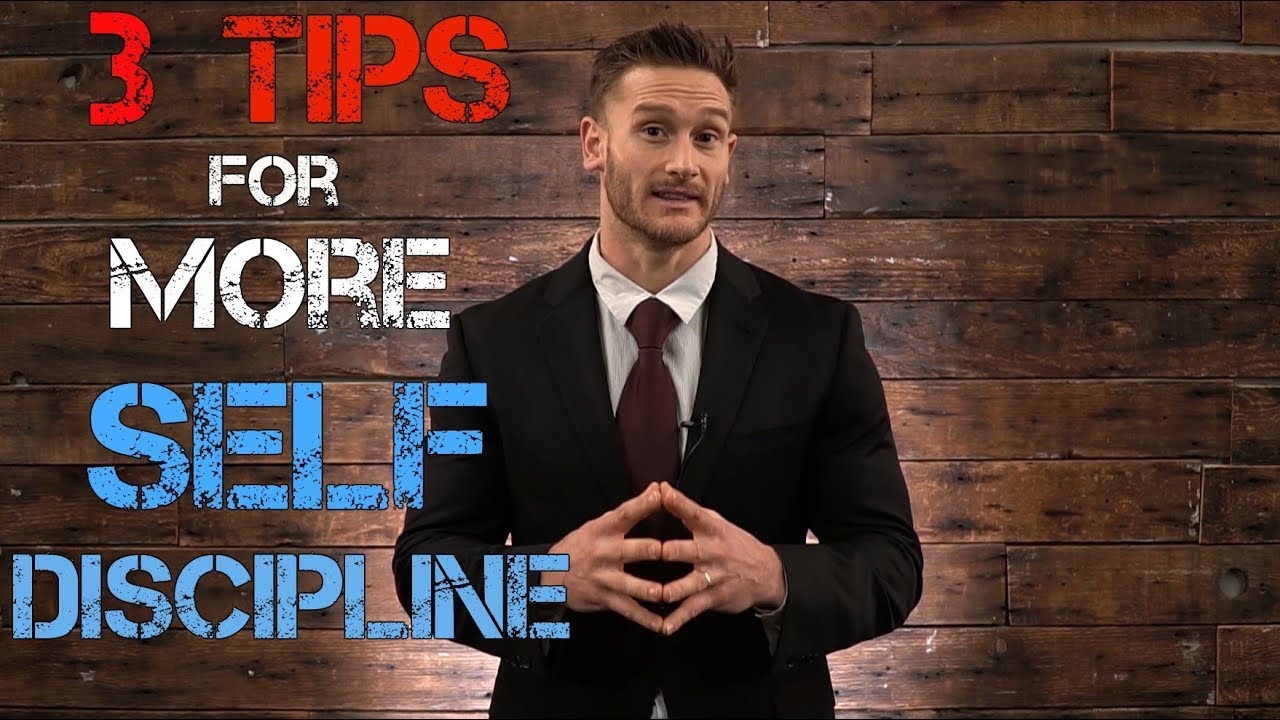
Improve Your Self Discipline with 3 Psychology Tips
Автор: Thomas DeLauer
Загружено: 2018-01-08
Просмотров: 139228
Описание:
Please Subscribe for 3-4x Videos Per Week + Live Broadcasts!
http://ThomasDeLauer.com
Improve Your Self Discipline with 3 Psychology Tips
1) Don’t wait for it to “feel right.” (Charles Duhigg, author of The Power of Habit)
Habit behaviors are traced to a part of the brain called the basal ganglia - a portion of the brain associated with emotions, patterns, and memories
Decisions, on the other hand, are made in the prefrontal cortex (section of the brain right behind your forehead), a completely different area
Embrace the wrong and acknowledge that it will take a while for your new regime to feel right (1,2)
Called the habit loop - a behavior becomes automatic, the decision-making part of your brain goes into a sleep mode of sorts.
Prefrontal Cortex & Sleep
Sleep deprivation hits the prefrontal cortex is hard, and it loses control over the regions of the brain that create cravings and the stress response
One of the most acclaimed sleep researchers, Daniel Kripke, found in a study that "people who sleep between 6.5 hours and 7.5 hours a night, live the longest, are happier, and most productive."
When the sleep-deprived catch a better night's sleep, their brain scans no longer show signs of prefrontal cortex impairment (3,4)
2) Set Clear Goals (SMART Goals)
The more specific the goal, the better able people are to reach it-
a highly abstract goal may not be actionable
SMART is a mnemonic acronym, giving criteria to guide in the setting of objectives - has suffered from acronym drift, but the most common definition is Specific, Measurable, Achievable, Realistic, and Time-based (5)
Goal Setting and the Brain
The human brain can’t tell the difference between what we want and what we have, so setting a goal invests ourselves into the target as if we’d already accomplished it
By setting something as a goal, however small or large, however near or far in the future, a part of our brain believes that desired outcome is an essential part of who we are
Brain & Rewards
With every achievement along the path to meeting our goal, our body releases dopamine into our brains, creating a sense of pleasure, which keeps us focused and motivated - we physically feel good when we’re taking steps towards our goals
Conversely, if you fail to meet your goals, your brain will have the opposite effect - failure to meet a goal means the dopamine supply gets cut off. (6,7)
3) The Why & How Mindsets
“Why” questions encourage long-term thinking, or desirability of pursuing an action; in contrast, “How” questions bring the mind down to the present and consider a goal’s attainability or feasibility (8)
References
1) Habits: How They Form And How To Break Them. (2012, March 5). Retrieved from https://www.npr.org/2012/03/05/147192...
2) Cohen, J. (2015, April 6). 5 Proven Methods For Gaining Self Discipline. Retrieved from https://www.forbes.com/sites/jennifer...
3) 6 Ways to Develop Greater Willpower and Discipline. (2017, July 11). Retrieved from https://www.inc.com/jeff-haden/the-sc...
4) How Much Sleep Do We Really Need to Work Productively? (2012, August 8). Retrieved from https://blog.bufferapp.com/how-much-s...
5) http://www.hr.virginia.edu/uploads/do...
6) The Psychology of Goal Setting. (2014, December 16). Retrieved from https://blog.rjmetrics.com/2014/12/16...
7) The Science of Setting Goals. (2008, July 7). Retrieved from http://www.lifehack.org/articles/feat...
8) 10 Strategies for Developing Self-Control. (2017, March 25). Retrieved from https://www.psychologytoday.com/blog/...
Повторяем попытку...
Доступные форматы для скачивания:
Скачать видео
-
Информация по загрузке: