Langlais : Hommage à Rameau, Op.134
Автор: D'Arcy Trinkwon # Virtuoso Organ Music
Загружено: 2025-01-20
Просмотров: 175
Описание:
Jean Langlais’ Homage to Rameau has had two incarnations.
In the early ‘60s the French Minister of Culture & Fine Arts, André Malraux (1901-1976), commissioned Langlais to write a work to mark the 200th anniversary of the great 17th French Baroque composer Jean-Philippe Rameau (1683-1764): he started work in 1962 and was finished in time ready to mark 1964.
There were six movements: the first letters of them spelled RAMEAU:
1. Remembrance
2. Allegretto
3. Meditation
4. Evocation
5. As a fugue
6. United themes
It was published the following year by Elkan-Vogel (1965) and Langlais - who was in that period enjoying great demand as a concert artist across the USA - dedicated each piece to a American in his organists' orbit: they included his then agent, Lilian Murtagh, and Ann Labounsky - a pupil of particular personal significance to him.
As a set, the whole - lasting some 30’ minutes - was a frankly ill-assorted, ungainly group that certainly would have been awkward to present complete in a recital as the balance between each movement (as much as which piece was where in the line-up) just didn’t ‘fit’ or progress well. Consequently, only occasionally did an odd single movements appear in concert programmes…
Years later, following changes to the Elkan-Vogel house which had been acquired by Theodore Presser in 1970, Langlais was given back the copyright of the work. He then reformed the set into the new version 'Hommage à Rameau' (now Op.134), in which he used only three of the original movements (United themes, Meditation and Evocation); the new incarnation was published by Bornemann in 1987 having been given its new 'premier' in Rennes Cathedral on April 5 that year by one of new pupil, the Naji Hakim.
Ostinato (formerly United Themes) pits the elements of an angular, piquant and sinewy shaped motif against a motoric ostinato rhythmic idea which gets progressively more irritated until the two opposing elements are combined………….
The slow, almost static Meditation is a rapturous, mysterious essay; almost timeless in its ‘music of the spheres’ atmosphere, its something his great crony Messiaen might even have written. (PS. The stifled cough at the very end was courtesy of one of Langlais’ own pupils, Jane Parker-Smith!)
But the closing Evocation - whose eruptive declaration ruins the peace with its opening fanfare - is another exercise in contrasts: wilful explosions of energy jostle and hassle meditation-like interludes until the final, extended assault is unleashed.
I gave this performance back in 1997 and for whatever reasons (I don't know what they are), I’ve only performed it a few times since... However, revisiting it, I really must programme it again because I think it’s a stunning recital piece which offers so many opportunities for great contrasts of mood, effect and colour from utter peace to wild abandon and fury – plus dramatic use of acoustic and ‘building’ …
I think that - even for me - I got a bit wild at the summation of the Evocation, just swept away with the thrill and furious tsunami of notes on the tutti. Sometimes such pieces are like the intoxication of driving a really fast car…….
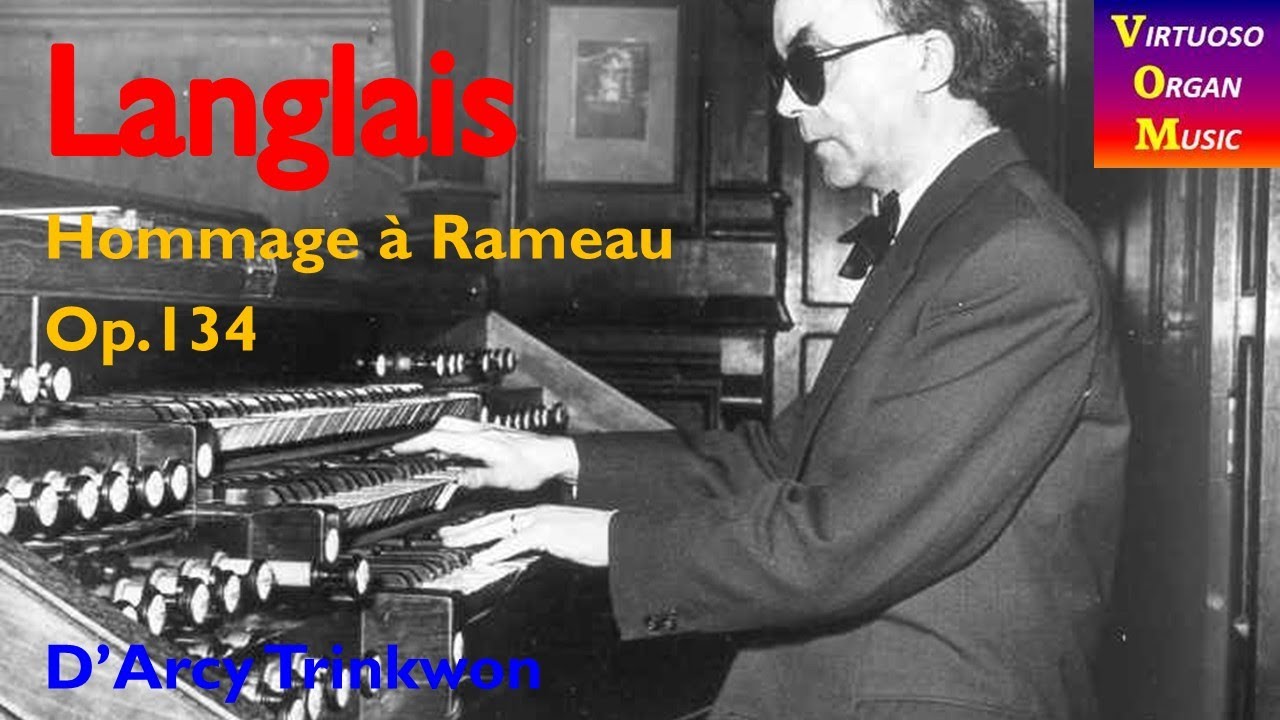
I love to unleash the emotions that the organ can so vividly portray and let them just flood out and flatten everything… and there’s so much of Langlais’ enormous œuvre that remains unknown and not played that is really worth exploring - stunning pieces like the terrifyingly vivid 5ème Trompette, the seething first symphony among them. A genius whose star shone brilliantly in the firmament of the great French organ tradition, I sadly only had a single chance to see him ‘live’ (1982, I think) – a youthful memory that had a marked impact on me as a budding musician: a tiny and frail old man, with his signature bow-tie and big black glasses (he was blind), he was gently led onto the stage by a pupil whereupon he then sat at the organ entirely motionless and just got on with it… and the power of the music just flowed…
Some years later in my student days in Paris, I was thrilled to be invited to make arrangements to go and play some of his music to him at the invitation of his wife Marie-Louise Jacquet-Langlais. Alas, he died just a short while after and before I got there, something I was so disappointed about ……. But at least I did speak to him on the telephone…
Повторяем попытку...
Доступные форматы для скачивания:
Скачать видео
-
Информация по загрузке:


![The Shadow of Calvary: Vivaldi Filiae maestae Jerusalem, RV 638 | [MuseLAB]](https://image.4k-video.ru/id-video/0sj824OYRoI)