Grammar: 'stop buying' or 'stop to buy'? - BBC English Masterclass
Автор: BBC Learning English
Загружено: 2016-08-30
Просмотров: 238018
Описание:
Some verbs change meaning depending on whether they are followed by a gerund or infinitive verb. Learn about three of them – ‘stop’, ‘regret’ and ‘go on’ - in this Masterclass with Sian.
For more, visit our website: http://www.bbc.co.uk/learningenglish/...
Transcript:
Sian
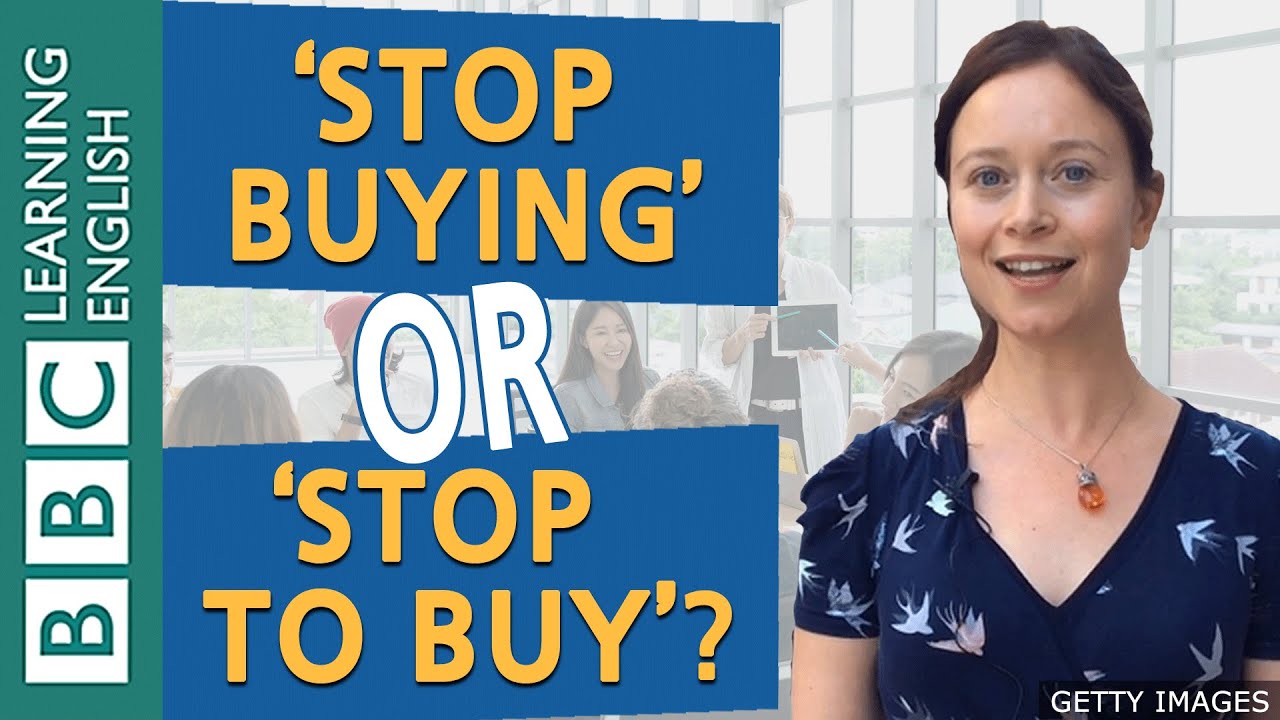
Hi Sian here for BBC Learning English. Now lots of people stop to buy a coffee on their way into work, but not me - I've stopped buying coffee. What's the difference - 'stop buying' 'stop to buy'? You'll find out in this Masterclass.
In English we have a group of verbs that can be followed by the gerund or the infinitive, but with a change in meaning. We're going to look at three of them: 'stop', 'regret' and 'go on'.
1) Stop
'I've stopped buying' 'I stopped to buy'?
OK, number one, listen to these two examples with 'stop' and try and work out the difference in meaning.
So, 'I've stopped buying coffee' and 'I stopped to buy a coffee this morning'. What's the difference?
Well, the first example 'I've stopped buying coffee' 'stop' is followed by the gerund. This means the activity in the gerund form stops, so 'I've stopped buying coffee because it's so expensive. I'm drinking tea from now on.'
In the second example, 'I stopped to buy a coffee this morning' the verb after 'stop' is in the infinitive, 'I stopped to buy a coffee' this means that we stop doing one action in order to do the action in the infinitive. So, this morning I stopped walking in order to buy a coffee.
2) Regret
'I regret telling you' 'We regret to tell you'?
Number two; listen to these two examples with 'regret'. 'I regret telling you that' 'we regret to tell you that...' What's the difference?
Ok, so the first example, 'I regret telling you that' 'regret' is followed by the gerund. This is when we feel sorry about something we've done in the past. So 'I regret telling you about that singing competition, now everybody knows I've entered!'
The second example 'I regret to tell you that...' is followed by the infinitive. We use this when you're about to give bad news - when you're sorry for something you're going to say. So, 'We regret to tell you that your application has been unsuccessful'. This is normally quite formal and often in written English and normally with verbs like 'say', 'tell' or inform.
3) Go on
'She went on talking' 'She went on to talk'
Ok, finally number three. What's the difference between these two examples with the verb 'go on'. 'She went on talking for hours' 'she went on to talk'? What's the difference?
Ok, the first example 'she went on talking' we use the gerund because the action continues 'She went on talking for hours about gerunds and infinitives!' The second one 'she went on to talk' the verb is followed by the infinitive. This means the activity changes to another one. For example, 'she started talking about gerunds and infinitives and she went on to tell a joke.'
That's all for now - Don't forget to visit our website. Ah now, there's another one - what's the difference between 'forget to do something' and 'forget doing something'?
Visit our website BBClearningenglish.com to find out if you're correct. Goodbye!
Повторяем попытку...
Доступные форматы для скачивания:
Скачать видео
-
Информация по загрузке:


![Let’s Take a C1 Grammar Test 📋 and critique it [949]](https://image.4k-video.ru/id-video/zXx-LmeChtA)


