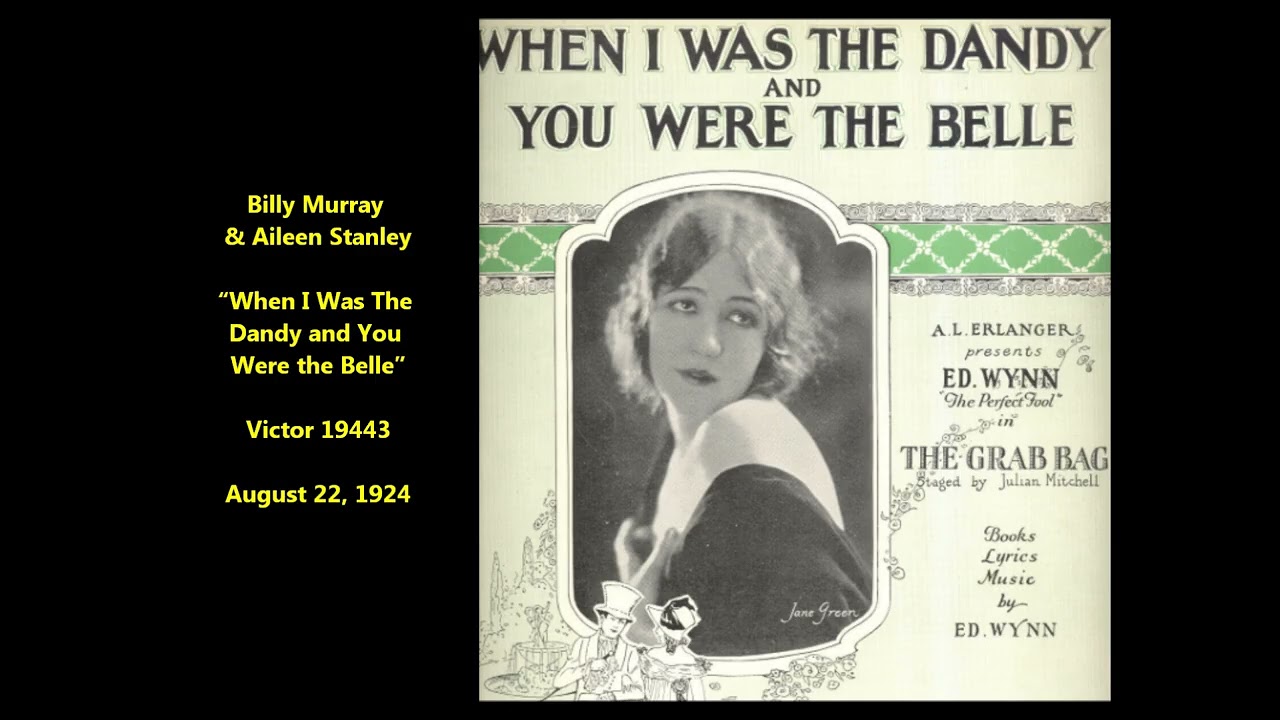
Billy Murray & Aileen Stanley "When I Was The Dandy and You Were the Belle" Victor 19443 (1924)
Автор: Tim Gracyk
Загружено: 2025-09-06
Просмотров: 61
Описание:
Billy Murray and Aileen Stanley sing "When I Was The Dandy and You Were the Belle" on Victor 19443, recorded on August 22, 1924.
The song is by Lou Handman, Dave Dreyer, and Herman Ruby.
In a big rocking chair
Sat an old loving pair
Watching the embers a-glow
And then she cuddled near
As he whispered, my dear
Remember the days long ago
When I was the Dandy and you were the Belle
We went out walking on Sunday
I wore a Tulip right in my lapel
And you wore the bonnet with red roses on it
Oh! how proud and happy I used to be
To have the crowd see you
Out walking with me, my dear
When I was the Dandy and you were the Belle
In those dear old Sweetheart days
Many years have gone by
Yet the light in your eye
Shines just as brightly today
And I look back with pride
As you stood by my side
When the clouds overhead were gray
--------------------------------------------------------------
Aileen Stanley was born on March 21, 1893. A later year is given by some internet sources, but that later date is unlikely (consider her success by the WWI years).
In the 1920s her records probably sold in larger quantities than those of any other female singer with the possible exception of opera diva Amelita Galli-Curci.
African-American singers of the 1920s such as Mamie Smith, Ma Rainey, Ethel Waters, and Bessie Smith are now better remembered, partly because they broke race barriers. White singers such as Ruth Etting, Helen Kane, and Helen Morgan are now more often associated with the Roaring Twenties--the three rose to fame late in the decade.
But no female singer matched Stanley in sales, her Victor records selling well from late 1920 into the late 1920s. Finding Stanley discs is far easier than finding discs of the other singers, notwithstanding extravagant claims made about sales of Mamie Smith and Bessie Smith discs.
Her real name was Maude Elsie Aileen Muggeridge. She was born in Chicago so it is fitting that she was among the first singers--in January 1923--to record Fred Fisher's newly published "Chicago" (dance bands recorded it months earlier but Stanley's Okeh 4792 was the first by a vocalist). Her father and mother had emigrated from England though her father died of typhoid several months before she was born, contracting it from another daughter who also died of the disease.
In 1919 she made a test record for Columbia at 229 West 46th Street in New York City. Within a few years most American companies, large and small, would issue Stanley records but not Columbia.
She recorded titles for Pathé in 1920. In the early 1920s she performed for Pathé, Olympic, Vocalion, Brunswick, Gennett, Okeh, Edison, and Operaphone. Stanley discs issued by these companies are rare today.
Her best-selling records of the 1920s were made for the Victor Talking Machine Company.
Her first Victor recordings were made on August 10, 1920, around the time "Alibi Blues" was issued by Pathé and following her success in Silks and Satins. "Broadway Blues" and "My Little Bimbo Down on the Bamboo Isle" were issued on Victor 18691 in November 1920 (the same month as Paul Whiteman's debut discs--Victor was introducing many new artists at this time), and the disc sold very well.
In the early 1920s she was known in vaudeville as "The Personality Girl." Edison promotional literature announcing new Blue Amberols for April 1922 identifies "Boo-Hoo-Hoo" (4487) as a "serio-comic song, which suits the style of Aileen Stanley to perfection." It adds, "In vaudeville, Miss Stanley is known as 'The Phonograph Girl,' because of her popularity on records."
For any company to dub Stanley "The Phonograph Girl" as early as 1922 was bold given the relatively few Stanley records released at this time--more records were being sold of Marion Harris, Nora Bayes, and possibly Mamie Smith. Stanley's popularity did increase and by 1923 may have been the most popular female singer making records though those of blues singer Bessie Smith, new to the industry in 1923, possibly sold in larger quantities than Stanley's in Smith's first year. By the mid-1920s Stanley records probably sold better than those of any other female singer.
By 1926 Stanley was dubbed "The Victrola Girl" (after cutting two final titles for Gennett in the fall of 1924, Stanley had sessions only for Victor and British affiliate HMV).
On January 4, 1922, she married Robert Buttenuth in Minneapolis. Page 135 of the June 1922 issue of Talking Machine World identifies Buttenuth as her piano accompanist and manager.
Stanley made early Orthophonic discs, the name for Victor's early electric records. She was immediately paired with Billy Murray though their efforts at "If I Had A Girl Like You" on August 20 and August 25 were rejected. From the August 20 session, only "You're In Wrong With The Right Baby," sung by Stanley alone, was issued.
Повторяем попытку...
Доступные форматы для скачивания:
Скачать видео
-
Информация по загрузке: