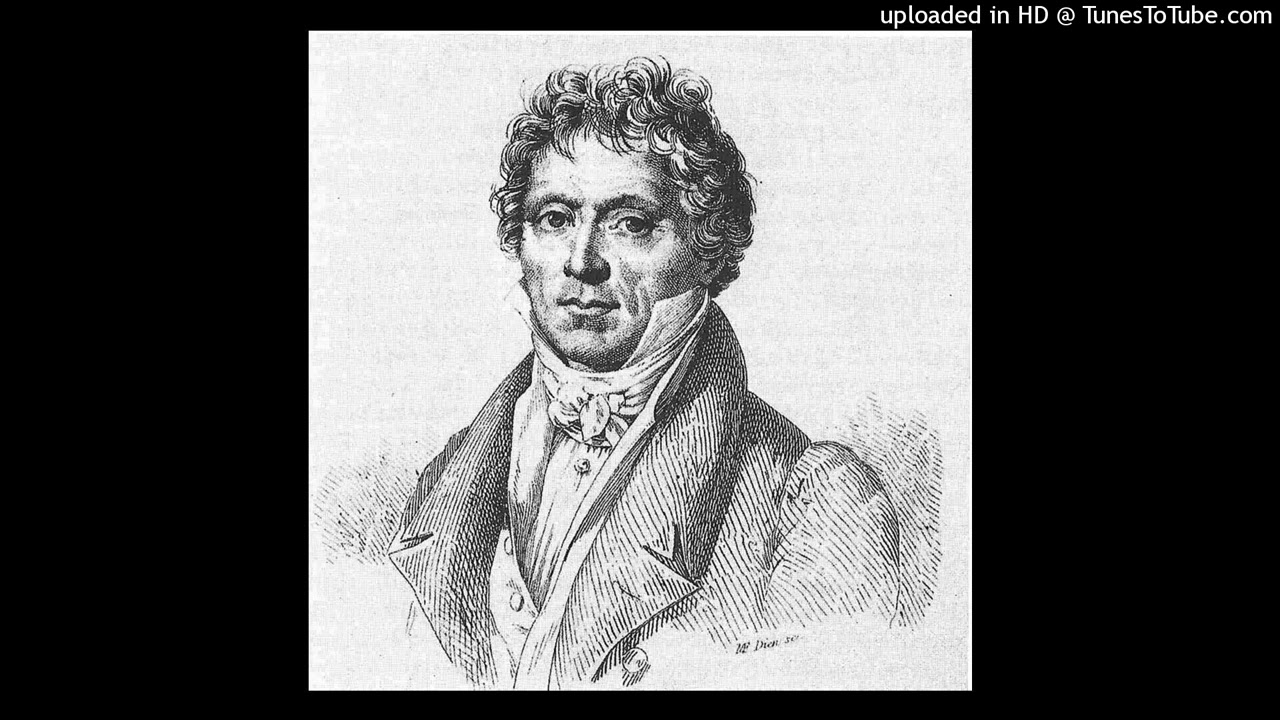
Antonín Reicha - "Scientific Quartet" for String Quartet - Part 1 - ( 1806 )
Автор: Justin Walsh
Загружено: 2025-08-11
Просмотров: 27
Описание:
Summary of Antonín Reicha’s Quatuor Scientifique for String Quartet
Antonín Reicha (1770–1836), a Czech-born composer pivotal in bridging Classicism and Romanticism, composed his Quatuor Scientifique for string quartet in 1806 during his Vienna period (1802–1808). This ambitious and unconventional work, subtitled “XII morceaux de musique pour deux violons, alto et violoncelle,” stands out for its innovative structure and intellectual depth, blending traditional string quartet movements with a series of fugues that reflect Reicha’s theoretical explorations. Created in Vienna under the influence of Haydn and Beethoven, the Quatuor Scientifique showcases Reicha’s bold approach to chamber music, pushing the boundaries of form, harmony, and counterpoint. This 600-word summary explores the historical context, musical characteristics, significance, and accessibility of Quatuor Scientifique, building on our prior discussions of Reicha’s chamber works, including La Pantomime and the Op. 48 and Op. 49 quartets.
Historical Context
Reicha’s Vienna years were marked by his immersion in a vibrant musical scene, shaped by his studies with Haydn and friendship with Beethoven. Composed in 1806, Quatuor Scientifique reflects Reicha’s fascination with musical theory and experimentation, particularly his interest in modernizing Baroque forms like the fugue. Unlike his earlier Op. 48 and Op. 49 quartets, which are more abstract, Quatuor Scientifique is a programmatic and structurally radical work, integrating traditional quartet movements with eight fugues, some adapted from his 36 Fugues pour Piano, Op. 36 (1803). The manuscript, rediscovered in the Bibliothèque Nationale de France, was unpublished during Reicha’s lifetime, contributing to its obscurity until recent performances. Its title, “Scientific Quartet,” underscores Reicha’s view of music as both a science and an art, blending intellectual rigor with expressive creativity.
Musical Characteristics
Quatuor Scientifique is a 12-movement work (sometimes listed as 13 with the inclusion of La Pantomime as an introduction), alternating four traditional string quartet movements with eight fugues, creating a unique blend of emotional and “scientific” elements. Key characteristics include:
Structure: The quartet opens with La Pantomime, a debated introductory movement possibly depicting mythological stories through evocative textures. The traditional movements include an Adagio–Allegro (I), Allegro assai (VIII), Menuetto (X), and Finale in 5/8 meter (XII). The eight fugues (II–VII, IX, XI) include one on a Mozart theme (VII), one on a Haydn theme (XI), and a three-subject fugue (IX), showcasing Reicha’s innovative approach to counterpoint.
Harmonic Innovation: Reicha’s use of polytonality and unconventional key relationships, as seen in his piano fugues, likely infuses the quartet with bold modulations and chromaticism, challenging Classical tonal norms.
Egalitarian Texture: The work distributes melodic and technical material equally among the two violins, viola, and cello, fostering a conversational interplay that demands virtuosity, aligning with Reicha’s style in Op. 48 and Op. 49.
Counterpoint and Experimentation: The fugues, rooted in Reicha’s “new system” of fugal writing, disregard traditional rules (e.g., dominant key restrictions), earning criticism from Beethoven, who remarked, “such fugues are no fugues.” This intellectual approach adds depth to the quartet’s expressive range.
Significance
Quatuor Scientifique is a landmark in Reicha’s oeuvre, embodying his dual role as composer and theorist. Its integration of fugues with traditional movements anticipates later experimental works, such as Beethoven’s late quartets, and highlights Reicha’s influence on the string quartet’s evolution. The work’s obscurity, due to its unpublished status until the late 20th century, underscores the challenge of Reicha’s vast output being overshadowed by his contemporaries. Its rediscovery by ensembles like the Reicha Quartet emphasizes its historical and musical significance.
Accessibility and Recordings
The primary recording is by the Reicha Quartet (Brilliant Classics, 2019, Cat. 95857), featuring all 12 movements plus La Pantomime. Available on Amazon (CD, ~$15), Presto Music (CD or high-resolution download, 44.1 kHz/24-bit), Spotify, and Apple Music, it is praised for its clarity and commitment to Reicha’s vision. Scores are accessible via IMSLP or the Bibliothèque Nationale de France (MS 12020). The Palazzetto Bru Zane (bruzanemediabase.com) may offer additional resources.
Conclusion
Reicha’s Quatuor Scientifique is a visionary work, merging Classical structure with groundbreaking fugal experimentation. Its significance lies in its bold contribution to the string quartet’s evolution, offering a window into Reicha’s Vienna period. Enthusiasts
Повторяем попытку...
Доступные форматы для скачивания:
Скачать видео
-
Информация по загрузке: