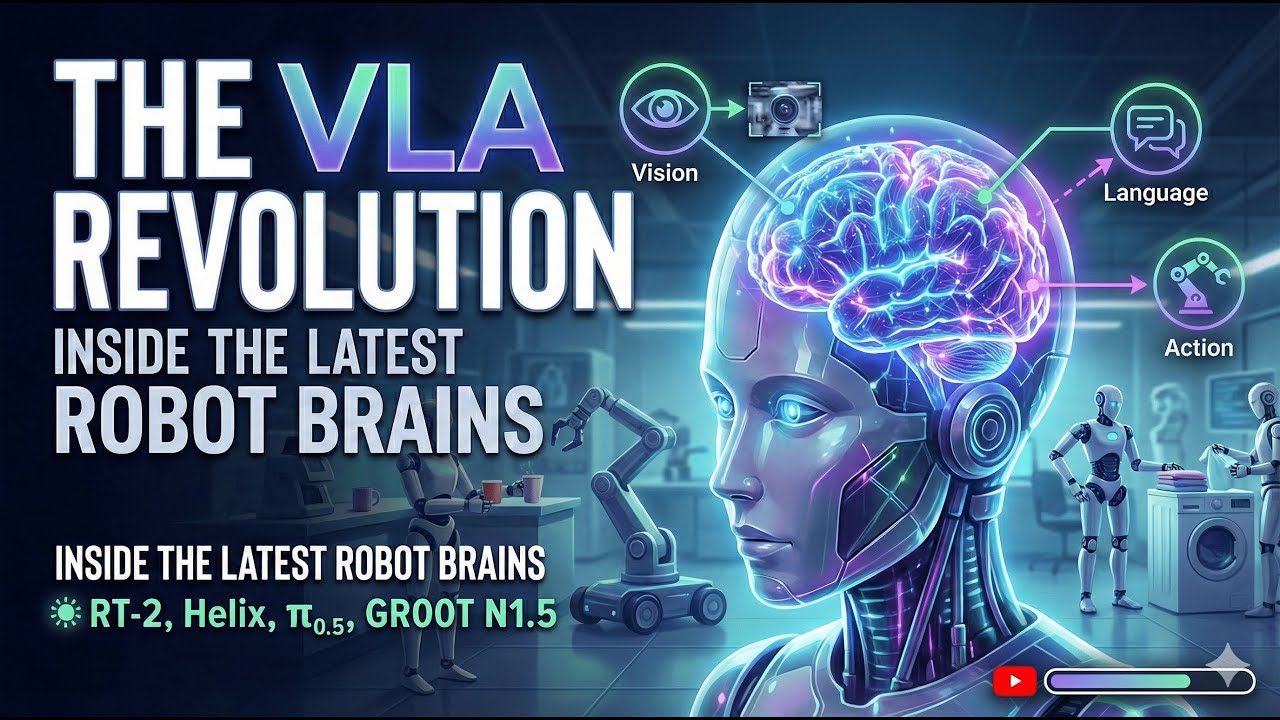
Vision-Language-Action Revolution: Inside the Latest Robot Brains (RT-2, Helix, π₀.₅, GR00T N1.5)
Автор: Foundation Models For Robotics
Загружено: 2025-12-01
Просмотров: 212
Описание:
The field of embodied AI is experiencing explosive innovation, with 28 new Vision-Language-Action (VLA) models released in 2025 alone, demonstrating a rapid shift toward generalist robotic intelligence. This video delves into the state-of-the-art architectures that are enabling robots, from large humanoids to dexterous manipulators, to understand natural language instructions and operate seamlessly in complex, unstructured environments.
Key VLA Models and Pioneers
RT-2 (Google DeepMind): The foundational model that established the VLA paradigm in 2023. The RT-2-X variant, with 55B parameters, leveraged web-scale vision-language data, treating robot actions as text tokens to achieve emergent reasoning and symbol understanding.
OpenVLA (Berkeley/Stanford/TRI): The first major open-source VLA model, combining a Llama-2 backbone with dual visual encoders. Despite having 7x fewer parameters (7B) than RT-2-X, it achieved a 16.5% superior absolute success rate in cross-embodiment manipulation tasks.
Helix (Figure AI): The first commercially deployable VLA system for humanoids, featuring a dual-system architecture. This system separates high-level planning (System 2, 7B VLM at 7-9 Hz) from real-time motor control (System 1, 80M action transformer at 200 Hz), supporting full upper-body control and multi-robot collaboration.
GR00T N1.5 (NVIDIA): A 3B parameter foundation model for humanoid robots (like the Fourier GR-1 and Unitree G1) that utilizes data pyramid training (human videos + synthetic data + real robot trajectories) for high data efficiency.
π₀ (Pi-Zero) & π₀.₅ (Physical Intelligence): π₀ (3B params) introduced flow matching for action generation, enabling precise dexterous manipulation tasks like laundry folding. π₀.₅ pushes this further, achieving open-world generalization by co-training on heterogeneous data (robot, web, verbal instructions) and excelling in long-horizon tasks, such as cleaning kitchens over 10-15 minute sequences.
Major Architectural Innovations
World Model Integration: Seven models now incorporate explicit or implicit world models. Systems like WoW (World-omniscient World-model) (14B params) and Genie-Envisioner (AgiBot) predict physical consistency and future outcomes, enabling better causal reasoning and planning.
Efficient Architectures: Models are becoming specialized for efficiency and edge deployment. SmolVLA (450M params) is designed for consumer hardware and achieves a 30% faster response time. RoboMamba (2.8B params) uses a Mamba state space model for 3x faster inference speed and linear inference complexity.
Advanced Reasoning and Planning:
CoT-VLA (NVIDIA/Stanford/MIT) uses Visual Chain-of-Thought reasoning by autoregressively predicting future image frames as visual goals before generating actions, which aids in complex temporal planning.
F1-VLA (Shanghai AI Lab) integrates foresight generation with predictive inverse dynamics, achieving a 95.7% average success rate on the challenging LIBERO benchmark.
Synthetic Data Pretraining: To overcome data scarcity, models are trained on massive synthetic datasets. GraspVLA (Peking University) achieves zero-shot grasping generalization by pretraining on 1 billion frames of synthetic data (SynGrasp-1B).
Dexterous and Humanoid Control: ERA-42 (Robot Era) is the first end-to-end model built for a 5-finger dexterous hand, capable of complex tool use. Psi R1 (PsiBot) is the first reinforcement learning-driven VLA, capable of long-horizon tasks (30-min+ Chain of Action Thought) and multi-agent collaboration, demonstrated by playing Mahjong.
Why It Matters
The innovations, particularly in efficiency (FlowerVLA requiring only ~200 GPU hours for pretraining) and generalization (BridgeVLA needing only 3 trajectories per task for high success), mean that sophisticated VLA models are transitioning rapidly from research prototypes to practical, real-world deployment on commercial humanoid platforms like 1X Technologies' NEO (Redwood model) and Figure AI's commercial robots.
These advancements move robotics beyond simple reactive behaviors toward truly general-purpose robotic intelligencecapable of integrating seamlessly into human environments.
Повторяем попытку...
Доступные форматы для скачивания:
Скачать видео
-
Информация по загрузке: