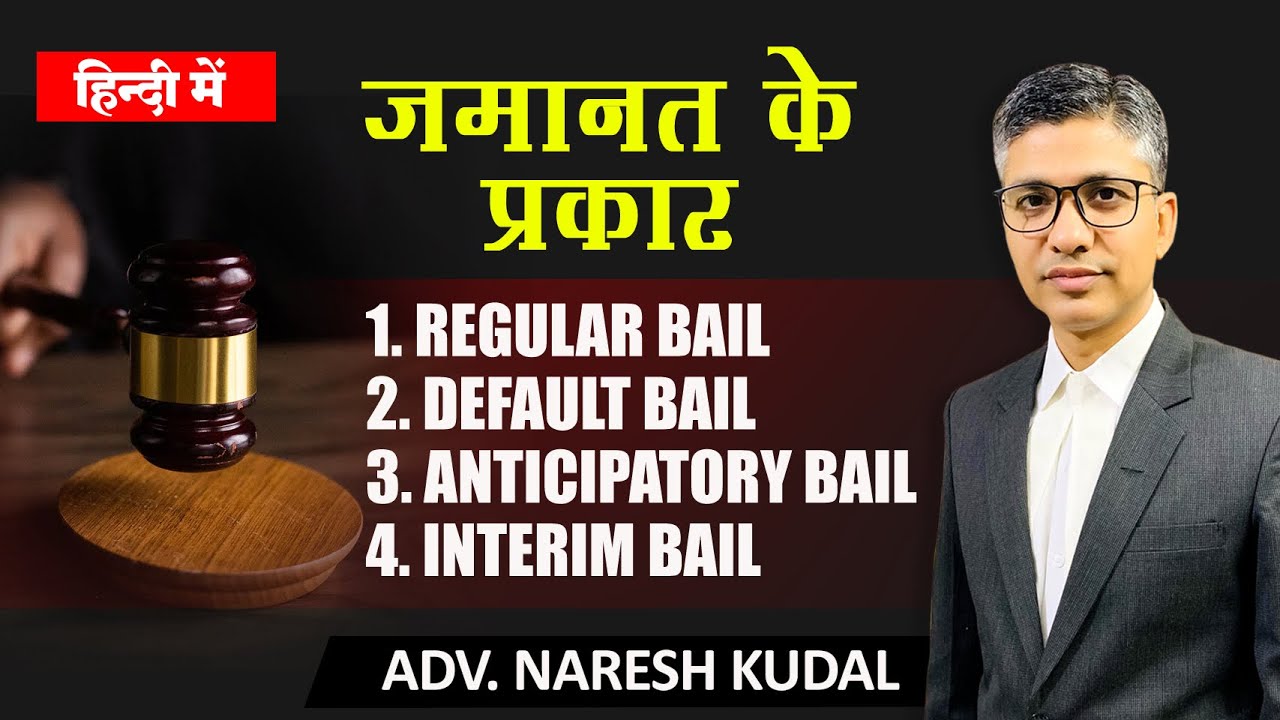
ANTICIPATORY BAIL Sec - 438 (1)(2)(3)&,439 (2) of Cr.p.c
Автор: Law study Point judicial academy
Загружено: 2023-01-16
Просмотров: 437
Описание:
Anticipatory or pre-arrest bail, though nowhere explicitly defined in the Criminal Procedure Code of 1973 essentially means providing bail to a person even before its arrest. It forms a critical component of the freedom of the right to life and personal liberty under the Indian Constitution. The term “anticipatory bail” was first coined by the 41st Law Commission Report of 1969 to give protection to those accused persons who had a reasonable fear or apprehension of an arrest. Therefore, its aim was to protect those accused persons who had a reasonable cause or fear to believe that they could be arrested for a non-bailable offence. The need for providing anticipatory bail was also felt due to the rising occurrence of false cases being built against people due to rivalry or disagreements. Moreover, it was also believed that keeping a person in custody where there is no likelihood of the person absconding or misusing his liberty on bail would be unfair and unreasonable. Therefore, it was absurd to expect a person to stay in custody for a time period and then apply for bail. Keeping in mind the above factors, in 1973, Parliament enacted the Criminal Procedure Code of 1973 and ensured to include the suggestions of the 41st Law Commission Report. The Parliament added Section 438 to the newly enacted code with the title “Direction of grant of bail to persons apprehending arrest”.
This article will discuss the meaning, interpretation, as well as some of the most important judicial decisions on Section 438 of the Criminal Procedure Code, 1973.
Section 438 CrPC and its meaning
Section 438 CrPC is divided into three sub-parts. In order to understand the provision in detail, it becomes necessary to understand each of its sub-parts in detail.
Section 438(1) provides that any person upon a reasonable belief of being arrested for a non-bailable offence can move an application to the High Court or Court of Sessions. Accordingly, the court, upon careful consideration, may reject or approve the application. If the application is approved, the person upon an arrest shall be released on bail. The most important condition in this provision is that the offence under consideration must be a non-bailable offence. This provision also clearly signifies that granting anticipatory bail is not a right but solely lies on the discretion of the Court.
Section 438(2) on the other hand, lays down certain conditions that the applicant must fulfil in case the High Court makes a direction under Section 438(a). The conditions are-
(i) The person should be available for the interrogation as and when required.
(ii) The person should not threaten, induce or promise any person who is familiar with the facts of the matter to disclose or reveal any facts to the police officer.
(iii) The person shall not leave India without the prior permission of the Court.
(iv) The person shall also be bound by the conditions enumerated under Section 437(b) and it shall be as if the bail was granted under the section.
Lastly, Section 438(3) clearly provides that upon the application being accepted, the person upon arrest without a warrant shall be immediately released on bail. Further, if the magistrate takes cognizance, any warrant issued thereafter shall also be bailable.
Nature of offence under Section 438 CrPC
Offences in criminal law can be classified as bailable and non-bailable. Section 2(a) of the CrPC defines bailable offences as those that have been explicitly defined as bailable in the First Schedule or are deemed bailable by the law in force. Non bailable is defined under the same Act as the ones that are not listed out in the First Schedule. Moreover, the second part of the Schedule also lists out non-bailable offences and defines non-bailable offences as those that are punishable with death, imprisonment for life, or imprisonment for seven years.
Bailable offences are those offences that are usually non-serious in nature. In bailable offences, bail is treated as a right and the accused shall be immediately released on bail. Non-bailable offences, on the other hand, include offences that are grave and serious in nature. In non-bailable offences, the bail solely lies at the discretion of the court. This means that bail under non-bailable offences is not a matter of right. Under Section 438 of the Criminal Procedure Code, 1973, the provision clearly states that anticipatory bails are only granted in case of non-bailable offences.
Повторяем попытку...

Доступные форматы для скачивания:
Скачать видео
-
Информация по загрузке:














![🔴 EXPRESS BIEDRZYCKIEJ | GEN. STANISŁAW KOZIEJ, JACEK NIZINKIEWICZ, TOMASZ ŻÓŁCIAK [NA ŻYWO]](https://imager.clipsaver.ru/6ajSzXkdHhY/max.jpg)