The Obsessive Engineering of Precision Linear Motion
Автор: New Mind
Загружено: 2026-06-27
Просмотров: 278661
Описание:
This video traces the evolution of precision linear motion, from ancient rack and pinion gearing to wafer stages that settle to the width of an atom.
ORIGIN OF LINEAR PRECISION
• The rack and pinion converts rotation into precise linear motion through meshing teeth.
• It appeared in Hellenistic and Roman engineering as an early linear translation mechanism.
• The Industrial Revolution's demand for precision would outpace traditional gearing.
THE CONCEPT OF PRECISION
• Britain's naval dominance depended on highly accurate navigational instruments.
• Before the late 1700s, screws were individually hand-filed, so no nut fit another.
• The lead screw translates rotation into precise, high-force linear motion via thread pitch.
RAMSDEN & MAUDSLAY
• Jesse Ramsden built his "dividing engine" in 1775 to inscribe fractions of a degree.
• The Board of Longitude awarded him £615 in 1777, forcing him to publish his design.
• Around 1800, Henry Maudslay's lathe mass-produced perfectly identical screws.
• Standardized thread sizes finally made interchangeable nuts and bolts practical.
MEASUREMENT
• James Watt designed a tabletop micrometer around 1772 for his steam engine parts.
• By 1805, Maudslay's brass device measured to 1/10,000 of an inch per graduation.
• It is now regarded as foundational to modern precision metrology.
PROPERTIES OF A LEAD SCREW
• Lead, pitch, diameter, thread form, and friction together dictate efficiency and load.
• A screw self-locks once the lead angle falls below the friction angle.
• Fine-lead Acme screws give high resolution and self-locking, but only 25-40% efficiency.
• Coarse multi-start screws hit 50-80% efficiency but are back-drivable.
RECIRCULATING BALLS
• Sliding friction causes heat and "galling," where surfaces cold-weld together.
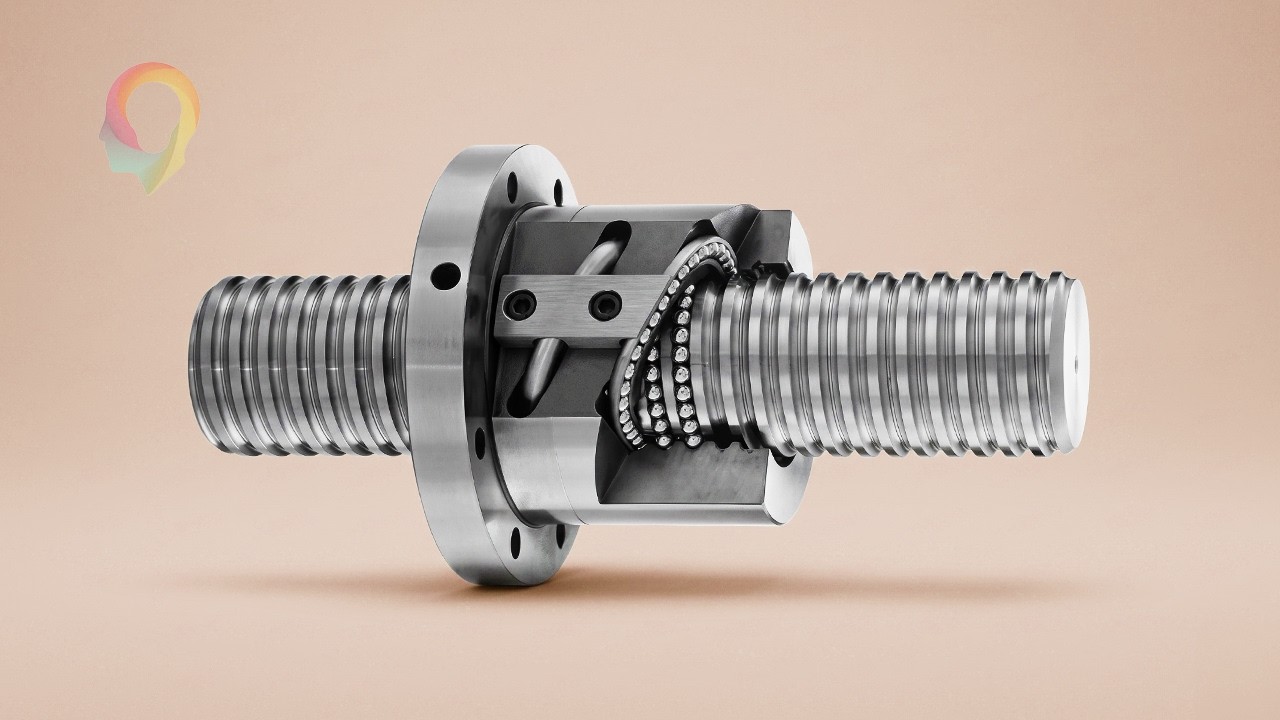
• In 1927, Rudolph G. Boehm patented a screw using recirculating hardened steel balls.
• In 1936, GM's Saginaw division built the first commercial recirculating ball screw.
• WWII adapted it to flight control on the Boeing B-29 Superfortress.
PROPERTIES OF A BALL SCREW
• Rolling friction pushes ball screw efficiency above 90%.
• This eliminates self-locking, letting gravity alone back-drive vertical loads.
• Thermal expansion stretches the lead by 11-13 um per meter per degree Celsius.
• Bigger or more balls raise capacity but trade away smoothness and speed.
PRECISION GUIDANCE
• True linear motion splits into two tasks: actuation and guidance.
• The simplest guide is the flat or V-shaped "way" machined into the machine bed.
• The 1945 linear ball bushing replaced sliding friction with recirculating balls.
LINEAR MOTION GUIDES
• The round-shaft deflection flaw persisted for nearly three decades.
• In 1972, Hiroshi Teramachi replaced the round shaft with a bolt-down profile rail.
• The company rebranded as THK in 1977 and went global.
• Its profile rail is now standard on essentially every CNC machine built today.
LM PROFILES
• The Circular-Arc profile touches each ball at two points for self-alignment.
• Back-to-back "O" layouts resist overturning; face-to-face "X" layouts tolerate distortion.
• The Gothic-Arch contacts four points for higher rigidity but lower capacity.
• THK's Cross-Roller Guides swap balls for crossed cylindrical rollers and line contact.
BEYOND MACHINING
• Semiconductor manufacturing exposed the limits of steel elasticity and metal contact.
• Dr. Eric Laithwaite conceived unrolling a rotary induction motor flat.
• The linear motor's traveling magnetic field drives a carriage with zero backlash.
THE SUB-NANOMETER REVOLUTION
• EUV photolithography prints nanometer geometries using a 13.5 nm wavelength.
• A levitated wafer stage accelerates at 8G while the reticle stage peaks at 32G.
• Sensors track position 20,000 times per second, accurate to about 60 picometers.
• Constant motor corrections leave a residual vibration known as servo jitter.
PIEZOELECTRIC MOTION
• Applying voltage makes a piezo crystal physically change shape, bypassing mechanics.
• The crystal holds its expanded state under constant voltage for stable positioning.
THE FUTURE
• Every leap in precision has come from removing a source of error.
• The bottleneck shifts from how fast a stage moves to how still it can hold.
• Future systems push into active vibration cancellation and predictive control.
• The simple lead screw now settles to within the width of an atom.
------
SUPPORT NEW MIND ON PATREON
/ newmind
SOCIAL MEDIA
Instagram - @newmindchannel
HISOTRIC IMAGE CREDIT
Science Museum Group
© The Board of Trustees of the Science Museum
#engineering #LinearMotion #precision #machining #CNC #ballscrew #leadscrew #semiconductor #lithography #metrology #mechanical #manufacturing #howitsmade #technology
Повторяем попытку...
Доступные форматы для скачивания:
Скачать видео
-
Информация по загрузке: