il SODOMA, Life of St Benedict, predicts the destruction of Montecassino, Monte Oliveto Abbey
Автор: Luigi Manfredi
Загружено: 2022-08-31
Просмотров: 55
Описание:
Giovanni Antonio Bazzi, known as 'Il Sodoma'
(Vercelli, 1477 – Siena, 1549)
Life of St Benedict, Scene 30
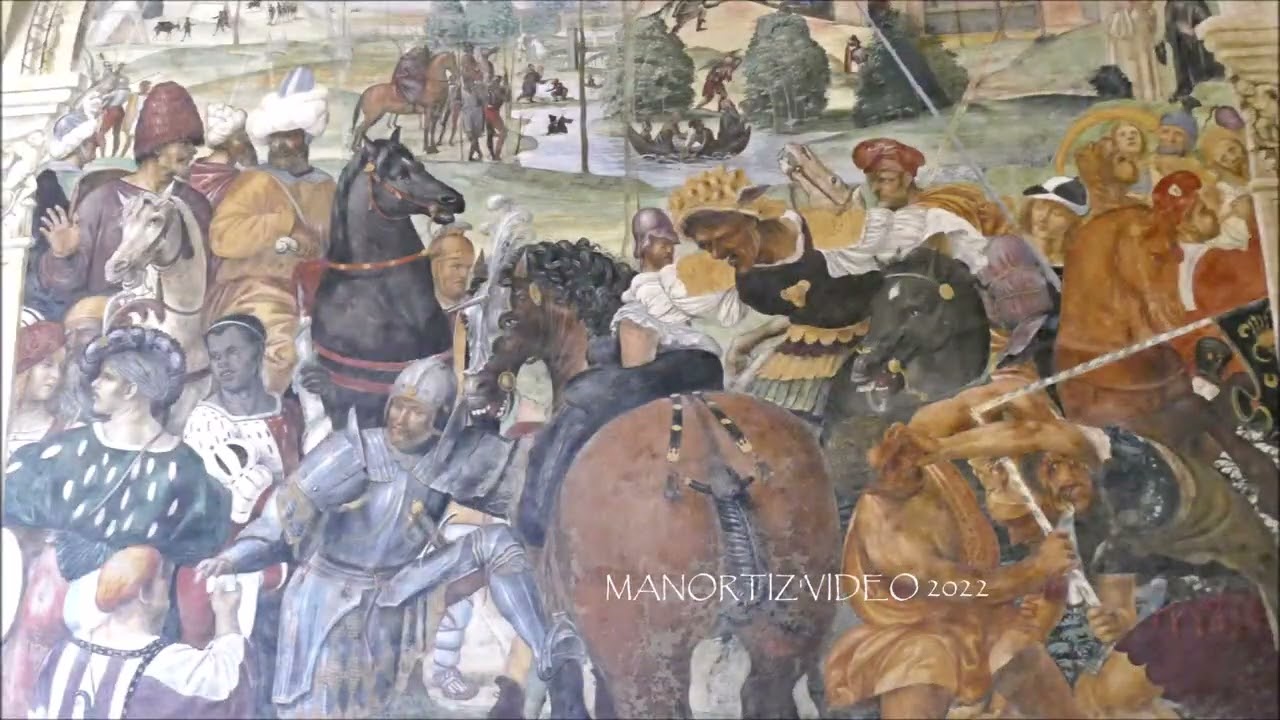
Benedetto predice la distruzione di Montecassino - Benedict predicts the destruction of Montecassino, 1505-1508 fresco
Inscription (under the fresco):
“COME BENEDETTO PREDICE LA DISTRUZIONE DI MONTECASSINO” [1]
Il Chiostro Maggiore, o Chiostro Grande - The main chiostro or the large chiostro
Abbazia di Monte Oliveto Maggiore
foto e filmato di
Luigi Manfredi
28 Agosto 2022
By the hand of Sodoma, the fresco is reputed to be the one with which the painter began his intervention in the cloister of Monte Oliveto Maggiore. The hypothesis is probable, in the first place because the location of the fresco made it possible to complete the west wall, which had remained incomplete since the abandonment of the site by Signorelli. On the other hand, because Sodoma takes up here the plastic codes of the two glasses, painted in the immediate vicinity by his illustrious predecessor, to represent Benoît's prophecy. Finally because, no doubt to show the full range of his painting skills, Sodoma, in an excess of virtuosity, displayed a battle scene on the wall. This one, by its particular characteristics,Sant'Anna in Camprena , an Olivetan property located some twenty kilometers from Monte Oliveto.
In the foreground, happily playing with the possibilities offered by perspective, a steed presents the viewer with its imposing rump and carefully braided tail. A rider in armor is about to mount it when a page presents him with a note whose content we will not know. Quivering with a truly warlike ardor, he has already engaged his left foot in the stirrup, while roughnecks fight for a banner adorned with a scorpion, whose shaft they have broken. Everything rustles, moves and stirs. In the distance, it is already too late. The abbey is in the throes of violence. The barbarians, crossing the river, mount an assault on the monastery from which the flames escape
How does the fresco show the announced prophecy? The same one that Benedict pronounced before Teoprobo, a young noble who later became a converse, the day when the latter found the holy abbot in tears, and when the latter predicted the destruction, by the barbarians, of the convent built by his hands. , with, however, the certainty that the monks would be spared. The event actually happened in 580.
Hidden in the right corner of the bezel, a monk is in conversation with a lay brother. Benedict, at this moment, exposes his prophecy to Teoprobo, while this same prophecy is realized before our eyes.
[1] “How Benedict predicted the destruction of Montecassino”. The episode appears in Book II of the Dialogues , Chapter 20:
“A certain nobleman called Theoprobus had been converted by the admonitions of this same Father Benedict, who treated him with confidence and even familiarity because of the merit of his life. One day, as he entered his cell, he found him crying very bitterly, and as he stood motionless for a long time and saw that the tears did not stop, considering on the other hand that he was not in the habit of praying with groans but that he only did it when he was in pain, he inquired about the cause of such great affliction. Immediately the man of God answered him, 'All this monastery that I have built and all that I have prepared for the brethren, by judgment of Almighty God, all of this will be handed over to the barbarian peoples.
'This word that Theoprobus heard, we see the realization, because we know that his monastery was recently destroyed by the Lombard nation. Recently in fact, under cover of the night, and taking advantage of the rest of the brothers, the Lombards entered and after having pillaged everything, they could not seize anyone, not even a single man. Almighty God has fulfilled what he had promised to the faithful servant of God Benedict: if he delivered goods to foreign nations, he would preserve lives' […]. »
According to http://www.abbayes.fr/lectio/Vie_Beno... , consulted on February 7, 2020, and CAVALCA, Domenico, Volgarizzamento del Dialogo di San Gregorio , reproduced in CARLO, Enzo, Le storie di San Benedetto at Monte Oliveto Maggiore . Cinisello Balsamo (Milano), 1980, pp. 161-180.
[2] Saint Gregory affirms that it was the Lombards who, in 580, plundered and destroyed Monte Cassino. The monks then withdrew to Rome at the Lateran monastery: “For us who know that the Lombards have just destroyed this monastery, we see the accomplishment of it with our eyes”. Saint Gregory, Pope, The Dialogues , Op. cit .
https://provincedesienne.com/2020/01/...
Повторяем попытку...
Доступные форматы для скачивания:
Скачать видео
-
Информация по загрузке:


