In-depth visit to the place where Jesus was crucified and resurrected. Jerusalem, Good Friday, 2021
Автор: The Holy Land, by Zahi Shaked
Загружено: 2021-04-02
Просмотров: 341426
Описание:
Information about the site itself will be provided after this announcement.
Unfortunately, I have not been able to work as a tour guide as from Feb 2020
Should you wish to support me and my videos please subscribe to my channel and let me guide you through the Holy Land via my videos. In this way I will be able to continue to do my work of uploading to YouTube. Upon your request and in return I am very much happy to pray for you at the Western Wall and/or light a candle in your name at the Church of the Holy Sepulchre or anywhere else in the Holy Land of Israel.
Should you have a personal request I will be more than happy to respond and even film it in a personal video.
Donations: https://www.buymeacoffee.com/zahishaked
Kindly share this site with your other friends/family that are interested in the rich and sacred history of Israel.
Thank you so much
Your tour guide
Zahi Shaked
/ zahishakedisraelitourguide
/ zahi_shaked_israeli_tour_guide
https://linktr.ee/zahishakedtourguide...
The Church of the Holy Sepulchre is one of the holiest and special sites in Christianity. Located in the Christian Quarter of the Old City of Jerusalem, the church is home to two of the holiest sites in Christianity – the site where Jesus was crucified, known as Calvary, and the tomb where Jesus was buried and then resurrected. Today, the tomb is enclosed by a shrine called the Aedicula. The final four Stations of the Cross, or Via Dolorosa, are also located inside the church.
history of the Church of the Holy Sepulchre
The New Testament tells that Jesus was crucified at Golgotha, “the place of the skull”, identified as an area of stone quarries outside the city’s walls at the time. Around a decade after Jesus’s crucifixion, a third wall was built to enclose the area of his execution and burial to within the city. This provides validation for the Holy Sepulchre’s location inside today’s Old City of Jerusalem.
After he had a vision of a cross in the sky in 312 AD, Constantine the Great converted to Christianity and sent his mother, Empress Helena, to Jerusalem in search of Jesus’s tomb. She found a relic of the cross near a tomb, leading her to believe she had found Calvary. In 326 AD, Constantine ordered a church built at the site. All the soil and debris that had gathered over the centuries was removed from the cave, revealing a rock-cut tomb identified as the burial site of Jesus.
The Church was thus built over the two holy sites. The great basilica or Martyrium encloses the traditional site of Calvary in one corner, and across the way, the Anastasis (“Resurrection”), encloses the cave tomb of Jesus’s burial. The church was finally consecrated on September 13, 335 AD. The wooden doors of the church’s main entrance are still the original doors from 326 AD, putting into perspective the ancient grandeur of this holy church.
Inside the church entrance, a stairway leads up to Calvary (Golgotha), the site of Jesus’ crucifixion and the most extravagantly decorated part of the church. The exit from this site is down another stairway that leads to the ambulatory.
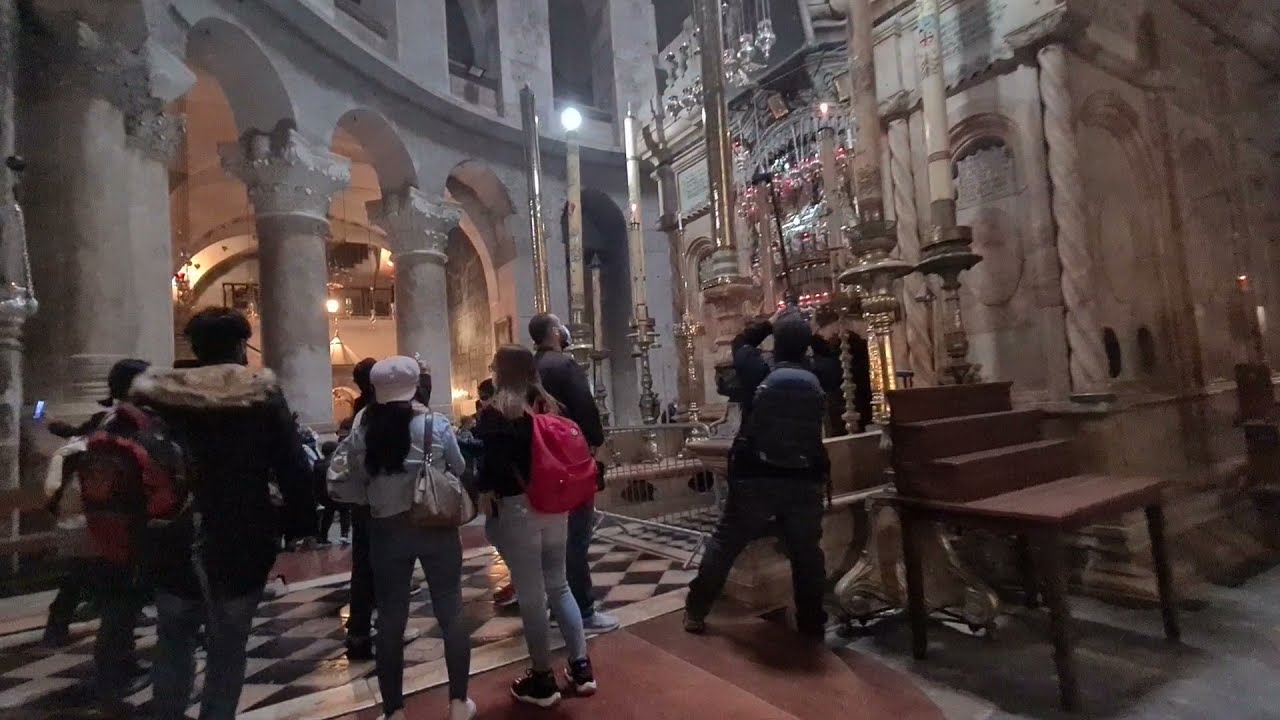
The rotunda is the building of the larger dome located on the far west side. In the centre of the rotunda is a small chapel called the Kouvouklion in Greek or the Aedicula in Latin, which encloses the Holy Sepulchre. The Aedicule has two rooms, the first holding the Angel's Stone, which is believed to be a fragment of the large stone that sealed the tomb; the second is the tomb of Jesus. Possibly due to the fact that pilgrims laid their hands on the tomb or to prevent eager pilgrims from removing bits of the original rock as souvenirs, a marble plaque was placed in the fourteenth century on the tomb to prevent further damage to the tomb.
Under the Status Quo, the Eastern Orthodox, Roman Catholic, and Armenian Apostolic Churches all have rights to the interior of the tomb, and all three communities celebrate the Divine Liturgy or Holy Mass there daily. It is also used for other ceremonies on special occasions, such as the Holy Saturday ceremony of the Holy Fire led by the Greek Orthodox patriarch (with the participation of the Coptic and Armenian patriarchs). To its rear, in a chapel constructed of iron latticework, lies the altar used by the Coptic Orthodox. Historically, the Georgians also retained the key to the Aedicule.
From May 2016 to March 2017, the Aedicule underwent restoration and repairs after the Israel Antiquities Authority declared the structure unsafe. Much of the $4 million project was funded by the World Monuments Fund.[67] King Abdullah II of Jordan also contributed a substantial sum to make the restoration possible.
To the right of the sepulchre on the northwestern edge of the Rotunda is the Chapel of the Apparition, which is reserved for Roman Catholic use.
Повторяем попытку...
Доступные форматы для скачивания:
Скачать видео
-
Информация по загрузке: