Blue Economy: India’s Strategic Framework
Автор: EIA PRACTITIONER
Загружено: 2026-06-26
Просмотров: 30
Описание:
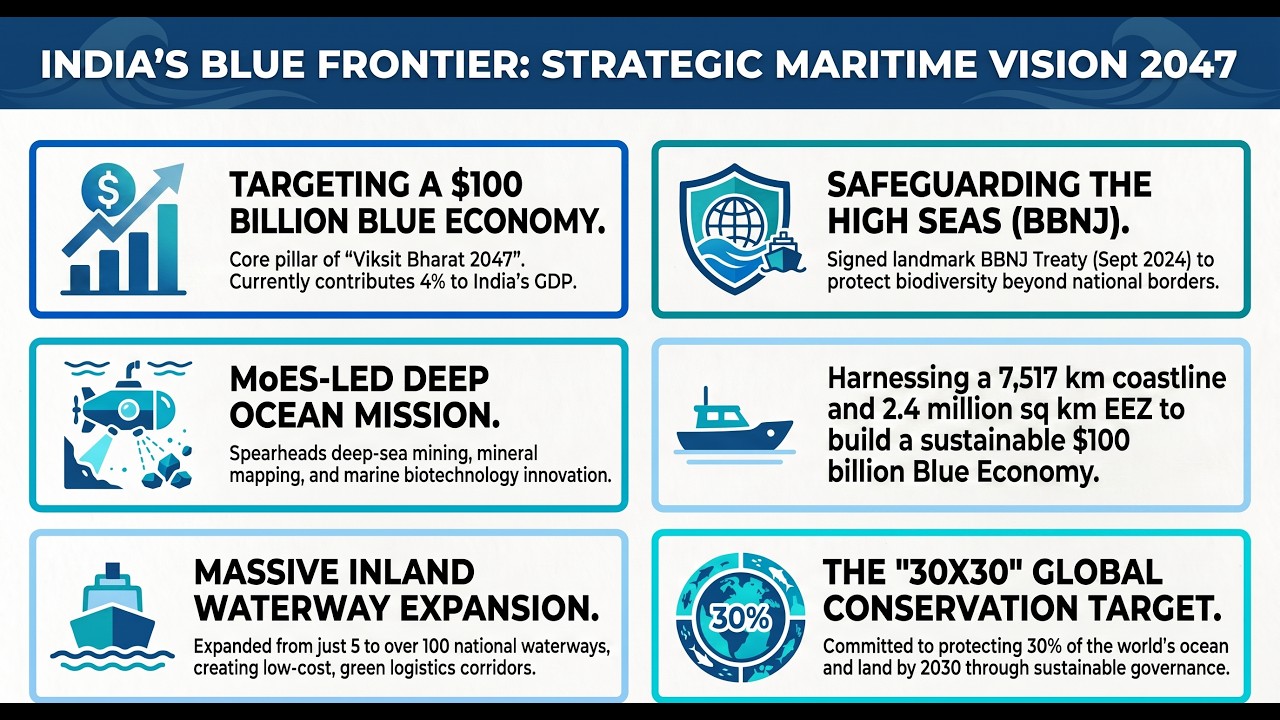
India’s approach to the Blue Economy and the BBNJ Treaty represents a transformative shift in maritime governance, moving from traditional resource exploitation to an integrated model of sustainable growth, environmental stewardship, and global leadership.
The Blue Economy: India’s Strategic Framework
India defines the Blue Economy as a subset of the national economy comprising the entire system of ocean resources and man-made economic infrastructure within its legal jurisdiction, which includes a 2.4 million square km Exclusive Economic Zone (EEZ) and an 11,098 km coastline.
Key Imperatives and Sectors:
• Economic Diversification: India seeks to enhance the Blue Economy's contribution to its GDP (currently estimated at 4%) through sectors such as fisheries, marine biotechnology, offshore renewable energy, and deep-sea mining.
• Environmental Sustainability: Initiatives like the Coastal Regulation Zone (CRZ) Notification 2019 and the expansion of Marine Protected Areas (MPAs) aim to protect critical habitats like mangroves and coral reefs.
• Strategic & Security: Proactive "Blue Diplomacy" and coastal security programs led by the Ministries of Defence and Home Affairs strengthen India’s geopolitical standing in vital shipping lanes.
• Management Tools: Essential tools include Marine Spatial Planning (MSP) to allocate marine space efficiently and Ocean Accounting to integrate environmental health metrics into economic performance.
The BBNJ Treaty (Treaty of the High Seas)
The Biodiversity Beyond National Jurisdiction (BBNJ) Agreement is a landmark treaty under UNCLOS aimed at protecting marine life in the "high seas"—areas covering nearly half the Earth's surface that were previously unregulated.
The Four Main Pillars of BBNJ:
1. Marine Genetic Resources (MGR): Ensuring fair and equitable sharing of benefits derived from deep-sea biological materials.
2. Area-Based Management Tools: Establishing a framework for Marine Protected Areas (MPAs) in international waters.
3. Environmental Impact Assessments (EIA): Setting standards for identifying potential harm from planned activities in the high seas.
4. Capacity-Building and Technology Transfer: Supporting developing nations to ensure they have the tools to engage in marine research and governance.
India’s Participation: India formally signed the treaty on September 25, 2024. To implement these global obligations, the government has proposed the Biodiversity Beyond National Jurisdiction Bill, 2026. This legislation aims to establish a national BBNJ Authority to regulate activities by Indian citizens and vessels in international waters.
Role of Government and Institutional Architecture
The Ministry of Earth Sciences (MoES) serves as the nodal agency for Blue Economy and BBNJ implementation. However, the framework is multi-stakeholder, involving over 24 central ministries:
• Ministry of Ports, Shipping and Waterways: Managing port infrastructure and the Sagarmala Programme.
• Ministry of Fisheries, Animal Husbandry and Dairying: Overseeing the Pradhan Mantri Matsya Sampada Yojana (PMMSY) to modernize fisheries.
• Ministry of External Affairs: Leading "Blue Diplomacy" and international negotiations.
• Ministry of New and Renewable Energy (MNRE): Scaling offshore wind and tidal energy.
Action Plan and Roadmap to 2035
India’s roadmap, developed in collaboration with knowledge partner EY, focuses on unlocking investment and building capacity:
1. Governance Reform: Establishment of the Inter-Ministerial Coordination Council on Blue Economy (IMCCBE) by 2026 to fast-track strategic projects and reduce approval delays.
2. Investment Facilitation: Launching a Blue Investment Helpdesk under MoES and introducing Blue Bonds and a Blue Loan Guarantee Scheme through NaBFID to attract private capital.
3. Capacity Building: The National Blue Skills Program aims to train 50,000 workers by 2028 in port logistics, offshore wind, and marine biotech.
4. Scalable Models: Replicating successful models like women-led seaweed farming in Odisha, "Smart Port" transformation in Kochi, and green ship recycling in Alang.
5. International Cooperation: Aligning with the "30x30" global target (protecting 30% of oceans by 2030) and the Cali Fund for equitable benefit-sharing of digital sequence information (DSI).
This comprehensive strategy positions the Blue Economy as a core pillar of India’s Viksit Bharat 2047 vision, aiming for a $100 billion blue economy by 2030.
Повторяем попытку...
Доступные форматы для скачивания:
Скачать видео
-
Информация по загрузке: