ಅಂತಿಮ ಡಿಗ್ರಿ ಅರ್ಜಿ ಸೆಕ್ಷನ್ 96-97 || Final Decree Petition Section(96 -97) CPC 1908
Автор: UdayaSingh Legal Entity
Загружено: 2024-02-02
Просмотров: 16806
Описание:
Decree under the Code of Civil Procedure
As only in a civil suit, a decree can be passed, it is necessary to understand the law governing 'Decree'1 under the Civil Procedure Code, 1908 ("CPC").
CPC is commonly understood to be a procedural law. However, the sections in CPC are substantial and the orders, rules, schedules etc. thereunder, are procedural. All civil proceedings commence with filing of a plaint and conclude with passing of judgment and decree. Judgment and decree are inter-connected. We cannot expect any Decree without there being a judgment.
A civil court, after final adjudication of the dispute between the parties in a suit, delivers judgment, either granting the reliefs sought for or dismissing the suit. Sometimes, it may partly allow or partly dismiss the suit. Then comes the necessity of drafting the Decree. The Decree is nothing but the operative portion of the judgment with additional information such as names of the parties, place of the Court, name of the judge, designation of judge, suit number, particulars and addresses of the parties, date of filing of suit, date of judgment, value of the suit, court fees, reliefs granted or rejected and costs if any imposed.
Section 2 (2) of CPC definesDecreeas follows: "Decree means the formal expression of an adjudication which, so far as regards the Court expressing it, conclusively determines the rights of the parties with regard to all or any of the matters in controversy in the suit and may be either preliminary or final
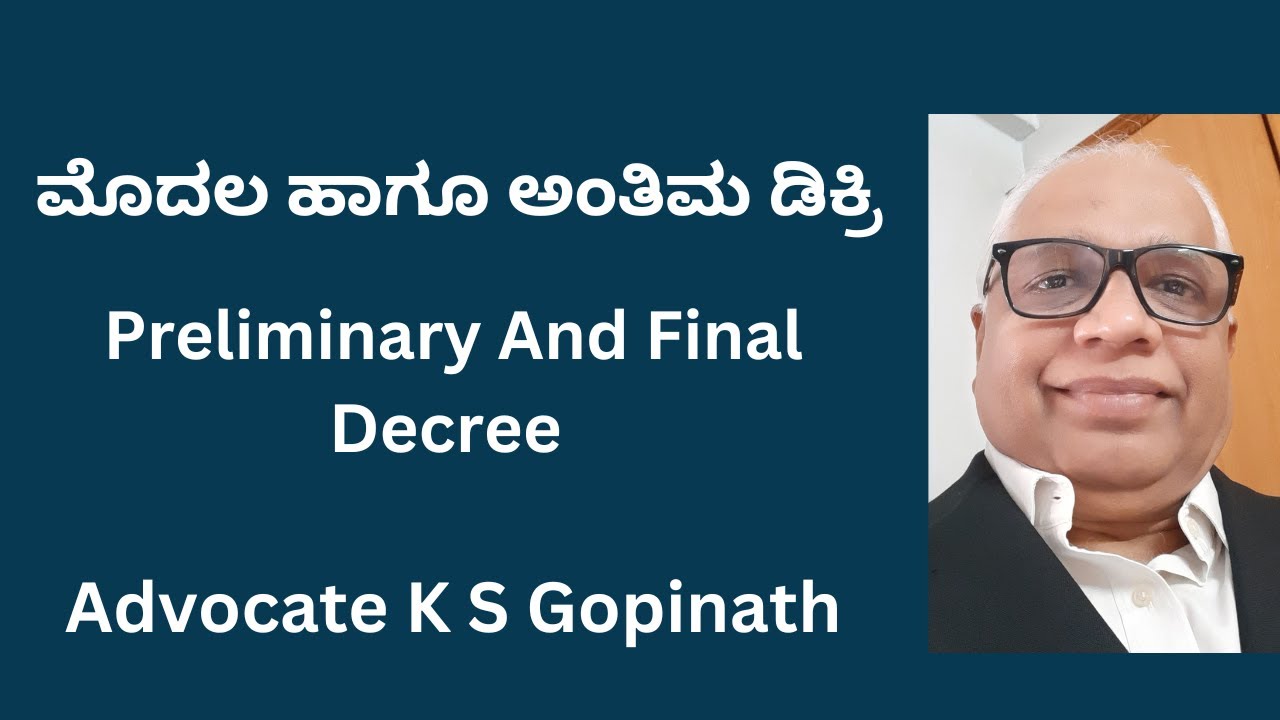
Preliminary & Final Decree
'Preliminary Decree' is not defined in the CPC. However, a passing reference is found in section 2 (2) of CPC, i.e., a Decree can be preliminary, final or partly preliminary and partly final. As the very name suggests, a preliminary Decree will not become final until a final Decree is passed. Therefore, after passing of a preliminary Decree and until the passing of a final Decree, a suit is said to be pending. For this reason alone, there is no applicability of the Limitation Act4 for filing of an application for passing of final Decree. Upon passing of a preliminary Decree, the rights of the parties get crystalized but will materialize finally only when the final Decree is passed, which alone is executable.
For instance, in a suit for partition, a party is declared that he is entitled to half (½) a share in the suit properties. But actual demarcation and identity of his share will be determined in final Decree proceedings.
Only in certain civil cases, CPC requires for passing of preliminary Decree. Such suits are as mentioned below:
Suits for partition and separate possession,
Suits for possession and mesne profits,
Mortgage suits,
Administrative suits,
Suits for pre-emption,
Dissolution of partnership and rendition of accounts.
Accounts between a principal and an gent
The Supreme Court has directed the Trial Courts dealing with partition suits to proceed suo motu with the case soon after passing the preliminary decree."We direct the Trial Courts to list the matter for taking steps under Order XX Rule 18 of the CPC soon after passing of the preliminary decree for partition and separate possession of the property, suo motu and without
#kannada #law #india #indianlaw #cpc1908 #petition #decree #partition #case #final #partition #partnership #pending #rejected #court #civil court
#preliminary
Recent Video:- • ನ್ಯಾಯಾಲಯದ ಆದೇಶ , ತೀರ್ಪು ಮತ್ತು ಡಿಗ್ರಿಗಳ ಪಾತ...
Повторяем попытку...

Доступные форматы для скачивания:
Скачать видео
-
Информация по загрузке: