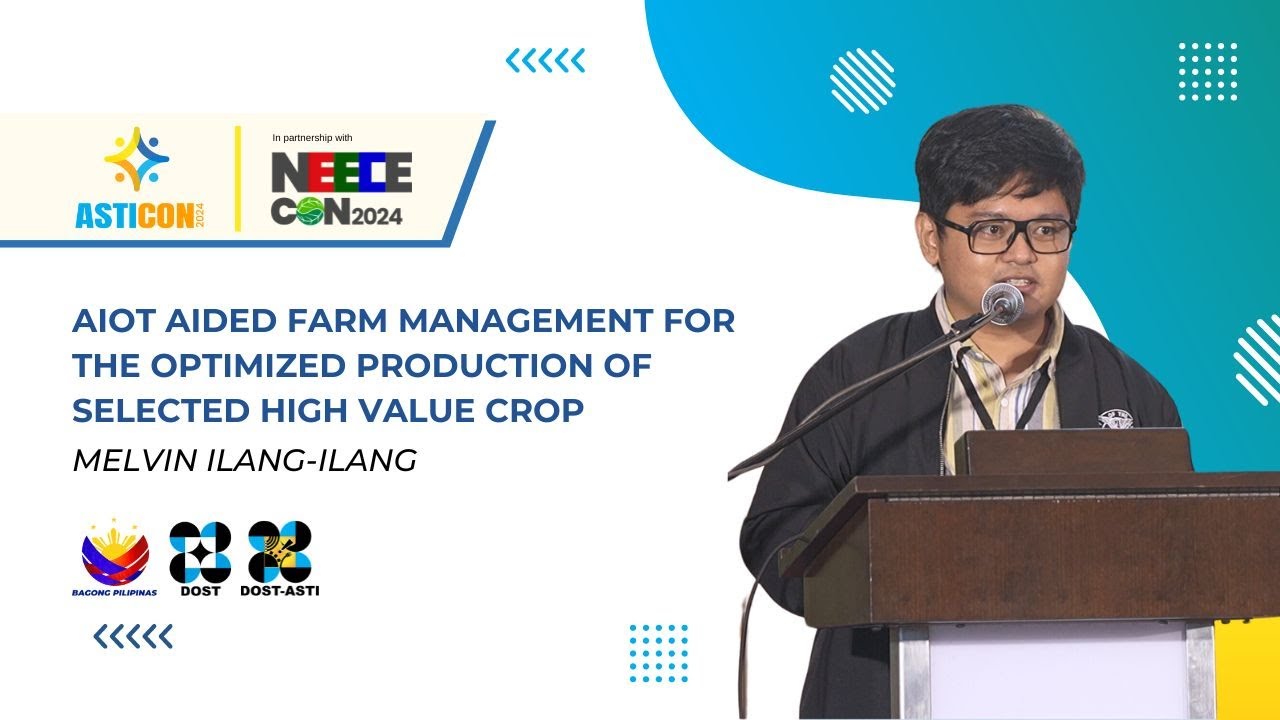
AIoT Aided Farm Management for the Optimized Production of Selected High Value Crop
Автор: DOST-Advanced Science and Technology Institute
Загружено: 2024-08-20
Просмотров: 38
Описание:
AIoT Aided Farm Management for the Optimized Production of Selected High Value Crop
Melvin Ilang-Ilang
Assistant Professor
Department of Electrical Engineering
UP Los Baños
Improving farm management practices to mitigate losses stemming from inefficiencies remains a significant challenge, particularly in the cultivation of high-value crops. Embracing a data-driven approach is crucial, necessitating the integration of advanced technology solutions. The advent of groundbreaking technologies such as the Internet of Things (IoT) and Artificial Intelligence (AI) has propelled precision agriculture to new heights, offering enhanced capabilities in data collection, management, and communication. In the context of tomato production, previous needs assessments and technology intervention studies highlighted the detrimental impact of inefficiencies in farm management, notably concerning irrigation and fertilizer application. To tackle these issues head-on, a study was undertaken to develop a system tailored for monitoring and regulating irrigation and fertilizer usage in tomato cultivation. This smart system utilizes calibrated sensors, connected to an online dashboard, optimized for actual field conditions, aiming to streamline operations and optimize resource utilization. Additionally, experiments were carried out to assess the hydraulic performance of the fertigation system developed. It was determined to exhibit performance ranging from good to excellent, as indicated by measures such as the coefficient of variation (CV), coefficient of uniformity (CU), and emission uniformity (EU). Randomized complete block design (RCBD) was used to investigate the effects of irrigation and fertilizer application methods on yield. The block which used scheduled irrigation, yielded the highest harvest with an average of 9,287.5 grams, while the block with manual irrigation had the lowest yield with an average of 5,875 grams. ANOVA indicated significant differences in means between irrigation methods. Duncan’s multiple range test (MRT) grouped scheduled and reactive irrigation together, showing significantly higher yields compared to manual irrigation. Least significant difference (LSD) confirmed these findings, with scheduled and reactive irrigation showing no significant difference in yield, while manual irrigation differed significantly from the other methods. Moreover, assuming two cropping cycles per year, the payback period for introducing AIoT interventions to farm production activities was computed to be 1.26, 0.89, and 0.66 years for low, medium, and high farm gate price cases, respectively.
As part of the National Electrical, Electronics and Computer Engineering Conference (NEECECON 2024), this technical session is organized by the UP Electrical and Electronics Engineering Institute with the theme "National Development through Sustainable Industrialization."
NEECECON 2024 is co-located with the Advanced Science, Technology, and Innovation Convention (ASTICON) 2024, held from 18 to 19 July 2024 at the Novotel Manila Araneta City in Quezon City.
ASTICON 2024 showcased DOST-ASTI and UP EEEI's pioneering contributions to the ICT landscape while celebrating the partnerships that drive technological advancement and societal progress in the country.
For more info about the event, visit https://neececon2024.eee.upd.edu.ph.
Повторяем попытку...
Доступные форматы для скачивания:
Скачать видео
-
Информация по загрузке:









![Эффект Джанибекова [Veritasium]](https://imager.clipsaver.ru/N9HlQ-XVnFk/max.jpg)