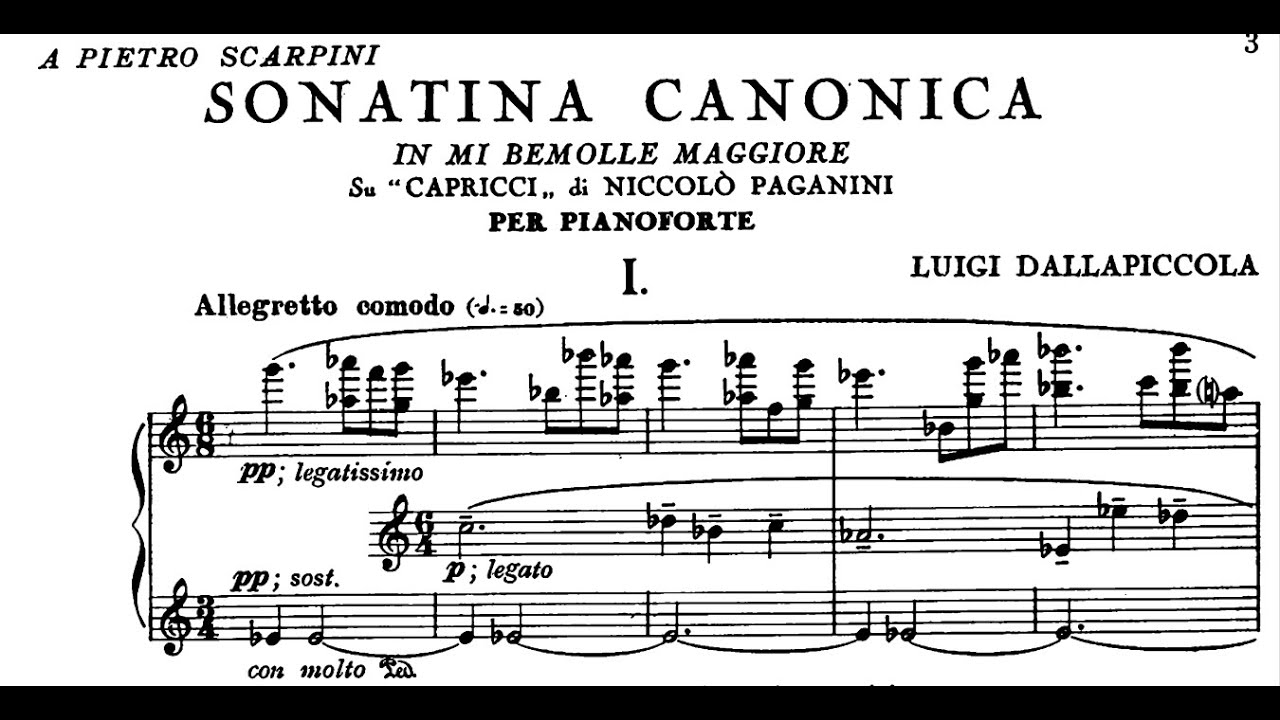
Luigi Dallapiccola - Sonatina canonica su "Capricci" di Niccolò Paganini
Автор: Classical Gems
Загружено: 2023-01-08
Просмотров: 1570
Описание:
- - -
Intro : [00:00]
I. Allegretto comodo - Allegro molto misurato [00:05]
II. Largo - Vivacissimo - Largo [03:45]
III. Andante sostenuto [05:44]
IV. Alla marcia: moderato [07:50]
- - -
Piano - Stephanie Fung
- - -
Luigi Dallapiccola was an Italian composer known for his lyrical twelve-tone compositions.
It was Richard Wagner's music that inspired Dallapiccola to start composing in earnest, and Claude Debussy's that caused him to stop: hearing Der fliegende Holländer while exiled to Austria convinced the young man that composition was his calling, but after first hearing Debussy in 1921, at age 17, he stopped composing for three years in order to give this important influence time to sink in. The neoclassical works of Ferruccio Busoni would figure prominently in his later work, but his biggest influence would be the ideas of the Second Viennese School, which he encountered in the 1930s, particularly Alban Berg and Anton Webern. Dallapiccola's works of the 1920s (the period of his adherence to fascism) have been withdrawn, with the instruction that they never be performed, though they still exist under controlled access for study.
His works widely use the serialism developed and embraced by his idols; he was, in fact, the first Italian to write in the method, and the primary proponent of it in Italy, and he developed serialist techniques to allow for a more lyrical, tonal style. Throughout the 1930s his style developed from a diatonic style with bursts of chromaticism to a consciously serialist outlook. He went from using twelve-tone rows for melodic material to structuring his works entirely serially. With the adoption of serialism he never lost the feel for melodic line that many of the detractors of the Second Viennese School claimed to be absent in modern dodecaphonic music. His disillusionment with Mussolini's regime effected a change in his style: after the Abyssinian campaign, he claimed that his writing would no longer ever be light and carefree as it once was. While there are later exceptions, particularly the Piccolo concerto per Muriel Couvreux, this is largely the case.
Повторяем попытку...
Доступные форматы для скачивания:
Скачать видео
-
Информация по загрузке:






![Ferruccio Busoni: 3 Morceaux; Op 4, 5, 6. [BV 197] (Harden)](https://imager.clipsaver.ru/hERfRaISFJ0/max.jpg)