How Pascal's Law Affects Everyday Life: Real-World Applications
Автор: Physics Topics by Praveen
Загружено: 2022-04-07
Просмотров: 1498
Описание:
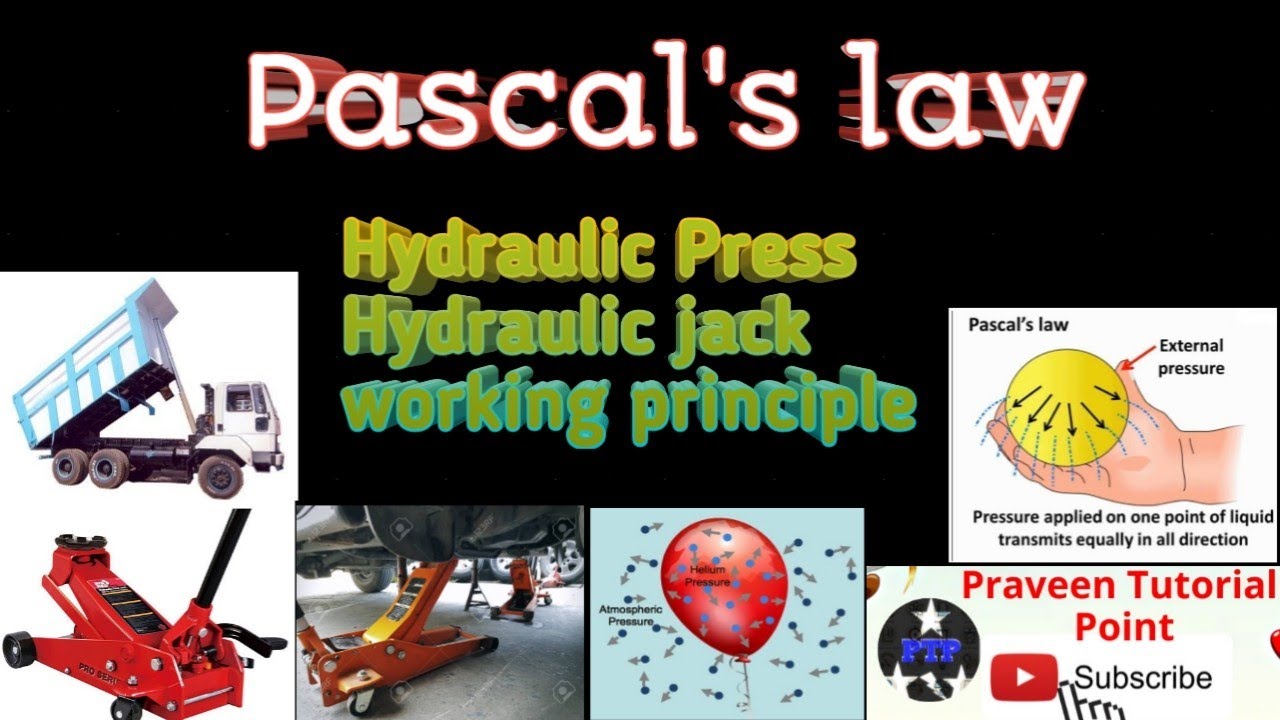
Pascal's law, also known as Pascal's principle, is a fundamental theory in fluid mechanics that has significant applications in various fields including engineering and hydraulics. At the core of Pascal's law lies the concept that when pressure is applied to a confined fluid, that pressure is transmitted undiminished and uniformly in all directions throughout the fluid. This principle is vital in understanding how hydraulic systems operate and is a crucial foundation in the study of fluid dynamics and physics.
To illustrate the significance of Pascal's law, consider a simple hydraulic system composed of two connected pistons of different sizes submerged in a hydraulic fluid, such as oil or water. When a force is applied to the smaller piston, Pascal's law dictates that the pressure created in the confined space is transferred to the larger piston, magnifying the effect of the force applied. This is why hydraulic machines, such as car lifts or excavators, can amplify the force applied by a user to accomplish heavy mechanical tasks with comparatively little effort.
The practical implications of Pascal's law extend far beyond just manual pumps and hydraulics; it also influences the design of various machinery, including airplanes and even medical devices. Understanding Pascal’s law allows engineers to calculate the necessary forces and dimensions needed to ensure safety and efficiency in systems relying on fluid pressure. This principle also assists in the design of pressure gauges, where changes in external pressure can be monitored and measured precisely due to the nature of fluid dynamics governed by Pascal’s law.
Furthermore, applications of Pascal's law are evident in everyday life; from the mechanism of a dentist's chair to the functioning of an aircraft's hydraulic braking systems, the principle plays a critical role in enabling these technologies to operate effectively and reliably. In fact, the culinary world also witnesses the impact of Pascal's law through methods such as pressure cooking, where the steam pressure can enhance cooking times and the quality of food.
One of the most important implications of Pascal's law in modern engineering is in the design of fluid power systems. These systems harness the force of fluids under pressure to drive machinery, making processes more efficient. By using this principle, engineers can create systems that provide smooth and controlled movements, enhancing the performance of various industrial applications ranging from manufacturing lines to construction machinery.
Pascal’s law is not just limited to practical applications; it also serves as an educational tool in physics classes around the world. Through experiments demonstrating how pressure is applied and transmitted, students gain a deeper understanding of force, motion, and the behavior of fluids. Experimentation typically involves simple activities such as using syringes filled with liquid or creating small hydraulic models, allowing learners to apply Pascal’s law in practical scenarios, see its effects firsthand, and appreciate its broader implications.
Moreover, the relationship between pressure and volume described by Pascal’s law ties into other fundamental concepts in physics, such as the ideal gas law, which describes how pressure, volume, and temperature interact in a gaseous environment. Thus, Pascal's law provides a gateway to numerous scientific explorations and insights that connect various disciplines, enhancing our comprehension of the physical world.
In conclusion, Pascal's law is more than an abstract theory; it is a practical, versatile principle that facilitates our modern way of living, driving innovations in technology and machinery. Understanding Pascal's law will continue to inspire new designs and inventions as we seek to harness the potential of fluids for diverse applications. Whether in simple hydraulic presses or complex aerospace systems, Pascal’s law remains a cornerstone of engineering practices, emphasizing the importance of pressure and the omnipresence of fluid dynamics in our everyday experiences. Thus, the study of Pascal's law is not merely an academic pursuit; it serves as a vital element influencing how we interact with the physical and engineered environments around us.
Повторяем попытку...
Доступные форматы для скачивания:
Скачать видео
-
Информация по загрузке: