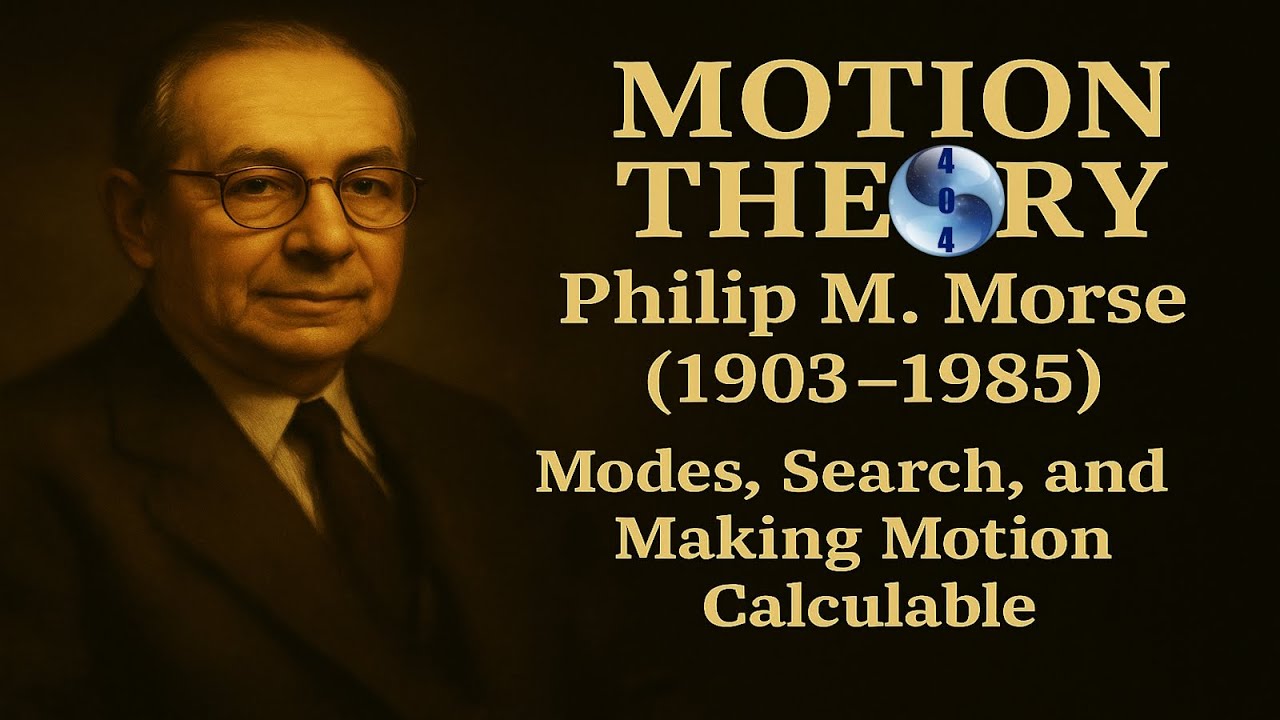
Philip M. Morse (1903–1985) — Modes, Search, and Making Motion Calculable
Автор: Motion Theory
Загружено: 2025-10-13
Просмотров: 37
Описание:
/ @themotiontheory
Keywords:
Philip M. Morse, Motion Theory, Morse potential, diatomic molecules, anharmonic oscillator, quantum vibrations, Green’s functions, separation of variables, Methods of Theoretical Physics, Herman Feshbach, operations research, U.S. Navy Operations Research Group, World War II science, optimization, search theory, convoy protection, sonar, radar detection, acoustics, vibration and sound, Theoretical Acoustics, MIT Computation Center, eigenmodes, boundary conditions, resonance, Q factor, synchronization density, coherence, leak, stability, coupling, applied mathematics, theoretical physics, boundary operators, decision physics, coherence control, Green’s-function analysis, structured motion, energy landscapes, mode coupling, impedance, cavities, waveguides, spectral identity, noise control, signal detection, Bayesian updating, ROC curves, S/R/C calculus, optimization under constraints, feedback systems, learning loops, acoustic modeling, urban acoustics, molecular spectroscopy, isotopic shifts, blind prediction, noise, dissociation energy, stability spectrum, theoretical modeling, harmonic vs. anharmonic, coherent motion, structural resonance, field theory, computational physics, applied coherence engineering, Green’s function workflow, testable spectra, measurement and modeling, MIT operations research, interdisciplinary computation, scientific method, problem-solving framework, decision loops, socio-technical systems, boundary-driven phenomena, physical modeling, computational acoustics, resonant structures, wave propagation, coherence landscape, modal analysis, physical decision theory, optimization physics, systems engineering, feedback dynamics, structure-motion interaction, physical design principles, predictive modeling, systems coherence
Description:
Philip M. Morse (1903–1985) stands as one of the quiet architects of modern calculable motion. In Motion Theory terms, he is the engineer who taught physics, acoustics, and decision science how to think in modes. His signature creation—the Morse potential—transformed how chemists understood molecular bonds. Instead of treating atoms as perfect harmonic oscillators that never break, Morse introduced an elegant formula that captures the real, anharmonic behavior of diatomic molecules: strong near equilibrium, softening with energy, and finally dissolving into free motion. It turned “molecular breathing” into a computable landscape, linking coherence and dissociation through a single curve.
Beyond molecules, Morse extended this same logic to the macroscopic world. His books Vibration and Sound and Theoretical Acoustics (with Ingard) transformed vibrating rooms, ducts, and seas into solvable boundary problems. Every geometry has its spectrum; every wall and opening selects which modes survive. Through the discipline of Green’s functions, Morse showed how to compute motion locally—respecting symmetry, boundary, and source—and rebuild the global field as a superposition of modes. This operator-based framework became a universal adapter for solving complex physical systems and remains the backbone of acoustic and wave analysis today.
Yet Morse’s genius reached further: he helped found operations research (OR), the physics of decisions. Leading the U.S. Navy’s Operations Research Group in World War II, he and his teams applied quantitative reasoning to convoy protection, sonar search patterns, and resource allocation—turning noisy, chaotic theaters into measurable, optimizable systems. His later books, including Methods of Operations Research and Methods of Theoretical Physics (with Feshbach), established an intellectual workflow uniting theory, computation, and real-world testing.
In Motion Theory’s modern language, Morse designed coherence architectures—structures and strategies that hold form against noise. Whether the loops were molecular, acoustic, or operational, he asked the same questions: What are the allowed modes? How does the boundary select them? Where does coherence leak, and how can we design couplings to minimize loss? His insistence on measurable spectra, solvable equations, and feedback-aware design created a bridge between physics, engineering, and organizational decision-making.
Morse’s influence endures in every domain that treats boundaries as operators and decisions as part of the physical system. His legacy informs today’s computational physics, data-driven modeling, and systems optimization—from urban acoustics to search-and-rescue algorithms. In the language of Motion Theory, Philip Morse taught us to turn motion into mathematics, decisions into dynamics, and coherence into a quantity we can compute. He built not just theories but workflows: calculate the modes, measure the leaks, optimize the coupling, and keep the right loops alive. In doing so, he gave science a method for making motion—and meaning—calculable.
Повторяем попытку...
Доступные форматы для скачивания:
Скачать видео
-
Информация по загрузке: