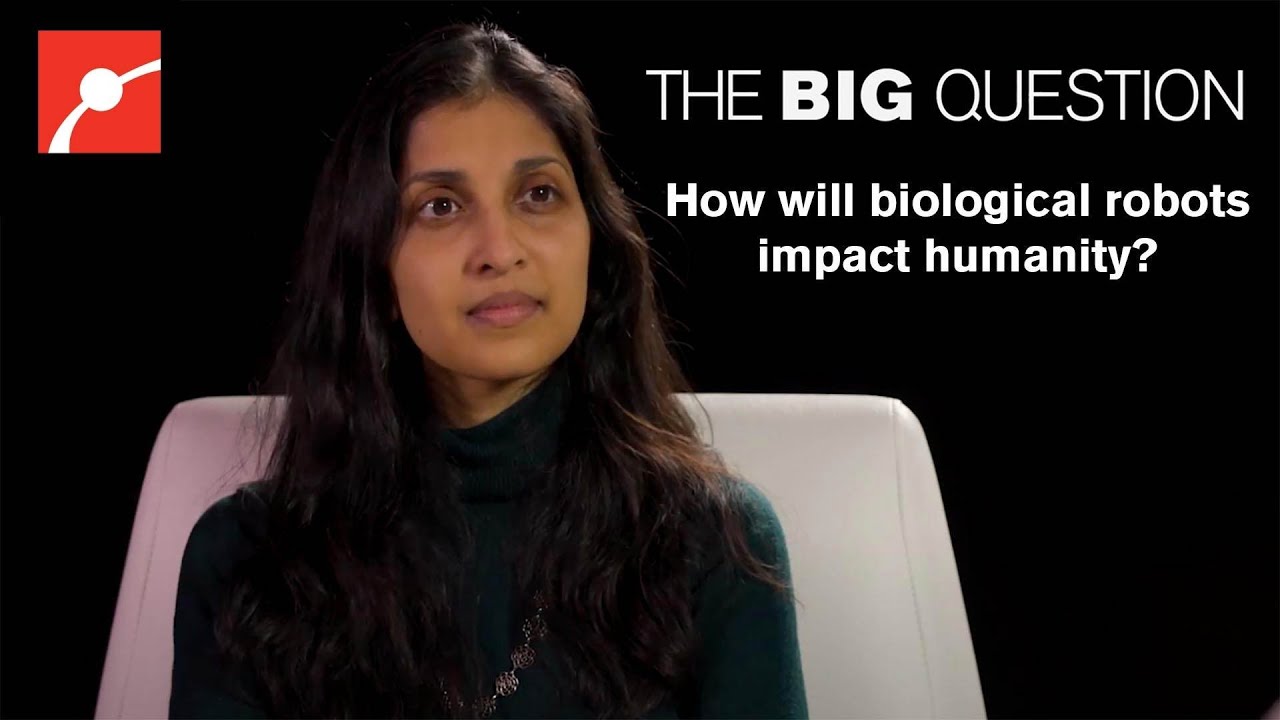
Using Living Cells to Make Biological Robots: MIT Engineer Ritu Raman on Her Pioneering Work
Автор: Museum of Science
Загружено: 2023-08-28
Просмотров: 2315
Описание:
Can biological robots be used to benefit society without inviting dystopian scenarios commonly portrayed in science fiction? Ethicist and Philosopher Insoo Hyun asks this big question to mechanical engineer Ritu Raman. Ritu’s research is focused on restoring mobility for individuals who've lost it due to illness or trauma using an innovative approach that merges living cells with engineered structures to build muscle-powered robots. Ritu believes biological robots can play a role in helping to restore ways in which humans rely on a combination of skeletal muscle and the nervous system to navigate our dynamic world. Interestingly, Ritu draws inspiration from science fiction, especially comic books. This fusion of biology, sci-fi and engineering has the potential to produce a wide range of applications in medicine and beyond. This conversation offers a thoughtful and enlightening perspective on this pioneering research.
Ritu Raman, PhD is the d’Arbeloff Career Development Assistant Professor of Mechanical Engineering at MIT. Her lab is centered on engineering adaptive living materials for applications in medicine and machines. She has also been named to the Forbes 30 Under 30 and MIT Technology Review 35 Innovators Under 35 lists, and is the author of the MIT Press book Biofabrication. She is passionate about increasing diversity in STEM and has championed many initiatives to empower women in science, including being named a AAAS IF/THEN ambassador and founding the Women in Innovation and STEM Database at MIT (WISDM). Prof. Raman received her BS from Cornell University and her PhD as an NSF Graduate Research Fellow at the University of Illinois at Urbana-Champaign. She completed her postdoctoral research with Prof. Robert Langer at MIT, funded by a L’Oréal USA For Women in Science Fellowship and a Ford Foundation Fellowship from the National Academies of Sciences, Engineering, and Medicine.
Insoo Hyun is Director of Research Ethics and a faculty member of the Center for Bioethics and senior lecturer on Global Health and Social Medicine at Harvard Medical School. He is also Director at the Center for Life Sciences and Public Learning at the Boston Museum of Science. As a Fulbright Scholar and Hastings Center Fellow, Dr. Hyun's interests include ethical and policy issues in stem cell research and new biotechnologies.
Chapters
00:00 Introduction
00:34 Biological Mechanical Engineering
01:44 Moving from Plastics to Living Cells
02:53 What Enabled the Crossover to Living Materials
04:12 Concerns Around Ritu's Work
05:49 Concerns in Ritu's Field of Study
6:59 The Million Year Picnic Comic Book Store
8:12 Caring for Biological Machines
9:39 Ritu's Adaptive Biological Materials in Her Lab
10:19 Size of Ritu's Adaptive Biological Materials
11:02 What Kind of Problems Can Engineering Materials Powered by Living Cells Solve?
12:38 Control Over Adaptive Biological Materials
14:15 Multiple Biological Parts
15:42 Superpowers
16:38 Adaptive Biological Material Growing and Healing
18:39 Ensuring Biological Robots Don't Harm Humanity
19:58 Tough Choices Ritu Has to Make
22:37 Art and Engineering
22:36 The Visuals of Ritu's Adaptive Biological Materials Powered by Living Cells
24:16 Should Society Have a Say in Creative Process
26:38 Getting People Excited about STEM
28:26 Ritu's Childhood
29:24 Can Comic Books Teach Important Concepts
30:37 Collaborating With Other Researchers
31:48 Art and Engineering
34:40 What Inspires Ritu in the Natural World
36:21 What Inspired Ritu as a Child
37:20 Closing Statements
The Big Question (Video Series): • The Big Question
More Dr. Ritu Raman Conversations:
-How Comic Books Inspired A Bioengineer’s Work: • How Comic Books Inspired A Bioengineer’s Work
Among the world's largest science centers, the Museum of Science engages millions of people each year to the wonders of science and technology through interactive exhibitions, digital programs, giant screen productions, and preK – 12 EiE® STEM curricula through the William and Charlotte Bloomberg Science Education Center. Established in 1830, the Museum is home to such iconic experiences as the Theater of Electricity, the Charles Hayden Planetarium, and the Mugar Omni Theater. Around the world, the Museum is known for digital experiences such as Mission: Mars on Roblox, and traveling exhibitions such as the Science Behind Pixar. Learn more at https://www.mos.org/
#MuseumofScience #Boston #ScienceforAll
Повторяем попытку...
Доступные форматы для скачивания:
Скачать видео
-
Информация по загрузке: