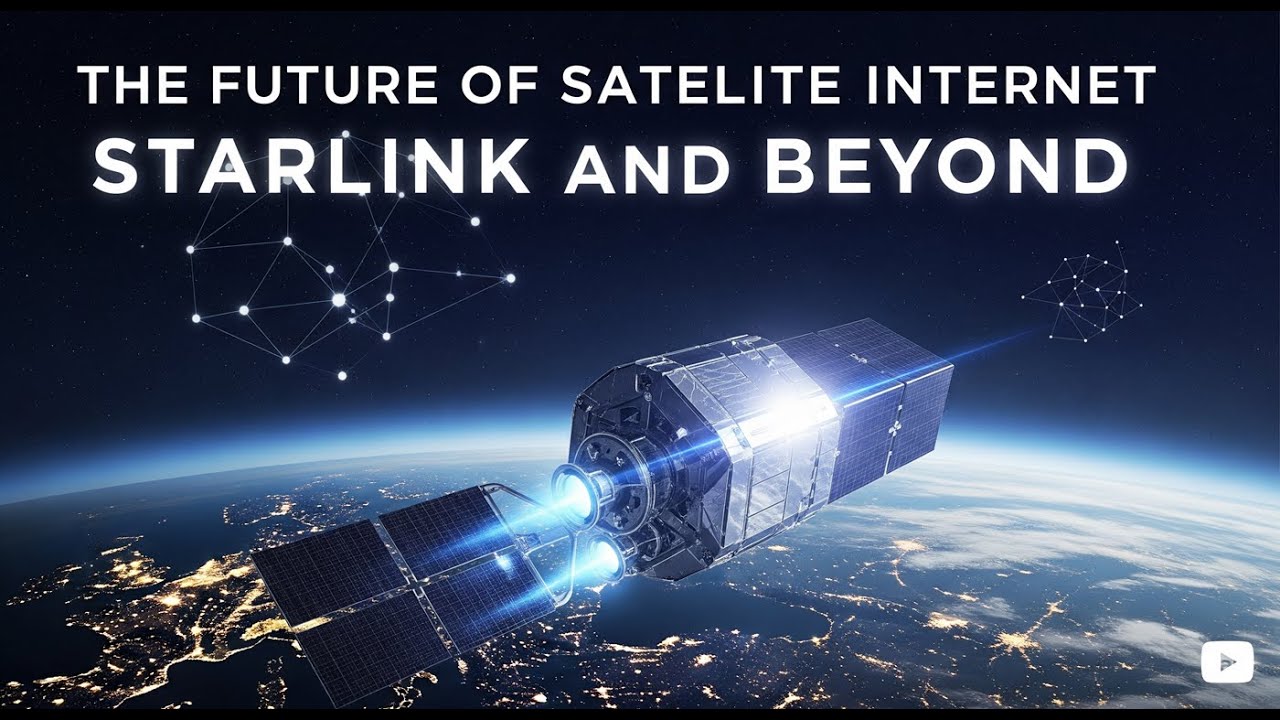
The Future of Satellite Internet Starlink and Beyond
Автор: The Curious Lab
Загружено: 2025-08-26
Просмотров: 14
Описание:
The Future of Satellite Internet Starlink and Beyond
The future of satellite internet is no longer a sci-fi concept; it's a rapidly expanding reality, largely driven by a new generation of Low Earth Orbit (LEO) constellations. While companies have provided satellite internet for years using a few large satellites in high-altitude geostationary orbits (GEO), LEO constellations promise to solve the traditional problems of slow speeds and high latency, opening up a new era of global connectivity.
At the heart of this revolution is SpaceX's Starlink, but a competitive landscape is quickly emerging.
Starlink: The Market Leader
Starlink is the dominant force in the LEO satellite internet market. As of mid-2025, it has a constellation of over 8,100 active satellites, providing high-speed, low-latency internet to a global customer base.
Rapid Growth and Global Reach: Starlink's subscriber count has seen explosive growth. By July 2025, it had over 6 million subscribers worldwide, with a significant number of new users coming from previously underserved regions in Africa and Asia. The service is now available in over 136 countries.
Performance: Starlink promises download speeds of hundreds of megabits per second (Mbps), and as of July 2025, the median download speed in the U.S. for its more than 2 million customers is nearly 200 Mbps during peak demand. This performance is a massive improvement over traditional satellite internet.
Business Model: Starlink's business model is now focused on achieving profitability. In 2025, the service is projected to generate billions of dollars in revenue, with a business that is cash-flow positive. The company is diversifying its revenue streams beyond residential users, including strategic partnerships for aviation, maritime, and government sectors.
The Competition: A Multi-Billion Dollar Race
While Starlink has a significant head start, it is not without formidable competition. Major players are investing billions to launch their own LEO constellations.
Amazon's Project Kuiper: This is Starlink's most ambitious competitor. Backed by a $10 billion investment from Amazon, Project Kuiper aims to deploy a constellation of over 3,200 satellites. After launching two prototype satellites in 2023, Amazon has moved into the operational phase, launching its first batches of production satellites in 2025. The company is actively building its ground infrastructure and has set a goal to have half its constellation in orbit by mid-2026.
OneWeb (Eutelsat Group): OneWeb has successfully deployed its initial constellation of 648 satellites, enabling it to provide global coverage. Unlike Starlink, which focuses on direct-to-consumer services, OneWeb's primary business model is to sell wholesale capacity to telecommunications companies and governments, allowing them to extend their networks. The company has also secured new contracts to build an additional 100 satellites for a next-generation constellation that will include 5G integration.
Telesat Lightspeed: This Canadian company is planning its own LEO constellation of hundreds of satellites. It is focused on serving the high-end enterprise and government markets, promising a secure and reliable network with ultra-low latency. While its deployment timeline is behind its competitors, it remains a significant player in the enterprise sector.
The Future of Connectivity
The rise of LEO satellite internet signals a new era for global connectivity. The traditional digital divide, where high-speed internet was a luxury of urban areas, is being challenged. Satellite internet is increasingly becoming a viable alternative for:
Rural and Remote Areas: Providing connectivity to communities that are too expensive or difficult to reach with fiber or cellular networks.
Maritime and Aviation: Offering reliable internet to ships and planes for passengers and crew.
Government and Military: Providing secure and resilient communications in remote or disaster-stricken areas.
IoT and Enterprise: Connecting devices and enabling business operations in locations with no terrestrial infrastructure.
#StudyWithMe #StudyVlog #StudyMotivation #StudyTips #Productivity #StudentLife #ExamPrep #OnlineLearning #Learning #Education #Student #CollegeLife #UniversityLife #School #StudyHard #Notes #StudyGoals #Focus #Motivation #Maths #Science #Physics #Chemistry #Biology #History #English #Literature #Coding #Programming #LanguageLearning #MedSchool #LawSchool #Engineering #BusinessStudies #ArtHistory #CreativeWriting #Dissertation #Thesis #Research #Pomodoro #ActiveRecall #SpacedRepetition #TimeManagement #StudyRoutine #MorningRoutine #NightRoutine #WhatsInMyBag #DeskTour #Stationery #StudyMusic #StudyWithMeLive #StudyChallenge #GoalSetting #SelfCare #Wellness #ProductivityHacks #Shorts #YouTubeShorts #Viral #Trending #ForYou #EduShorts #KnowledgeNuggets #LearnWithMe #QuickLearn #DailyLearning
Повторяем попытку...
Доступные форматы для скачивания:
Скачать видео
-
Информация по загрузке: