Primary Care – Periodic Health Exam: By Ted Osmun M.D.
Автор: Medskl.com
Загружено: 2016-06-29
Просмотров: 4902
Описание:
medskl.com is a global, free open access medical education (FOAMEd) project covering the fundamentals of clinical medicine with animations, lectures and concise summaries. medskl.com is working with over 170 award-winning medical school professors to provide content in 200+ clinical presentations for use in the classroom and for physician CME.
Primary Care – Periodic Health Exam
Whiteboard Animation Transcript
with Ted Osmun, MD
https://medskl.com/Module/Index/perio...
There was a time when an annual health exam was considered necessary and appropriate. No longer. We now do periodic health exams and investigations targeted to a patient’s age and gender.
The three key populations that we do periodic exams are in babies, teens, and middle age.
Babies get the most frequent periodic health exams. They are seen regularly from 1 week to 18 months, and after that yearly until age 5 when they will finish their primary vaccine series. The goal is to assess growth and development, administer vaccines, and address parental concerns.
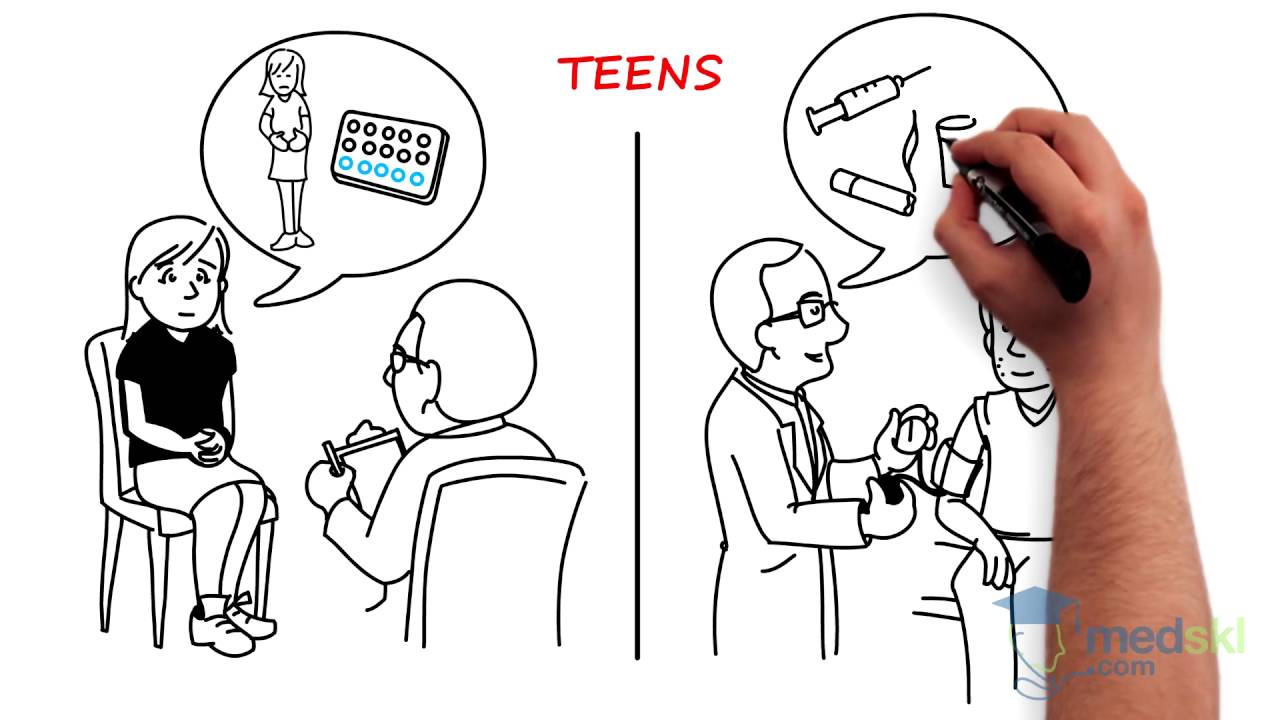
Teen girls appear for menstruation issues or the need for birth control. In teens, remember to check blood pressure and counsel about high-risk behaviours and drug/alcohol abuse. Pap smears are recommended starting at age 21 every 3 years until age 70. If a problem arises, a woman may need more frequent pap smears. In some countries pap smears don’t start until age 30.
In the 50’s we ramp up screening. For men and women, we start screening for blood pressure, cholesterol, diabetes, and colon cancer.
At age 50, fecal occult blood testing is done every two years until age 75, if you have no family history of colon cancer. If you have a positive family history of colon cancer in first-degree relatives, colonoscopy is recommended 10 years earlier than the age your relative was diagnosed.
In addition, women in this age group will also start getting mammograms for breast screening every two years, from age 50 to age 75. There is considerable controversy when mammograms should start and just how effective they are.
Also remember, at all periodic health visits, address risky behaviours, smoking, alcohol and drug abuse, diet, exercise, and immunization requirements.
Повторяем попытку...
Доступные форматы для скачивания:
Скачать видео
-
Информация по загрузке: