Direct Sampled RF Receiver System Design, part 7,
Автор: Dr. Mohamed Nezami دكتور محمد النظامي
Загружено: 2026-01-14
Просмотров: 268
Описание:
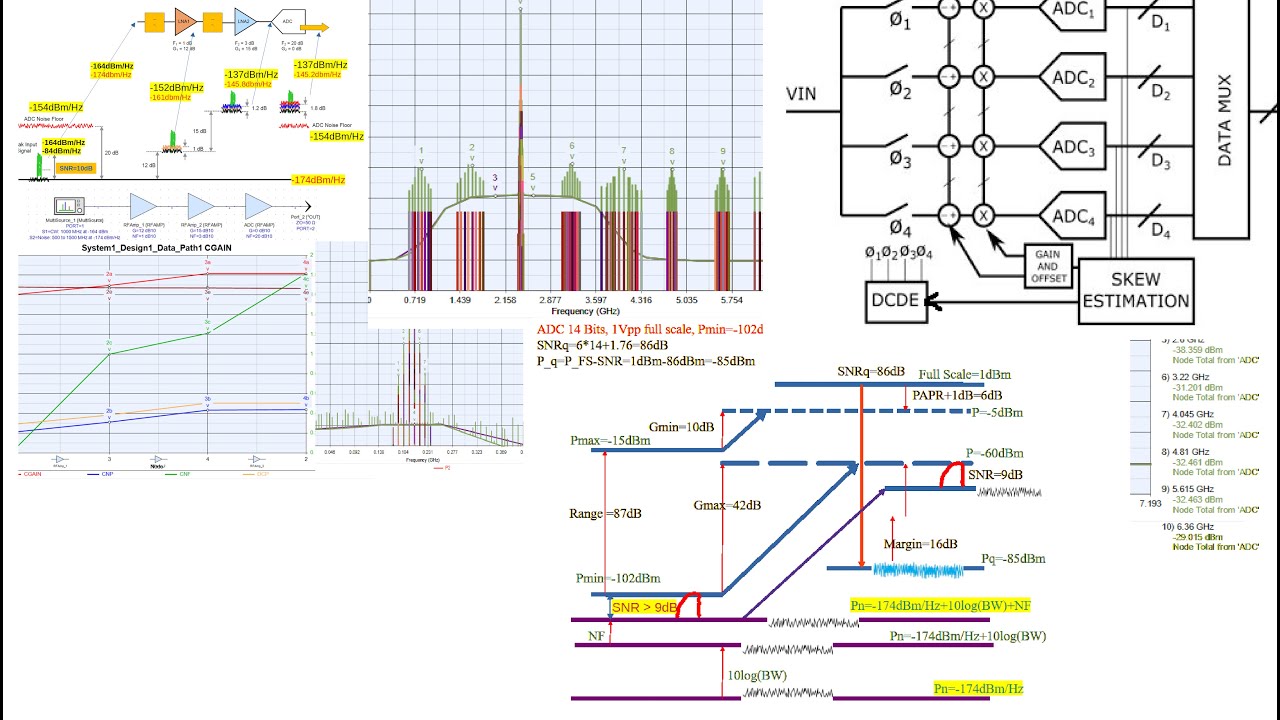
Direct Sampled RF Receiver System Design, part 7,
RF Receiver Architecture Evolution.
Direct and IF Sampled RF Signal Chain.
ADC Filtering, Digital Down Conversion, and Decimation Filtering.
Principle of Direct RF Sampling Receiver.
RF Sampling ADCs and SERDES
Commercially Available RF sampling Gsps ADCs.
Direct RF Sampling Receiver Design Modeling Examples:
Direct RF Sampled S-Band Receiver System Design.
Direct RF Sampled 28GHz mmWave Receiver System Design .
An RF direct sampling receiver is a receiver architecture that uses high-speed analog-to-digital converters (ADCs) to digitize radio frequency (RF) signals directly, eliminating the need for traditional analog components like mixers and local oscillators. This approach simplifies the hardware, reduces size and power consumption, and allows for greater flexibility and programmability through digital signal processing (DSP) for tasks like filtering and demodulation.
How it works:
RF input: The RF signal from the antenna is fed directly into the ADC, often after initial analog filtering and amplification.
Direct digitization: The high-speed ADC captures the analog RF signal and converts it into a digital stream, which can span a wide range of frequencies.
Digital signal processing (DSP): The digital signal is then processed using DSP, which can be implemented in an FPGA or a digital signal processor.
Signal isolation: Through digital downconversion (DDC), DSP can isolate the desired signal from the broad spectrum captured by the ADC.
Flexibility: Because the conversion and filtering happen in the digital domain, the receiver can be reconfigured in software to tune to different frequencies or standards without hardware changes.
Повторяем попытку...
Доступные форматы для скачивания:
Скачать видео
-
Информация по загрузке: