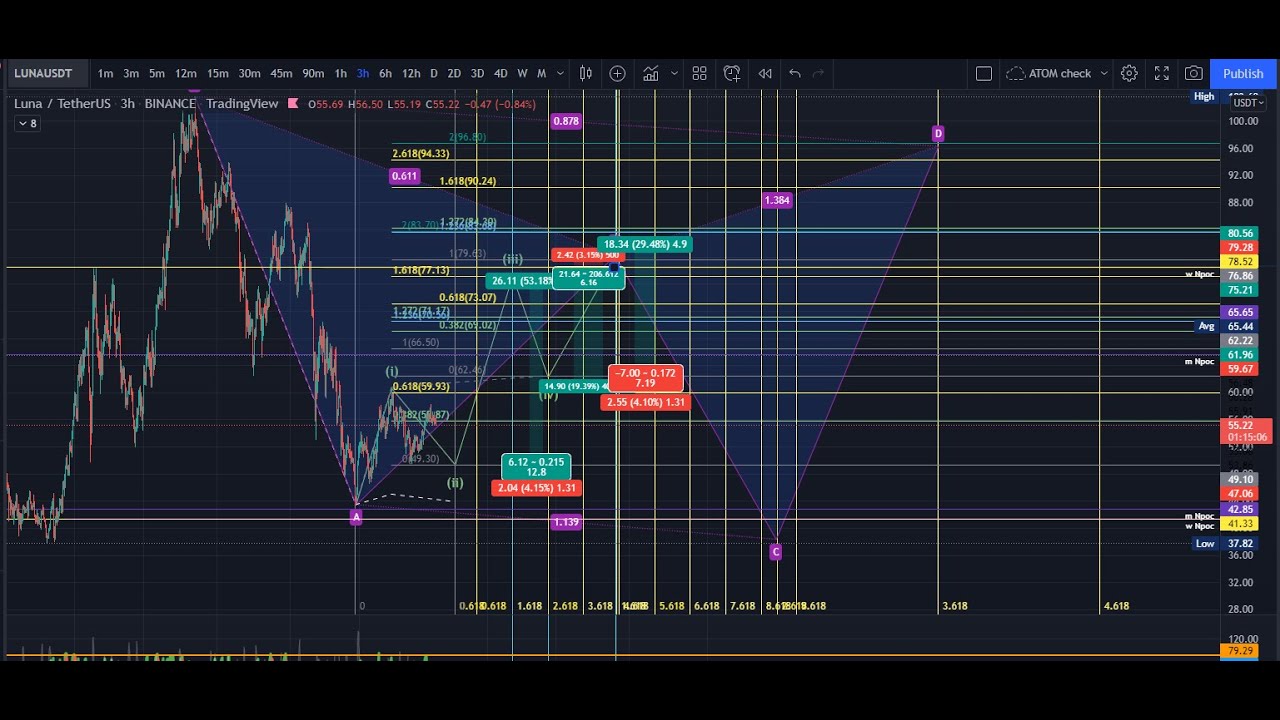
LUNAUSDT 17 February 2022 - Fib Time, Elliot Waves, Harmonics, Fibonacchi, Pitchfork, PitchFan $LUNA
Автор: Paul Mears
Загружено: 2022-02-17
Просмотров: 45
Описание:
About the Terra Protocol
The Terra protocol is the leading decentralized and open-source public blockchain protocol for algorithmic stablecoins. Using a combination of open market arbitrage incentives and decentralized Oracle voting, the Terra protocol creates stablecoins that consistently track the price of any fiat currency. Users can spend, save, trade, or exchange Terra stablecoins instantly, all on the Terra blockchain. Luna provides its holders with staking rewards and governance power.
Terra and Luna
The protocol consists of two main tokens, Terra and Luna.
Terra: Stablecoins that track the price of fiat currencies. Users mint new Terra by burning Luna. Stablecoins are named for their fiat counterparts. For example, the base Terra stablecoin tracks the price of the IMF’s SDR, named TerraSDR, or SDT. Other stablecoin denominations include TerraUSD or UST, and TerraKRW or KRT. All Terra denominations exist in the same pool.
Luna: The Terra protocol’s native staking token that absorbs the price volatility of Terra. Luna is used for governance and in mining. Users stake Luna to validators who record and verify transactions on the blockchain in exchange for rewards from transaction fees. The more Terra is used, the more Luna is worth.
How the Terra protocol works
Stablecoins
Stablecoins are the main feature of the Terra protocol: crypto assets that track the price of an underlying currency. As a digital form of currency, Terra stablecoins can be used just like fiat currency with blockchain’s added benefits: an unchangeable public ledger, instant transactions, faster settlement times, and fewer fees.
Stablecoins are only valuable to users if they maintain their price peg. The Terra protocol uses the basic market forces of supply and demand to maintain the price of Terra. When the demand for Terra is high and the supply is limited, the price of Terra increases. When the demand for Terra is low and the supply is too large, the price of Terra decreases. The protocol ensures the supply and demand of Terra is always balanced, leading to a stable price.
Expansion and contraction
Imagine the whole Terra economy as two pools: one for Terra and one for Luna. To maintain the price of Terra, the Luna supply pool adds to or subtracts from Terra’s supply. Users burn Luna to mint Terra and burn Terra to mint Luna, all incentivized by the protocol’s algorithmic market module.
Expansion: When the price of Terra is high relative to its peg, supply is too small and demand is too high. The protocol incentivizes users to burn Luna and mint Terra. The new supply of Terra makes its pool larger, balancing supply with demand. Users mint more Terra from burned Luna until Terra reaches its target price. The Luna pool gets smaller in this process, increasing the price of Luna.
Contraction: When the price of Terra is too low relative to its peg, supply is too large and demand is too low. The protocol incentives users to burn Terra and mint Luna. The decrease in Terra’s supply causes scarcity, and the price of Terra increases. More Luna is minted from burned Terra until Terra reaches its target price. The Luna pool increases and lowers in price.
Luna is the variable counterpart to the stable asset Terra. By modulating supply, Luna’s price increases as the demand for stablecoins increases.
The market module and arbitrage
The price stability of Terra is achieved by the protocol’s algorithmic market module, which incentivizes the minting or burning of Terra through arbitrage opportunities. Arbitrage occurs when a user profits from price differences between markets.
The Terra protocol’s market module enables users to always trade 1 USD worth of Luna for 1 UST, and vice versa, incentivizing users to maintain the price of Terra. This same principle is true for all Terra stablecoin denominations.
Scalability
The Terra protocol is scalable: it is designed to maintain Terra’s price stability regardless of market size, volatility, or demand. The monetary policies encoded into the protocol ensure its durability and resilience in all market fluctuations.
Seigniorage and deflation
Seigniorage is the value of a coin minus the cost of its production. In early versions of the Terra protocol, seigniorage was diverted to fund various community projects. While seigniorage can create enormous value, it also creates inflation in the system. All seigniorage in the Terra protocol is burned, making Luna deflationary in nature.
Consensus
The Terra blockchain is a proof-of-stake blockchain, powered by the Cosmos SDK and secured by a system of verification called the Tendermint consensus.
Staking
Staking is the process of bonding Luna to a validator in exchange for staking rewards.
Who owns staked Luna?
Staked Luna never leaves the possession of the delegator. Even though it can’t be traded freely, staked Luna is never owned by a validator. For more information, visit the Validator FAQ
Повторяем попытку...
Доступные форматы для скачивания:
Скачать видео
-
Информация по загрузке: