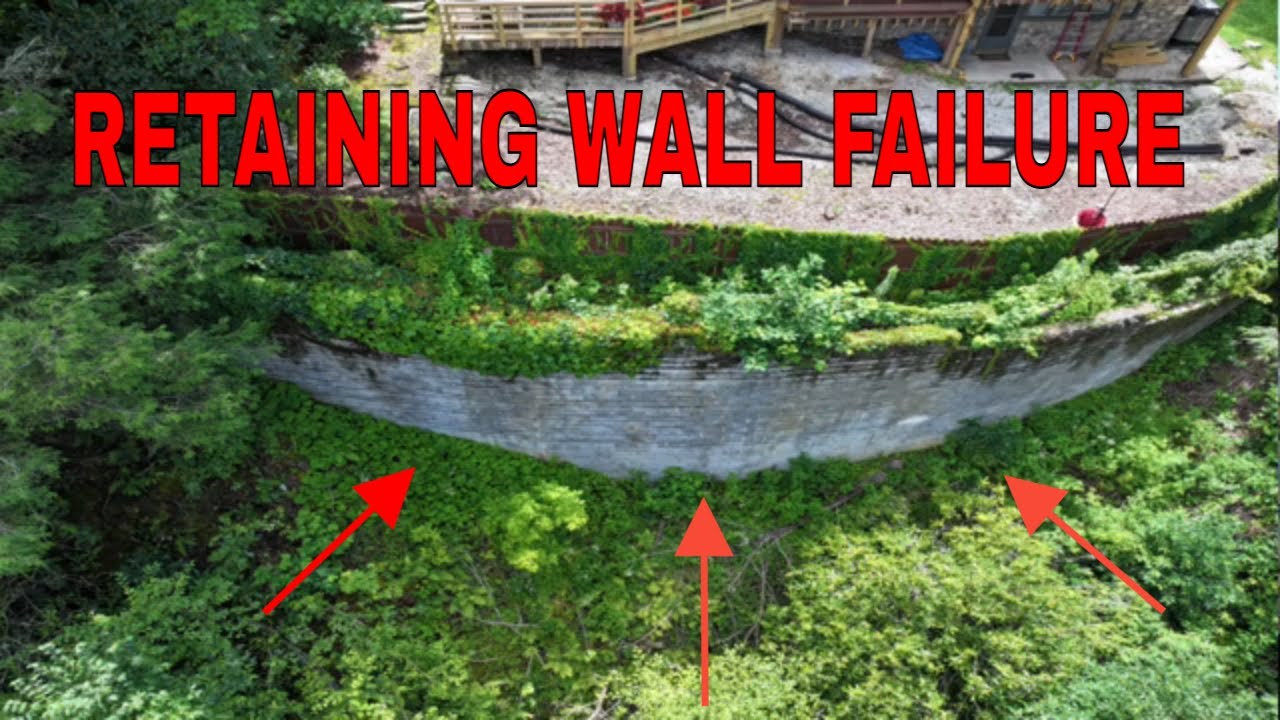
RETAINING WALL / SLOPE FAILURE PROJECT IN LINVILLE, NC - HIRE AN ENGINEER TO DESIGN THE REPAIR?
Автор: Specialty Foundation Repair
Загружено: 2025-10-03
Просмотров: 382
Описание:
RETAINING WALL / SLOPE FAILURE PROJECT IN LINVILLE, NC - HIRE AN ENGINEER TO DESIGN THE REPAIR?
https://specialtyfoundationrepair.com
https://rhino-db.com/
704-787-6972
DAMAGE FROM HURRICANE HELENE? WE CAN HELP!
PLEASE WATCH OUR OTHER VIDEOS FOR MORE INFORMATION ON RETAINING WALLS!!
• Bowing, Bulging, and/or Failing Retaining ...
• Timber Retaining Wall Stabilization & Repair
WHAT CAUSED THE WALL AND SLOPE TO FAIL?
Soil, structure, and water interaction failures, a key topic in geotechnics, occur when water infiltrates soil, altering its structural integrity, leading to instability in slopes, foundations, and other infrastructure. Water saturation softens clay, weakens particle-to-particle bonds, and can increase pore water pressure, which reduces the soil's shear strength and bearing capacity. Conversely, poor soil structure, with small pores and low aggregation, can lead to increased runoff, erosion, and reduced water infiltration, which also undermines structural stability over time.
If you are a homeowner, realtor, Home Owners Association president and/or a property manager in the Grandfather Mountain North Carolina region and/or the mountain communities of Hendersonville, Linville, Banner Elk, Boone, Hendersonville, Asheville, Blowing Rock, Black Mountain, and/or Lenoir, we would be interested in helping with your damaged retaining walls, roads, and other infrastructure needs. Are you are dealing with a damaged, failing, and/or decaying timber, masonry, or cinderblock retaining wall on the property? Exploring a repair strategy as opposed to removal and/or replacement could save thousands of dollars on the project. There are currently hundreds of rotten and decaying timber and/or masonry retaining walls located all over the mountains of North Carolina, the Charlotte Mecklenburg region, and the surrounding counties, cities and towns. Built in the 70’s and 80’s for the most part, these walls decay over time usually from poor construction, moisture damage, erosion, and/or drainage problems around the wall. As some of these retaining systems could be in hard to reach places on the grounds holding back large areas of earth, the cost for replacement could be astronomical. For the right candidate, a retrofit strategy could be considered to potentially cut the cost of the project in half without all of the aggravation of replacing the old wall. Stabilization in place would have several advantages.
The first advantage would be egress. Replacement will require the use of heavy equipment. If the wall is in an area that is hard to reach, extensive grading and/or cutting down of trees and/or building roads to create access to the job site may be required before any repairs can begin. These same access issues may require that production is done completely by hand work increasing labor costs on the job tenfold just to bring materials in and out of the work area. The second challenge is removal and disposal. Old railroad timbers are soaked in creosote which is a toxic chemical. The old timbers cannot be disposed of in a public landfill and must be disposed of in special dumping areas at extensive cost. It is more advantageous to keep the old wall in place and allow it to degrade naturally into the ground over time allowing it to dissipate slowly and safely back into the surrounding soils. If no other option is available, RHINO can design build a new wall to replace the old one. We have you covered!
Using a design build licensed general contractor that is an expert in limited access drilling will have the expertise, tools and the skills necessary to stabilize the old wall in place. The company can trim back the bushes and trees around the work area to expose the wall fully. Set up scaffolding along the wall, and utilize small hand drills and other specialized equipment that can be utilized for the installation of a soil nail retaining system without the need of using heavy equipment. Working with structural and geotechnical engineers here locally inside our network a design build repair plan can be engineered to install a series of soil nails supported with mechanical connections such as fencing and/or geogrid to stabilize the wall in place to prevent additional deflection and soil loss. Any rotten timbers at the top of the wall can be replaced and proper drainage established on top of the wall to re-direct water around the wall as needed during the project. Bushes and hedge groves can also be installed at the top of the wall to help control moisture and erosion. If the wall is visible to the public, a vegetative application can be added to the face by installing burlap and pockets of Ivy that can overtake the work zone over time camouflaging the soil nail locations and bearing plates completely after a few seasons. If needed, a shotcrete or Gunite face can also be applied over the soil nails to completely hide the repair with a more industrial finish.
Повторяем попытку...
Доступные форматы для скачивания:
Скачать видео
-
Информация по загрузке: