Write a note on chain reaction and explain multiplication factor (K) Nuclear Chemistry
Автор: Edmerls
Загружено: 2019-04-13
Просмотров: 9584
Описание:
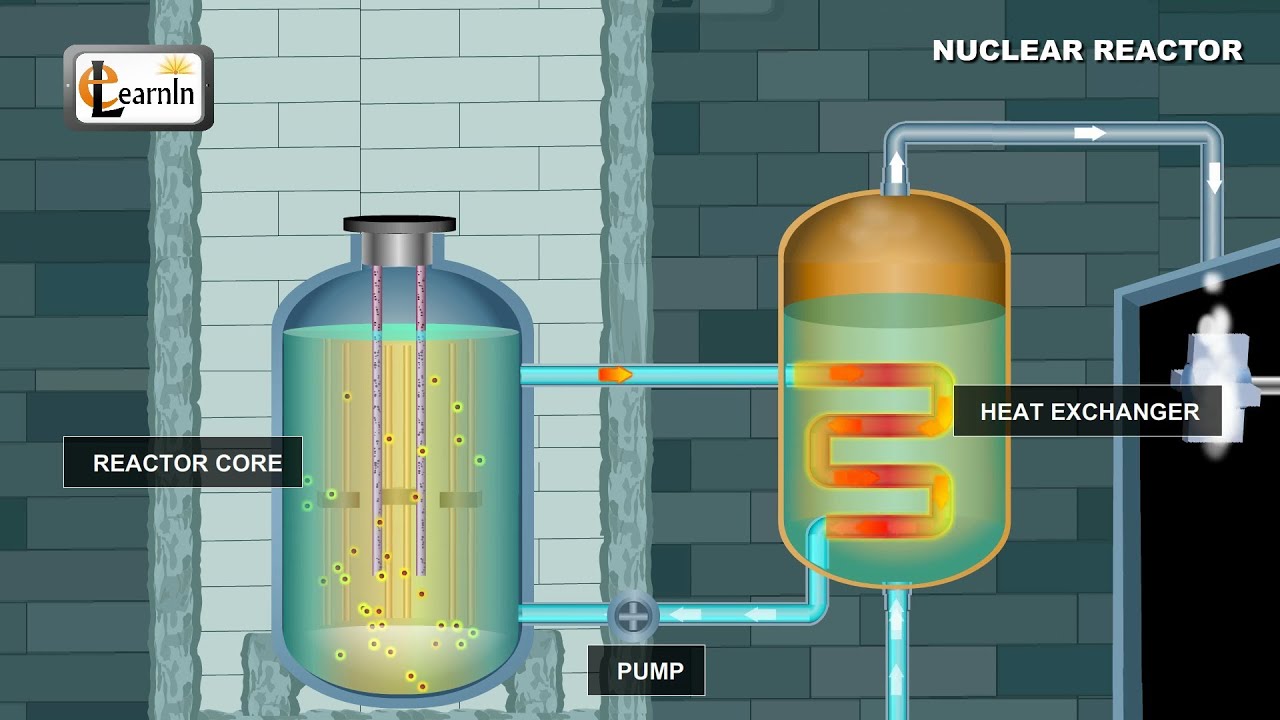
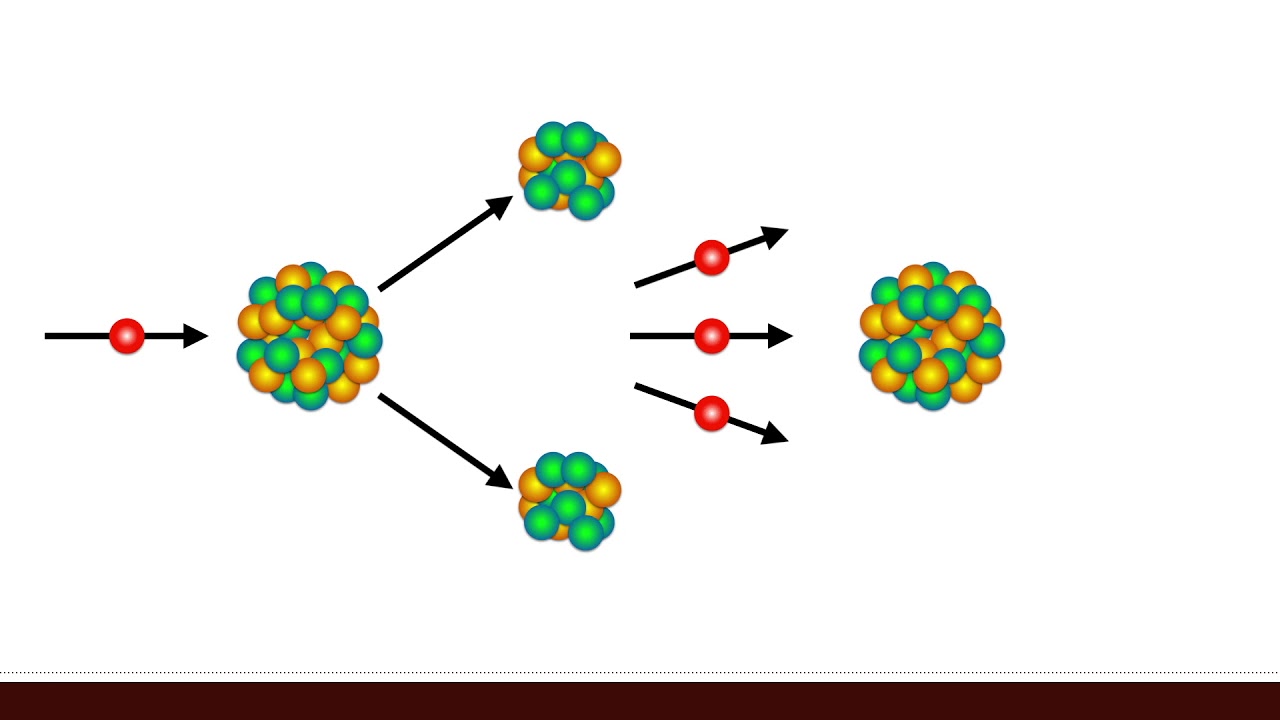
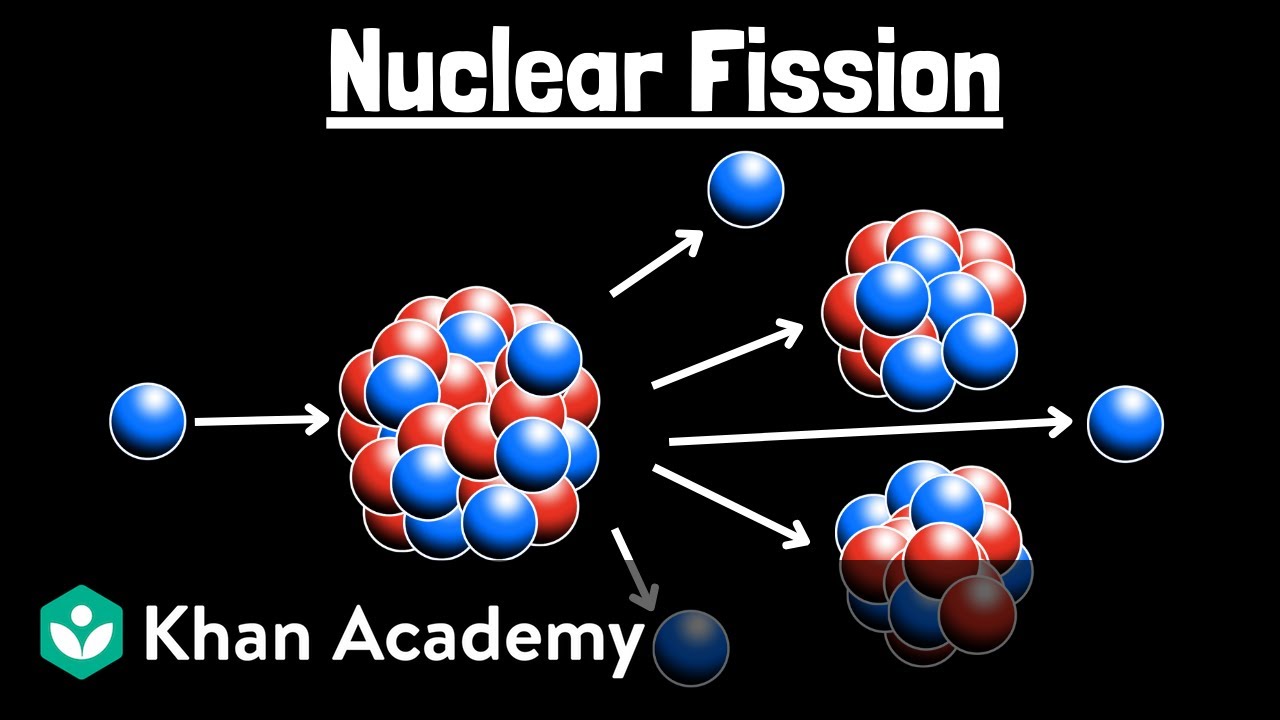
The fission is accompanied by liberation of 2-3 neutrons. These neutrons are used for further fission of U235 and continue the chain reaction.
_{ 92 }^{ 235 }{ U }+_{ 0 }^{ 1 }{ n }\underset { slow }{ \longrightarrow } \quad \left[ _{ 92 }^{ 236 }{ U } \right] \longrightarrow \quad _{ 56 }^{ 144 }{ Ba }+_{ 36 }^{ 89 }{ Kr }+3_{ 0 }^{ 1 }{ n }+Energy
The neutrons produced in the fission can cause fission of more uranium nuclei. And this process continues.
A chain reaction is maintained by the neutrons. A chain reaction in one in which products of the earlier stage acts as the projectile in subsequent stages. Once the chain reaction is started, the process will be self-sustaining and energy can be produced continuously. All the neutrons released in fission are not available to bring further fission unless proper conditions are maintained. For this, the compound nucleus should acquire a minimum value of energy called critical energy. This energy is provided by the projectile.
For self-propagated chain reaction, the rate at which neutrons are lost (consumed) must be less, than the rate at which they are produced. The rate at which neutrons are consumed and produced should be such that from each fission of uranium nucleus at least one neutron is available to bring about the fission in further uranium. This condition of self-propagated chain reaction is expressed in the form of one factor called Multiplication Factor (K) = Reproductivity Factor
\text{ Multiplication Factor } = K = \frac{ \text{ No of neutron in one generation } }{\text{ No of neutron in preceding generation }}
K = \frac{ \text{ No of neutron in } {n}^{th} \text { generation } }{\text{ No of neutron in } {(n-1)}^{th} \text { generation }}
If the multiplication factor is unity or greater than unity, the chain reactions are possible. If the K is even slightly less than unity, the self-propagated chain reaction will not take place. But if K = 1 then the reaction will continue with the same rate. For U235 the K value is 2.5 i.e. in every step neutron generation is 2.5 times larger than the preceding.
Analytical Reasoning
• Solve Problems Related To Ages With These ...
English Grammar
• Making Sense With Tense #1 - English Grammar
Interview Skills
• Questions You May Be Asked During an Inter...
Managerial Economics
• MCQ #1 of Managerial Economics
Royalty Free Stock Footage
• Flowers - Royalty free footage
Chemical Thermodynamics - Physical Chemistry
• State and Explain first law of thermodynam...
Ionic Equilibria - Physical Chemistry
• Derive expression for Ostwald’s Dilution law.
Electrochemistry - Physical Chemistry
• What are different types of Reversible Ele...
Solid State - Physical Chemistry
• Explain the following terms | Solid State ...
Gaseous State - Physical Chemistry
• Postulates of Kinetic Molecular Theory of ...
Colloidal States - Physical Chemistry
• What is Colloidal Solution? | Colloidal St...
Stereochemistry - Organic Chemistry
• Explain Configuration and Conformation | S...
Nanomaterials - Engineering Chemistry
• Compare top down with bottom up Processes ...
Water and Its Treatment - Engineering Chemistry
• Explain why hard water gives out a curd li...
Electrochemistry - Engineering Chemistry
• Distinguish between metallic and electroly...
Environmental Studies
• MCQ on Environmental Studies Part 8
Optics - Applied Physics
• What are cartesian sign conventions for sp...
For Details Visit
http://cepekmedia.co.nf
http://cepek.hol.es/
http://edmerls.66Ghz.com/
http://edmerls.tk/
Повторяем попытку...
Доступные форматы для скачивания:
Скачать видео
-
Информация по загрузке:









![Как измеряют самые слабые силы во Вселенной? [Veritasium]](https://imager.clipsaver.ru/6lK2JVwajTw/max.jpg)