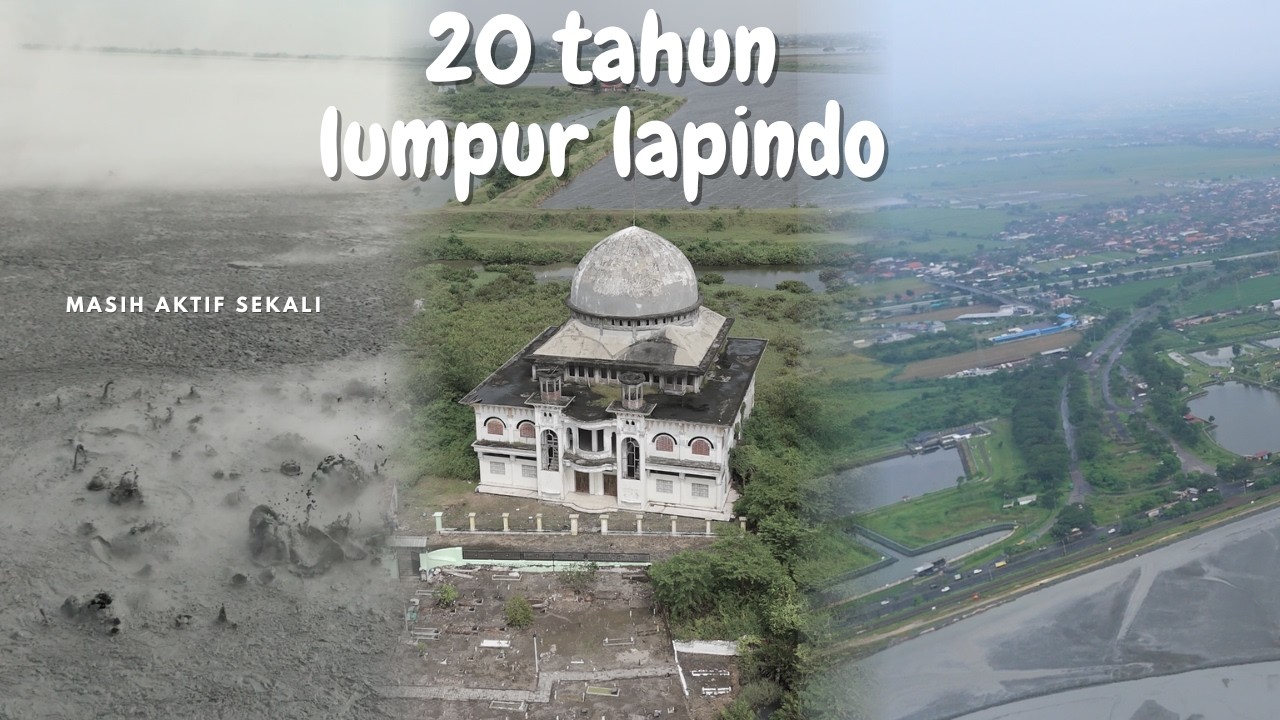
MENGERIKAN!!!! 20 Tahun bencana lumpur lapindo masih aktif sampai sekarang
Автор: Mr beny
Загружено: 2026-03-06
Просмотров: 15534
Описание:
hi guys in this video i will show you a worst human eror disaster
The Sidoarjo mudflow (commonly known as Lumpur Lapindo, wherein lumpur is the Indonesian word for mud; and as Lusi (short for Lumpur Sidoarjo) is the result of an erupting mud volcano in the subdistrict of Porong, Sidoarjo, in East Java, Indonesia, that has been active since May 29 2006. It is the largest mud volcano in the world. Responsibility for the disaster was assigned to the blowout of a natural gas well drilled by Lapindo Brantas, although company officials contend it was caused by a very distant earthquake that occurred in a different province.
At its peak, the blowout spewed up to 180,000 cubic metres (6,400,000 cu ft; 240,000 cu yd) of mud per day. By mid-August 2011, mud was being discharged at a rate of 10,000 cubic meters (13,000 cu yd) per day, with 15 bubbles around its gushing point. This was a significant decline from the previous year, a rate of 100,000 cubic meters (130,000 cu yd) per day, with 320 bubbles.[5] Initial estimates suggested that the flow would continue for 25 to 30 years. Although the Sidoarjo mud flow has been contained by levees since November 2008, resultant floodings regularly disrupt local highways and villages, and further breakouts of mud are still possible.
Chronology
On 28 May 2006, PT Lapindo Brantas targeted gas in the Kujung Formation carbonates in the Brantas PSC area by drilling a borehole named the "Banjar-Panji 1 exploration well". In the first stage of drilling, the drill string first went through a thick clay seam (500–1,300 metres [1,640–4,265 ft] deep), then through sands, shales, volcanic debris, and finally into permeable carbonate rocks.The borehole was cased down to 1,091 m (3,579 ft). At 5:00 a.m. local time (UTC+7) on 29 May 2006, after the well had reached a total depth of 2,834 metres (9,298 ft), this time without a protective casing, water, steam, and a small amount of gas erupted at a location about 200 m southwest of the well.Two further eruptions occurred on the second and the third of June about 800–1,000 m northwest of the well, but these stopped on 5 June 2006.[11] During these eruptions, hydrogen sulfide gas was released, and local villagers observed hot mud, thought to be at a temperature of around 60 °C (140 °F).
source
https://en.wikipedia.org/wiki/Sidoarj...
thankyou for watching and dont forget to subscribe like and comment where do we go next
#dji #djiflip #humaneror #disaster #lapindo #lapindomudflow #lumpurlapindo
Повторяем попытку...
Доступные форматы для скачивания:
Скачать видео
-
Информация по загрузке: