AI powered Legal Case Management System Demo Video
Автор: Hammad Ali Tahir
Загружено: 2025-10-08
Просмотров: 43
Описание:
Pakistan’s courts are overloaded with thousands of pending cases, and the bulk of unstructured court judgments makes it difficult for lawyers, judges, and researchers to quickly
identify the key details. To tackle this, we built an AI-Powered Legal Case Management System during the AI Techathon 2025, aimed at three main tasks: classifying cases, prioritizing them, and retrieving precedents using RAG.
We worked with a dataset of 2,809 Supreme Court judgments spanning 2007–2022. Since the judgments were long, inconsistent, and unstructured, they could not be used directly. To clean and prepare them, we consulted with lawyers and law students who helped us understand the cases and decide on labels. Each judgment was tagged with a case statement (a short summary), a case category (Civil, Criminal, or Constitutional), and a priority level (High, Medium, or Low). This labeling process was tough and time-consuming, but it ensured that the dataset was consistent and legally
accurate.
For case classification, we trained a Support Vector Classifier (SVC), which
reached 91.5% accuracy and precision in separating cases into Civil, Criminal, or
Constitutional. For case prioritization, we used a Stacking Classifier that achieved
95.2% test accuracy. Priority labeling was not straightforward because of imbalanced data: Constitutional cases, which often deal with governance and fundamental rights, and Criminal cases, which involve punishment and justice, tend to be high priority by nature. In fact, criminal cases can never reasonably be marked as low priority, while
Civil cases were more evenly spread across all three levels.
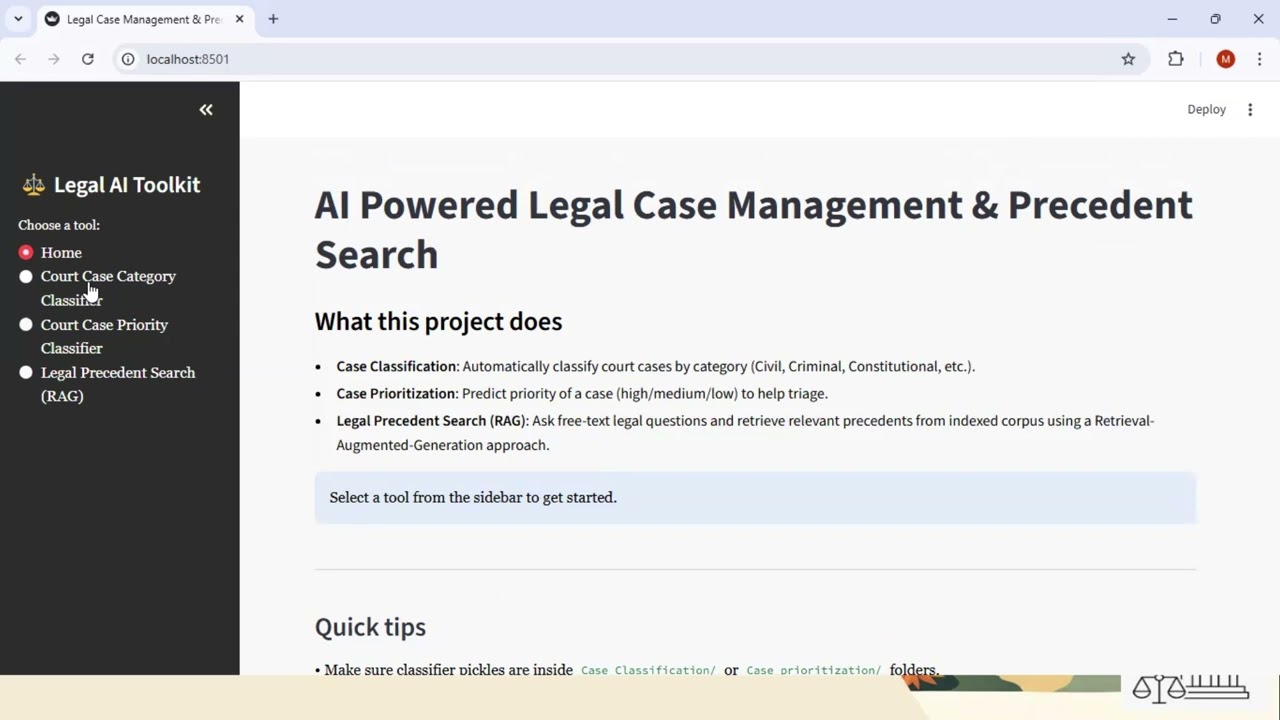
The third component of our system was Legal Precedent Retrieval using a RAG pipeline. We turned legal judgments into embeddings with Hugging Face’s all-MiniLM-L6-v2 model and stored them in ChromaDB. For answering queries, we used GROQ’s Llama-3.1-8B-Instant API, which pulled relevant precedents based on similarity scores.
This setup gave us over 80% accuracy in retrieving relevant matches, making it effective for real legal research.
To make all of this usable, we built a Streamlit-based interface that integrates the three modules. Users can input or upload a case, and the system instantly provides its category, urgency level, and related precedents in one place. Despite dataset imbalance and manual labeling challenges, the system performed strongly. With 91.5 percent classification accuracy, 95.2 percent prioritization accuracy, and robust precedent retrieval, our project shows how NLP can support Pakistan’s legal system. By reducing manual work and improving access to precedent
knowledge, it highlights the potential of AI to make justice more efficient.
Повторяем попытку...
Доступные форматы для скачивания:
Скачать видео
-
Информация по загрузке: