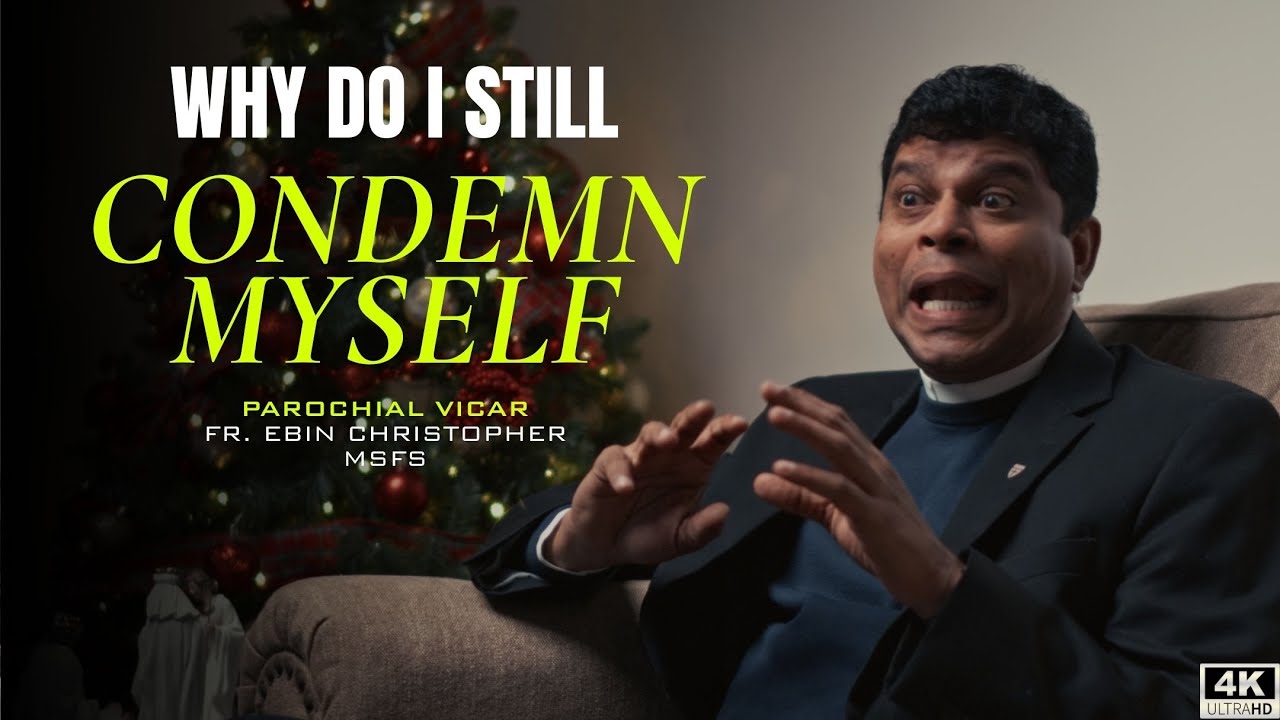
When God Has Forgiven Me, Why Do I Still Condemn Myself? | Fr. Ebin
Автор: Prince of Peace Catholic Community
Загружено: 2026-01-15
Просмотров: 249
Описание:
Many faithful Catholics carry a quiet and painful sorrow, not because they doubt God’s mercy in doctrine, but because they struggle to live as forgiven people in reality.
They confess sincerely.
They hear the words of absolution.
They know, intellectually, that God forgives.
And yet they walk away still bowed, still accused, still inwardly burdened.
This talk addresses that hidden struggle, one that the Church has recognized for centuries, long before modern psychology gave it clinical language. It is not rebellion. It is not lack of faith. It is often confusion, shame, and a wounded conscience that has not yet learned how to rest in mercy.
Fr. Ebin explores why the mind continues to replay forgiven sins, not as moral guidance, but as a psychological mechanism searching for certainty, control, and coherence. Modern psychology calls this rumination. Catholic moral theology calls it a disordered operation of conscience, where responsibility collapses into self-punishment.
St. Thomas Aquinas teaches that conscience is an act of reason ordered toward truth. When reason is clouded by anxiety, shame, or a distorted image of God, conscience stops guiding and begins accusing indiscriminately. This is not the voice of God. Tradition calls it a troubled conscience.
St. Gregory the Great named it plainly: the soul that remembers what God has forgiven.
St. Alphonsus Liguori identified this pattern as scrupulosity, not holiness, but fear masquerading as humility. He warned that the soul clings to fear because fear feels controllable, while mercy requires surrender.
St. Teresa of Ávila goes even deeper. She taught that true humility is not astonishment at one’s weakness, but trust in God’s mercy in the face of it. She refused to dwell on forgiven sins, not because she denied them, but because she believed God more than her emotions.
St. John of the Cross observed that after sincere repentance, the enemy often attacks not through new sin, but through relentless recollection, attempting to erode trust and peace. The temptation is not against chastity or obedience, but against hope.
Psychologically, persistent self-condemnation often arises from shame-based memory, where the brain continues to replay moral failure as if suffering longer might finally earn peace. Spiritually, this becomes dangerous when the person begins to identify more with past sin than with their redeemed identity in Christ.
St. John Paul II explains that guilt accepted in truth leads to conversion, but guilt internalized without mercy fractures the person. The self becomes both judge and accused. Freedom collapses into self-surveillance. Instead of standing before God, the person turns inward endlessly.
Scripture speaks with clarity:
“If our hearts condemn us, God is greater than our hearts.” (1 John 3:20)
This is not poetic comfort. It is theological reality. The heart is not the final judge. God is.
The Sacrament of Reconciliation is not therapy, not symbolism, not emotional reassurance. It is an objective act of divine judgment reversed. When the priest says, “I absolve you,” Christ Himself speaks. To doubt that forgiveness is not humility. It is disbelief.
The Fathers used a powerful image:
St. John Chrysostom described confession as a tribunal where the Judge becomes the Advocate. Once the verdict is given, the case is closed. To reopen it is not justice, but mistrust.
A prisoner released by royal decree who refuses to leave his cell is not virtuous. He is refusing freedom.
This talk also explains why lingering emotional pain, shame, or memory does not mean forgiveness failed. Aquinas clarifies that while guilt and eternal punishment are removed, temporal consequences may remain, not as retribution, but as healing. Just as the body aches after surgery, the soul recovers after mercy.
Fr. Ebin offers concrete pastoral remedies rooted in Catholic tradition:
• Obedience to truth over emotion
• Redirecting rumination toward responsibility
• Renouncing false control disguised as self-punishment
• Re-locating memory into the confessional, not the self
• Eucharistic confirmation of forgiveness
• Naming the inner accuser correctly as a temptation against hope
• Spiritual direction instead of solitary self-analysis
• Moving outward in charity and vocation rather than inward in surveillance
The saints did not grow holy by obsessive introspection. They grew by sustained attachment to Christ.
St. Francis de Sales advised:
“Acknowledge your sin calmly and briefly, then turn immediately toward the mercy of God.”
The cross is complete.
Nothing remains to be paid.
Grace is not earned by suffering longer.
It is received by trust.
God is not asking you to punish yourself more.
He is asking you to trust Him more.
Not as one tolerated.
Not as one defined by sin.
But as one restored, sent, and free.
Visit Us: POPHouston.org
Повторяем попытку...
Доступные форматы для скачивания:
Скачать видео
-
Информация по загрузке: