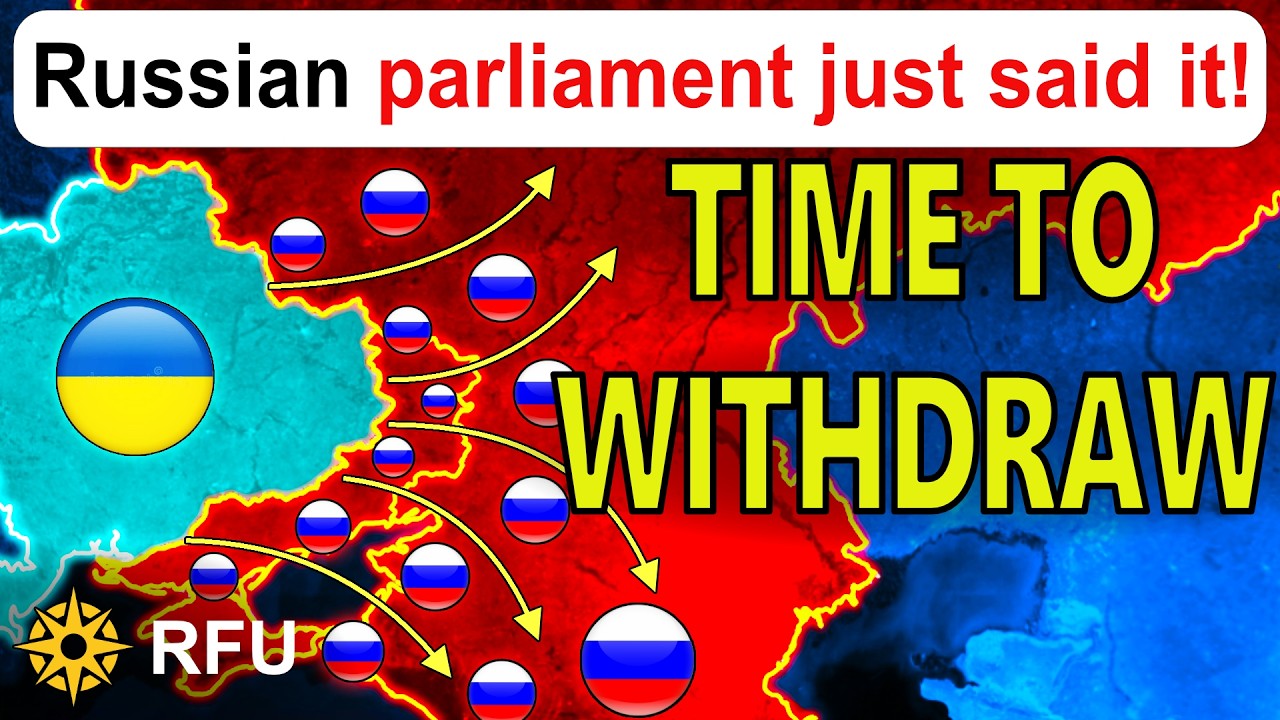
Russian parliament openly calls to end the failed war in Ukraine
Автор: RFU News — Strategic Geopolitics
Загружено: 2026-02-05
Просмотров: 65318
Описание:
🔴 Our interactive news map: https://www.rfunews.com/map
🔴 Subscribe to unlock full access to the map + exclusive strategic insights: https://www.rfunews.com/pricing
Today, there are important updates from the Russian Federation.
Here, what was previously discussed mainly in private by regular citizens or online by analysts is now openly said in the Russian parliament. Even Russian officials cannot pretend anymore, starting to admit that the war is lost and the only way out is for the Russian army to end it now.
For the first time since the invasion of Ukraine, a sitting regional lawmaker has publicly declared that the war is lost and must be ended. At a session of the Samara regional assembly, 69-year-old Grigory Yeremeyev openly urged colleagues to acknowledge what he called the failure of the war and to share responsibility with Vladimir Putin. Yeremeyev stated that the goals of the invasion are fundamentally unattainable and argued that Putin continues the war not for victory, but to avoid entering history as a defeated president. The reaction was immediate and revealing, as other deputies shouted him down, cut his microphone, and unanimously voted to file a complaint against him. Shortly afterward, Yeremeyev was charged with abusing press freedom.
In a political system where even mild doubt about victory has long been treated as treason, the fact that such words were spoken aloud in a regional parliament is significant. It reflects not courage alone, but accumulated frustration that fear can no longer fully suppress. Internal criticism of the war is steadily growing, even as repression remains severe. Dissidents, activists, and ordinary citizens who openly oppose the invasion continue to receive harsh prison sentences, with more than 600 prosecuted within 2025.
At the same time, fractures are appearing inside the pro-war camp itself. Influential military bloggers and commentators who once amplified Kremlin narratives have been labeled foreign agents after criticizing battlefield realities, commanders, and decisions, exposing divisions among those who were supposed to sustain public morale for the war effort. Beneath another layer, economic strain and the visible disconnect between official statements and daily experience are feeding quiet discontent. While most Russians still avoid public protest, the erosion of legitimacy is evident in conversations, commentary, and now even legislative chambers.
Russian analysts increasingly frame this dissatisfaction through uncomfortable comparisons, as they watch foreign intelligence services conduct decisive operations while Russia’s war drags on inconclusively. They continue to refer to how the United States showed how a real special military operation looks like in their precision raid against Venezuela, extracting the sitting president and achieving operational goals in only 3 hours. The very thing the Russian analysts have dreamed of for years for their country to achieve in Ukraine, and now the inevitable question inside Russia has become blunt: what about us?
To cope, many commentators retreat into self-soothing explanations, insisting that Russia could win instantly if there were an order to do so, or that secret backroom deals are singlehandedly causing the failing war effort. However, with Ukrainian drones continuing to fly more than 1,500 kilometers into Russian territory, and battlefield progress is measured in meters per day, even the most pro-war analysts and commentators start to admit these are not anomalies or conspiracies but indicators of systemic failures in planning, command, and adaptation.
The growing anger is magnified by history, as in mid-January, the war in Ukraine surpassed 1,418 days, or the exact length of the Soviet Union’s fight against Germany in what Russians call the Great Patriotic War. Between 1941 and 1945, the Red Army drove enemy forces roughly 1,500 to 1,800 kilometers west, ending in Berlin. For comparison, after four years in Ukraine, Russia’s deepest sustained advances extend maximally at 150 kilometers beyond its own borders, or more than 10 times less, and it still cannot fully seize the Donbas it claims as its own.
These facts are no longer confined, and doubt is spreading upward from the public to analysts, from analysts to politicians. The speech in the local parliament was shut down, but it was also heard. That alone signals a loss of narrative control at the top, and once officials begin openly questioning the war’s purpose and sustainability, even at great personal risk, it indicates that the political system is entering a downward cycle.
Overall, after Russia's war in Ukraine has been going on longer than World War 2 for Russia, the core lesson is clear. The myth of Russia’s invincibility has shattered, as the country couldn't defeat Ukraine outright. This reality is now visible not only to the public but to officials themselves, as more voices conclude that the...
Повторяем попытку...
Доступные форматы для скачивания:
Скачать видео
-
Информация по загрузке: